

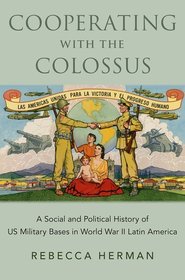
Cooperating with the Colossus
A Social and Political History of US Military Bases in World War II Latin America
-
10% KEDVEZMÉNY?
- A kedvezmény csak az 'Értesítés a kedvenc témákról' hírlevelünk címzettjeinek rendeléseire érvényes.
- Kiadói listaár GBP 102.50
-
46 278 Ft (44 075 Ft + 5% áfa)
Az ár azért becsült, mert a rendelés pillanatában nem lehet pontosan tudni, hogy a beérkezéskor milyen lesz a forint árfolyama az adott termék eredeti devizájához képest. Ha a forint romlana, kissé többet, ha javulna, kissé kevesebbet kell majd fizetnie.
- Kedvezmény(ek) 10% (kb. 4 627 Ft)
- Kedvezményes ár 41 651 Ft (39 668 Ft + 5% áfa)
Iratkozzon fel most és részesüljön kedvezőbb árainkból!
Feliratkozom
46 278 Ft

Beszerezhetőség
Becsült beszerzési idő: A Prosperónál jelenleg nincsen raktáron, de a kiadónál igen. Beszerzés kb. 3-5 hét..
A Prosperónál jelenleg nincsen raktáron.
Why don't you give exact delivery time?
A beszerzés időigényét az eddigi tapasztalatokra alapozva adjuk meg. Azért becsült, mert a terméket külföldről hozzuk be, így a kiadó kiszolgálásának pillanatnyi gyorsaságától is függ. A megadottnál gyorsabb és lassabb szállítás is elképzelhető, de mindent megteszünk, hogy Ön a lehető leghamarabb jusson hozzá a termékhez.
A termék adatai:
- Kiadó OUP USA
- Megjelenés dátuma 2022. november 18.
- ISBN 9780197531860
- Kötéstípus Keménykötés
- Terjedelem308 oldal
- Méret 235x156x15 mm
- Súly 567 g
- Nyelv angol
- Illusztrációk 14 black and white halftones 238
Kategóriák
Rövid leírás:
Cooperating with the Colossus reconstructs the history of US military bases in World War II Latin America, from the perspectives of Latin American leaders and diplomats and the local communities that experienced these installations, as well as of US leadership and military.
TöbbHosszú leírás:
During the Second World War, the United States built over two hundred defense installations on sovereign soil in Latin America in the name of cooperation in hemisphere defense. Predictably, it proved to be a fraught affair. Despite widespread acclaim for Pan-American unity with the Allied cause, defense construction incited local conflicts that belied the wartime rhetoric of fraternity and equality.
Cooperating with the Colossus reconstructs the history of US basing in World War II Latin America, from the elegant chambers of the American foreign ministries to the cantinas, courtrooms, plazas, and brothels surrounding US defense sites. Foregrounding the wartime experiences of Brazil, Cuba, and Panama, the book considers how Latin American leaders and diplomats used basing rights as bargaining chips to advance their nation-building agendas with US resources, while limiting overreach by the "Colossus of the North" as best they could. Yet conflicts on the ground over labor rights, discrimination, sex, and criminal jurisdiction routinely threatened the peace. Steeped in conflict, the story of wartime basing certainly departs from the celebratory triumphalism commonly associated with this period in US-Latin American relations, but this book does not wholly upend the conventional account of wartime cooperation. Rather, the history of basing distills a central tension that has infused regional affairs since a wave of independence movements first transformed the Americas into a society of nations: national sovereignty and international cooperation may seem like harmonious concepts in principle, but they are difficult to reconcile in practice.
Drawing on archival research in five countries, Cooperating with the Colossus is a revealing history told at the local, national, and international levels of how World War II transformed power and politics in the Americas in enduring ways.
Burrowing deep into the national archives in Brazil, Cuba, and Panama, Herman has produced a splendid, well-balanced history of an extraordinary but seldom studied period in inter-American relations. She pushes back against the still prevalent academic caricature of the United States as an all-powerful imperial actor, aligning herself instead with a younger generation of scholars that has emphasized Latin American agency and the ability of Latin Americans to astutely bargain with Washington....Herman deftly demonstrates how onsite U.S. commanders and diplomats cooperated with local authorities to find informal, flexible solutions to potentially tricky issues....Such pragmatic accords successfully managed the inherent tensions between international security cooperation and national sovereignty, enabling a brilliant if brief chapter of solidarity in the Western Hemisphere.
Tartalomjegyzék:
Acknowledgments
Introduction
Chapter One: The Specter of Guantanamo
Chapter Two: High Politics and Horse-Trading
Chapter Three: Base Labor
Chapter Four: Discrimination in the Canal Zone
Chapter Five: Sex, Honor, and Moral Hygiene
Chapter Six: Criminal Jurisdiction
Chapter Seven: Cooperation at the War's End
Conclusion
Notes
Bibliography
Index

