

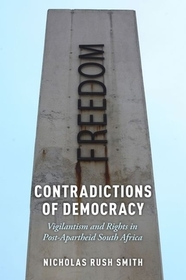
Contradictions of Democracy
Vigilantism and Rights in Post-Apartheid South Africa
Sorozatcím: Oxford Studies in Culture and Politics;
-
10% KEDVEZMÉNY?
- A kedvezmény csak az 'Értesítés a kedvenc témákról' hírlevelünk címzettjeinek rendeléseire érvényes.
- Kiadói listaár GBP 31.49
-
14 217 Ft (13 540 Ft + 5% áfa)
Az ár azért becsült, mert a rendelés pillanatában nem lehet pontosan tudni, hogy a beérkezéskor milyen lesz a forint árfolyama az adott termék eredeti devizájához képest. Ha a forint romlana, kissé többet, ha javulna, kissé kevesebbet kell majd fizetnie.
- Kedvezmény(ek) 10% (cc. 1 422 Ft off)
- Kedvezményes ár 12 795 Ft (12 186 Ft + 5% áfa)
Iratkozzon fel most és részesüljön kedvezőbb árainkból!
Feliratkozom
14 217 Ft

Beszerezhetőség
Becsült beszerzési idő: A Prosperónál jelenleg nincsen raktáron, de a kiadónál igen. Beszerzés kb. 3-5 hét..
A Prosperónál jelenleg nincsen raktáron.
Why don't you give exact delivery time?
A beszerzés időigényét az eddigi tapasztalatokra alapozva adjuk meg. Azért becsült, mert a terméket külföldről hozzuk be, így a kiadó kiszolgálásának pillanatnyi gyorsaságától is függ. A megadottnál gyorsabb és lassabb szállítás is elképzelhető, de mindent megteszünk, hogy Ön a lehető leghamarabb jusson hozzá a termékhez.
A termék adatai:
- Kiadó OUP USA
- Megjelenés dátuma 2019. március 7.
- ISBN 9780190847197
- Kötéstípus Puhakötés
- Terjedelem264 oldal
- Méret 155x231x17 mm
- Súly 408 g
- Nyelv angol 0
Kategóriák
Rövid leírás:
Despite being one of the world's most vibrant democracies, vigilantism is regularly practiced in South Africa. Based on twenty months of field work, Contradictions of Democracy shows why, explores what South Africa reveals about vigilantism in other democracies, and uses vigilantism to explore the contradictions of democracy more generally.
TöbbHosszú leírás:
Despite being one of the world's most vibrant democracies, police estimate between five and ten percent of the murders in South Africa result from vigilante violence. This is puzzling given the country's celebrated transition to democracy and massive reform of the state's legal institutions. Where most studies explain vigilantism as a response to state or civic failure, in Contradictions of Democracy, Nicholas Rush Smith illustrates that vigilantism is actually a response to the processes of democratic state formation. In the context of densely networked neighborhoods, vigilante citizens often interpret the technical success of legal institutions-for instance, the arrest and subsequent release of suspects on bail-as failure and work to correct such perceived failures on their own. Smith also shows that vigilantism provides a new lens through which to understand democratic state formation. Among young men of color in some parts of South Africa, fear of extra-judicial police violence is common. Amid such fear, instead of the state seeming protective, it can appear as something akin to a massive vigilante organization. An insightful look into the high rates of vigilantism in South Africa and the general challenges of democratic state building, Contradictions of Democracy explores fundamental questions about political order, the rule of law, and democratic citizenship.
The book provides a striking example of how anthropological approaches are making inroads into the field of urban studies.
Tartalomjegyzék:
Preface
Introduction
Chapter 1 - Vigilantism and the Contradictions of Democratic State Formation
Chapter 2 - The People's Justice: Historical Antecedents of Contemporary Vigilantism
Chapter 3 - Spectacles of State Craft: The Truth and Reconciliation Commission and Post-Apartheid Law Making
Chapter 4 - Rights in Translation: Vigilantism and the Meanings of Institutional Effectiveness and Failure
Chapter 5 - Taking Charge: The Contradictory Pleasures of Citizen Crime Fighting
Chapter 6 - The Risks and Rewards of Vigilantism
Chapter 7 - The Racial Geographies of Criminal Panic: Protesting Crime in the Suburbs
Chapter 8 - Against Vigilantism: Citizen and State Action to Combat Vigilantism
Chapter 9 - Law-Making and State-Making as Vigilantism
Epilogue
Bibliography

