

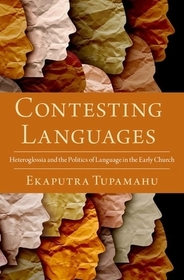
Contesting Languages
Heteroglossia and the Politics of Language in the Early Church
-
10% KEDVEZMÉNY?
- A kedvezmény csak az 'Értesítés a kedvenc témákról' hírlevelünk címzettjeinek rendeléseire érvényes.
- Kiadói listaár GBP 83.00
-
39 653 Ft (37 765 Ft + 5% áfa)
Az ár azért becsült, mert a rendelés pillanatában nem lehet pontosan tudni, hogy a beérkezéskor milyen lesz a forint árfolyama az adott termék eredeti devizájához képest. Ha a forint romlana, kissé többet, ha javulna, kissé kevesebbet kell majd fizetnie.
- Kedvezmény(ek) 10% (cc. 3 965 Ft off)
- Kedvezményes ár 35 688 Ft (33 989 Ft + 5% áfa)
Iratkozzon fel most és részesüljön kedvezőbb árainkból!
Feliratkozom
39 653 Ft

Beszerezhetőség
Megrendelésre a kiadó utánnyomja a könyvet. Rendelhető, de a szokásosnál kicsit lassabban érkezik meg.
Why don't you give exact delivery time?
A beszerzés időigényét az eddigi tapasztalatokra alapozva adjuk meg. Azért becsült, mert a terméket külföldről hozzuk be, így a kiadó kiszolgálásának pillanatnyi gyorsaságától is függ. A megadottnál gyorsabb és lassabb szállítás is elképzelhető, de mindent megteszünk, hogy Ön a lehető leghamarabb jusson hozzá a termékhez.
A termék adatai:
- Kiadó OUP USA
- Megjelenés dátuma 2022. december 21.
- ISBN 9780197581124
- Kötéstípus Keménykötés
- Terjedelem266 oldal
- Méret 159x243x22 mm
- Súly 535 g
- Nyelv angol 272
Kategóriák
Rövid leírás:
How did the Apostle Paul navigate the language differences in Corinth? In this book, Ekaputra Tupamahu investigates Corinthian tongue-speech as a site of political struggle. Tupamahu demonstrates that conceptualizing speaking in tongues as ecstatic, unintelligible expressions is an interpretive invention of German romantic-nationalist scholarship. Instead, drawing on Mikhail Bakhtin's theories of language, Tupamahu finds two forces of language at work in the New Testament: a centripetalizing force of monolingualism, which attempts to force heterogeneous languages into a singular linguistic form, and a countervailing centrifugal force that diverse languages unleash.
TöbbHosszú leírás:
How did the Apostle Paul navigate the language differences in Corinth? In Contesting Languages: Heteroglossia and the Politics of Language in the Early Church, Ekaputra Tupamahu investigates Corinthian tongue-speech as a site of political struggle. Tupamahu demonstrates that conceptualizing speaking in tongues as ecstatic, unintelligible expressions is an interpretive invention of German romantic-nationalist scholarship. Instead, drawing on Mikhail Bakhtin's theories of language, Tupamahu finds two forces of language at work in the New Testament: a centripetalizing force of monolingualism, which attempts to force heterogeneous languages into a singular linguistic form, and a countervailing centrifugal force that diverse languages unleash.
The city of Corinth in the Roman period was a multilingual city-a sociolinguistic context that Tupamahu argues should be taken seriously when reading Paul's directives concerning Corinthians "speaking in tongues". Grounding his reading of the texts in the experiences of immigrants who speak minority languages, Tupamahu reads Paul's prohibition against the use of tongues in public gathering as a form of cultural domination. This book offers a competing social imagination, in which tongues as a heteroglossic phenomenon promises a radically hospitable space and a new socio-linguistic vision marked by unending difference.
Deftly combining contemporary theory with Greco-Roman sources, Tupamahu gives us a compelling reading of 1 Corinthians. For Tupamahu, a language—then and now—can gain legitimacy not only by its power to persuade, but even more so through its position of priority over and above other languages. Demonstrating both the language of power and the power of language, Tupamahu's book points out the problem of monolingualism for a truly pluralistic practice.
Tartalomjegyzék:
Acknowledgements
Introduction
Chapter 1: Why on Earth Does Tongue(s) Become Ecstatic Speech?
Chapter 2: Heteroglossia of Corinth in the Roman Period
Chapter 3: Tongue(s) as a Heteroglossic Phenomenon
Chapter 4: The Constructed Linguistic Stratification: Prophecy vs. Tongue(s)
Chapter 5: The Politicization of Language
Chapter 6: Early Responses to Paul
Conclusion
Bibliography

