

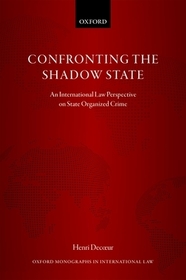
Confronting the Shadow State
An International Law Perspective on State Organized Crime
Sorozatcím: Oxford Monographs in International Law;
-
10% KEDVEZMÉNY?
- A kedvezmény csak az 'Értesítés a kedvenc témákról' hírlevelünk címzettjeinek rendeléseire érvényes.
- Kiadói listaár GBP 122.50
-
55 308 Ft (52 675 Ft + 5% áfa)
Az ár azért becsült, mert a rendelés pillanatában nem lehet pontosan tudni, hogy a beérkezéskor milyen lesz a forint árfolyama az adott termék eredeti devizájához képest. Ha a forint romlana, kissé többet, ha javulna, kissé kevesebbet kell majd fizetnie.
- Kedvezmény(ek) 10% (cc. 5 531 Ft off)
- Kedvezményes ár 49 778 Ft (47 408 Ft + 5% áfa)
Iratkozzon fel most és részesüljön kedvezőbb árainkból!
Feliratkozom
55 308 Ft

Beszerezhetőség
Megrendelésre a kiadó utánnyomja a könyvet. Rendelhető, de a szokásosnál kicsit lassabban érkezik meg.
Why don't you give exact delivery time?
A beszerzés időigényét az eddigi tapasztalatokra alapozva adjuk meg. Azért becsült, mert a terméket külföldről hozzuk be, így a kiadó kiszolgálásának pillanatnyi gyorsaságától is függ. A megadottnál gyorsabb és lassabb szállítás is elképzelhető, de mindent megteszünk, hogy Ön a lehető leghamarabb jusson hozzá a termékhez.
A termék adatai:
- Kiadó OUP Oxford
- Megjelenés dátuma 2018. június 8.
- ISBN 9780198823933
- Kötéstípus Keménykötés
- Terjedelem302 oldal
- Méret 241x164x23 mm
- Súly 612 g
- Nyelv angol 0
Kategóriák
Rövid leírás:
In this first comprehensive analysis of state organized crime from the perspective of international law, Decoeur discusses how international law can and should be used to tackle state organized crime and argues for the development of international legal mechanisms specifically designed to address this issue.
TöbbHosszú leírás:
This book examines the rules and mechanisms of international law relevant to the suppression of state organized crime, and provides a normative justification for developing international legal mechanisms specifically designed to address this phenomenon.
State organized crime refers to the use by senior state officials of the resources of the state to facilitate or participate in organized crime, in pursuit of policy objectives or personal profit. This concept covers diverse forms of government misconduct, including strategic partnerships with drug traffickers, the plundering of a country's resources by kleptocrats, and high-level corruption schemes.
The book identifies the distinctive criminological characteristics of state organized crime, and analyses the applicability, potential, and limits of the norms and mechanisms of international law relevant to the suppression of state organized crime. In particular, it discusses whether the involvement of state organs or agents in organized crime may amount to an internationally wrongful act giving rise to the international responsibility of the state, and highlights a number of practical and normative shortcomings of the legal framework established by relevant crime-suppression conventions.
The book also sketches proposals to develop an international legal framework designed to hold perpetrators of state organized crime accountable. It presents a normative justification for criminalizing and suppressing state organized crime at the international level, proposes draft provisions for an international convention for the suppression of state organized crime, and discusses the potential role of the UN Security Council and of international criminal courts and tribunals, respectively, in holding perpetrators accountable.
Providing the first comprehensive analysis, from the perspective of international law, of a phenomenon so far mainly studied by criminologists, this study would appeal to researchers, social activists, and policy makers alike.
Decoeur's approach is methodical, thorough, and sufficiently cautious. His arguments are carefully developed and his conclusions, referred to as 'utopian' in the book's preface, are, in fact, compelling.
Tartalomjegyzék:
Introduction
State organized crime
The phenomenon of state organized crime
The limits of applicable international law
State responsibility for state organized crime
International criminal law instruments for the suppression of organized crime and corruption
The limits of applicable crime-suppression conventions
International legal mechanisms for the suppression of state organized crime
A normative justification for establishing state organized crime as an international crime
A convention for the suppression of state organized crime
The potential role of the UN Security Council in the suppression of state organized crime
The potential role of international criminal tribunals in the suppression of state organized crime
Concluding remarks

