

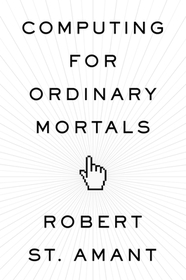
Computing for Ordinary Mortals
-
10% KEDVEZMÉNY?
- A kedvezmény csak az 'Értesítés a kedvenc témákról' hírlevelünk címzettjeinek rendeléseire érvényes.
- Kiadói listaár GBP 39.99
-
19 105 Ft (18 195 Ft + 5% áfa)
Az ár azért becsült, mert a rendelés pillanatában nem lehet pontosan tudni, hogy a beérkezéskor milyen lesz a forint árfolyama az adott termék eredeti devizájához képest. Ha a forint romlana, kissé többet, ha javulna, kissé kevesebbet kell majd fizetnie.
- Kedvezmény(ek) 10% (cc. 1 911 Ft off)
- Kedvezményes ár 17 194 Ft (16 376 Ft + 5% áfa)
Iratkozzon fel most és részesüljön kedvezőbb árainkból!
Feliratkozom
19 105 Ft

Beszerezhetőség
Megrendelésre a kiadó utánnyomja a könyvet. Rendelhető, de a szokásosnál kicsit lassabban érkezik meg.
Why don't you give exact delivery time?
A beszerzés időigényét az eddigi tapasztalatokra alapozva adjuk meg. Azért becsült, mert a terméket külföldről hozzuk be, így a kiadó kiszolgálásának pillanatnyi gyorsaságától is függ. A megadottnál gyorsabb és lassabb szállítás is elképzelhető, de mindent megteszünk, hogy Ön a lehető leghamarabb jusson hozzá a termékhez.
A termék adatai:
- Kiadó OUP USA
- Megjelenés dátuma 2012. november 15.
- ISBN 9780199775309
- Kötéstípus Keménykötés
- Terjedelem256 oldal
- Méret 216x140x22 mm
- Súly 363 g
- Nyelv angol 0
Kategóriák
Rövid leírás:
In Computing for Ordinary Mortals, cognitive scientist and AI expert Robert St. Amant explains what he calls, "the really interesting part" of computing, which are the ideas behind the technology. They're powerful ideas, and the foundations for everything that computers do, but they are little discussed. This book will not tell you how to use your computer, but it will give you a conceptual tour of how it works. Some of the ideas, like modularity which are so embedded in what we do as humans, can also give us insight into our own daily activities, how we interact with other people, and in some cases even what's going on in our heads. Computing is all around us, and, to quote Richard Hamming, the influential mathematician and computer scientist, "The purpose of computing is insight, not numbers," and it is this insight that informs the entire book.
TöbbHosszú leírás:
Computing isn't only (or even mostly) about hardware and software; it's also about the ideas behind the technology. In Computing for Ordinary Mortals, computer scientist Robert St. Amant explains this "really interesting part" of computing, introducing basic computing concepts and strategies in a way that readers without a technical background can understand and appreciate.
Each of the chapters illustrates ideas from a different area of computing, and together they provide important insights into what drives the field as a whole. St. Amant starts off with an overview of basic concepts as well as a brief history of the earliest computers, and then he traces two different threads through the fabric of computing. One thread is practical, illuminating the architecture of a computer and showing how this architecture makes computation efficient. St. Amant shows us how to write down instructions so that a computer can accomplish specific tasks (programming), how the computer manages those tasks as it runs (in its operating system), and how computers can communicate with each other (over a network). The other thread is theoretical, describing how computers are, in the abstract, machines for solving problems. Some of these ideas are embedded in much of what we do as humans, and thus this discussion can also give us insight into our own daily activities, how we interact with other people, and in some cases even what's going on in our heads.
St. Amant concludes with artificial intelligence, exploring the possibility that computers might eventually be capable of human-level intelligence, and human-computer interaction, showing how computers can enrich our lives--and how they fall short.
Tartalomjegyzék:
Introduction
Chapter 1. Getting Started
Chapter 2. From Mechanical to Electronic Computers
Chapter 3. Computer Architecture: The Nuts and Bolts
Chapter 4. Data Structures and Algorithms: Solving Problems
Chapter 5. Programming: Putting Plans into Action
Chapter 6. Operating Systems: Working Together
Chapter 7. Computer Networks: Making Connections
Chapter 8. Theoretical Computer Science: Pushing Boundaries
Chapter 9. Artificial Intelligence: Being Smart Chapter 10. Human-Computer
Interaction: Thinking About People
Appendix
Information management: The file system
Information management: Databases
Computational Science
Graphics
Security

