

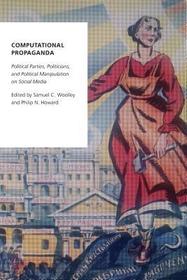
Computational Propaganda
Political Parties, Politicians, and Political Manipulation on Social Media
Sorozatcím: Oxford Studies in Digital Politics;
-
10% KEDVEZMÉNY?
- A kedvezmény csak az 'Értesítés a kedvenc témákról' hírlevelünk címzettjeinek rendeléseire érvényes.
- Kiadói listaár GBP 27.49
-
12 411 Ft (11 820 Ft + 5% áfa)
Az ár azért becsült, mert a rendelés pillanatában nem lehet pontosan tudni, hogy a beérkezéskor milyen lesz a forint árfolyama az adott termék eredeti devizájához képest. Ha a forint romlana, kissé többet, ha javulna, kissé kevesebbet kell majd fizetnie.
- Kedvezmény(ek) 10% (cc. 1 241 Ft off)
- Kedvezményes ár 11 170 Ft (10 638 Ft + 5% áfa)
Iratkozzon fel most és részesüljön kedvezőbb árainkból!
Feliratkozom
12 411 Ft

Beszerezhetőség
Becsült beszerzési idő: A Prosperónál jelenleg nincsen raktáron, de a kiadónál igen. Beszerzés kb. 3-5 hét..
A Prosperónál jelenleg nincsen raktáron.
Why don't you give exact delivery time?
A beszerzés időigényét az eddigi tapasztalatokra alapozva adjuk meg. Azért becsült, mert a terméket külföldről hozzuk be, így a kiadó kiszolgálásának pillanatnyi gyorsaságától is függ. A megadottnál gyorsabb és lassabb szállítás is elképzelhető, de mindent megteszünk, hogy Ön a lehető leghamarabb jusson hozzá a termékhez.
A termék adatai:
- Kiadó OUP USA
- Megjelenés dátuma 2018. november 22.
- ISBN 9780190931414
- Kötéstípus Puhakötés
- Terjedelem272 oldal
- Méret 155x234x12 mm
- Súly 363 g
- Nyelv angol 0
Kategóriák
Rövid leírás:
Social media platforms do not just circulate political ideas, but support computational propaganda and manipulative disinformation campaigns. Although some of these disinformation campaigns are carried out directly by individuals, most are waged by software, commonly known as bots, programmed to perform simple, repetitive, robotic tasks. Including case studies from nine countries and covering propaganda efforts over a wide array of social media platforms, this book argues that bots, fake accounts, and social media algorithms amount to a new political communications mechanism that it terms "computational propaganda."
TöbbHosszú leírás:
Social media platforms do not just circulate political ideas, they support manipulative disinformation campaigns. While some of these disinformation campaigns are carried out directly by individuals, most are waged by software, commonly known as bots, programmed to perform simple, repetitive, robotic tasks. Some social media bots collect and distribute legitimate information, while others communicate with and harass people, manipulate trending algorithms, and inundate systems with spam. Campaigns made up of bots, fake accounts, and trolls can be coordinated by one person, or a small group of people, to give the illusion of large-scale consensus. Some political regimes use political bots to silence opponents and to push official state messaging, to sway the vote during elections, and to defame critics, human rights defenders, civil society groups, and journalists. This book argues that such automation and platform manipulation, amounts to a new political communications mechanism that Samuel Woolley and Philip N. Noward call "computational propaganda." This differs from older styles of propaganda in that it uses algorithms, automation, and human curation to purposefully distribute misleading information over social media networks while it actively learns from and mimicks real people so as to manipulate public opinion across a diverse range of platforms and device networks. This book includes cases of computational propaganda from nine countries (both democratic and authoritarian) and four continents (North and South America, Europe, and Asia), covering propaganda efforts over a wide array of social media platforms and usage in different types of political processes (elections, referenda, and during political crises).
[Computational Propaganda] offers robust data-driven evidence around the degree to which social and political manipulation occurs over social media, in countries and contexts, as well as within communities in more mature liberal democracies.
Tartalomjegyzék:
Part I: Theoretical Introduction and Analytical Frame
Introduction: Computational Propaganda Worldwide
Chapter 1 - Russia: The Origins of Digital Misinformation
Chapter 2 - Ukraine: External Threats and Internal Challenges
Chapter 3 - Canada: Building Bot Typologies
Chapter 4 - Poland: Unpacking the Ecosystem of Social Media Manipulation
Chapter 5 - Taiwan: Digital Democracy Meets Automated Autocracy
Chapter 6 - Brazil: Political Bot Intervention During Pivotal Events
Chapter 7 - Germany: A Cautionary Tale
Chapter 8 - United States: Manufacturing Consensus Online
Chapter 9 - China: An Alternative Model of a Widespread Practice
Conclusion: Political Parties, Politicians, and Computational Propaganda
Index

