

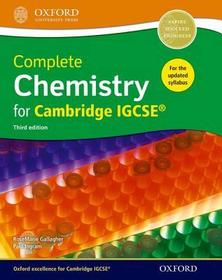
Complete Chemistry for Cambridge IGCSE ? Student book (Third edition)
-
10% KEDVEZMÉNY?
- A kedvezmény csak az 'Értesítés a kedvenc témákról' hírlevelünk címzettjeinek rendeléseire érvényes.
- Kiadói listaár GBP 25.99
-
11 734 Ft (11 175 Ft + 5% áfa)
Az ár azért becsült, mert a rendelés pillanatában nem lehet pontosan tudni, hogy a beérkezéskor milyen lesz a forint árfolyama az adott termék eredeti devizájához képest. Ha a forint romlana, kissé többet, ha javulna, kissé kevesebbet kell majd fizetnie.
- Kedvezmény(ek) 10% (cc. 1 173 Ft off)
- Kedvezményes ár 10 560 Ft (10 058 Ft + 5% áfa)
Iratkozzon fel most és részesüljön kedvezőbb árainkból!
Feliratkozom
11 734 Ft

Beszerezhetőség
A kiadónál véglegesen elfogyott, nem rendelhető. Érdemes újra keresni a címmel, hátha van újabb kiadás.
Why don't you give exact delivery time?
A beszerzés időigényét az eddigi tapasztalatokra alapozva adjuk meg. Azért becsült, mert a terméket külföldről hozzuk be, így a kiadó kiszolgálásának pillanatnyi gyorsaságától is függ. A megadottnál gyorsabb és lassabb szállítás is elképzelhető, de mindent megteszünk, hogy Ön a lehető leghamarabb jusson hozzá a termékhez.
A termék adatai:
- Kiadás sorszáma és címe :Complete Chemistry for Cambridge IGCSE ? Student book (Third edition)
- Kiadó OUP Oxford
- Megjelenés dátuma 2014. szeptember 25.
- ISBN 9780198308706
- Kötéstípus Kötés ismeretlen
- Terjedelem336 oldal
- Méret 275x221x14 mm
- Súly 983 g
- Nyelv angol
- Illusztrációk Colour 0
Kategóriák
Rövid leírás:
The Complete Chemistry for Cambridge IGCSE Student Book's stretching approach is trusted by teachers around the world to support advanced understanding and achievement. With plenty of engaging material, practice questions and practical ideas, this updated edition contains everything your students need to succeed in Cambridge IGCSE Chemistry.
TöbbHosszú leírás:
The best-selling Complete Chemistry for Cambridge IGCSE Student Book is trusted by teachers around the world to support understanding and achievement. The popular, stretching approach will help students to reach their full potential. Written by an experienced author, this updated edition is full of engaging content with up-to-date examples to cover all aspects of the Cambridge syllabus. We are working with Cambridge towards endorsement, so you know it will
be comprehensive.
The step-by-step approach will lead students through the course in a logical learning order building knowledge and practical skills with regular questions and practical activities. Extension material will stretch the highest ability students and prepare them to take the next step in their learning. Practice exam questions will consolidate student understanding and prepare them for exam success.
Each book is accompanied by a free CD with a wealth of extra support for students including practice exam questions, revision checklists and advice on how to prepare for an examination.
Complete Chemistry, Biology and Physics are for students following the Cambridge International Examinations updated syllabuses for Cambridge IGCSE. These three books provide clear, well-written course material and a wealth of questions and exercises, including exam-level revision. In addition to this, an accompanying CD-ROM provides interactive questions, mock exam papers with questions from real past papers, and revision checklists to aid learning. With a highly
illustrative and colourful design, this engaging recourse is deal for the international student.
Tartalomjegyzék:
1 States of matter
Everything is made of particles
Solids, liquids, and gases
The particles in solids, liquids, and gases
A closer Look at gases
Checkup on Chapter 1
2 Separating substances
Mixtures, solutions, and solvents
Pure substances and impurities
Separation methods (part I)
Separation methods (part II)
More about paper chromatography
The chromatography detectives
Checkup on Chapter 2
3 Atoms and elements
Atoms and elements
More about atoms
Isotopes and radioactivity
How electrons are arranged
How our model of the atom developed
The atom: the inside story
The metals and non-metals
Checkup on Chapter 3
4 Atoms combining
Compounds, mixtures, and chemical change
Why do atoms form bonds?
The ionic bond
More about ions
The covalent bond
Covalent compounds
Comparing ionic and covalent compounds
Giant covalent structures
The bonding in metals
Checkup on Chapter 4
5 Reacting masses, and chemical equations
The names and formulae of compounds
Equations for chemical reactions
The masses of atoms, molecules, and tons
Some calculations about masses and %
Checkup on Chapter 5
6 Using moles
The mole
Calculations from equations, using the mole
Reactions involving gases
The concentration of a solution
Finding the empirical formula
From empirical to final formula
Finding % yield and % purity
Checkup on Chapter 6
7 Redox reactions
Oxidation and reduction
Redox and electron transfer
Redox and changes in oxidation state
Oxidising and reducing agents
Checkup on Chapter 7
8 Electricity and chemical change
Conductors and insulators
The principles of electrolysis
The reactions at the electrodes
The electrolysis of brine
Two more uses of electrolysis
Checkup on Chapter 8
9 Energy changes, and reversible reactions
Energy changes in reactions
Explaining energy changes
Energy from fuels
Giving out energy as electricity
The batteries in your life
Reversible reactions
Shifting the equilibrium
Checkup on Chapter 9
10 The speed of a reaction
Rates of reaction
Measuring the rate of a reaction
Changing the rate of a reaction (part I)
Changing the rate of a reaction (part II)
Explaining rates
Catalysts
More about enzymes
Photochemical reactions
Checkup on Chapter 10
11 Adds, bases, and salts
Acids and alkalis
A closer look at acids and alkalis
The reactions of acids and bases
A closer look at neutralisation
Oxides
Making salts
Making insoluble salts by precipitation
Finding concentrations by titration
Checkup on Chapter 11
12 The Periodic Table
An overview of the Periodic Table
Group I: the alkali metals
Group VII: the halogens
Group VIII: the noble gases
The transition elements
Across the Periodic Table
How the Periodic Table developed
Checkup on Chapter 12
13 The behaviour of metals
Metals: a review
Comparing metals for reactivity
Metals in competition
The reactivity series
Making use of the reactivity series
Checkup on Chapter 13
14 Making use of metals
Metals in the Earth's crust
Extracting metals from their ores
Extracting iron
Extracting aluminium
Making use of metals and alloys
Steels and steel-making
Metals, civilisation, and you
Checkup on Chapter 14
15 Air and water
What is air?
Making use of air
Pollution alert!
The rusting problem
Water supply
Living in space
Checkup on Chapter 15
16 Some non-metals and their compounds
Hydrogen, nitrogen, and ammonia
Making ammonia in industry
Fertilisers
Sulfur and sulfur dioxide
Sulfuric acid
Carbon and the carbon cycle
Some carbon compounds
Greenhouse gases, and global warming
Limestone
Checkup on Chapter 16
17 Organic chemistry
Petroleum: a fossil fuel
Refining petroleum
Cracking hydrocarbons
Families of organic compounds
The alkanes
The alkenes
The alcohols
The carboxylic acids
Checkup on Chapter 17
18 Polymers
Introducing polymers
Addition polymerisation
Condensation polymerisation
Making use of synthetic polymers
Plastics: here to stay?
Natural polymers in food (part I)
Natural polymers in food (part II)
Checkup on Chapter 18
19 In the lab
Chemistry: a practical subject
Example of an experiment
Working with gases in the lab
Testing for ions in the Lab: cations
Testing for ions in the lab: anions
Checkup on Chapter 19
Answers for Chapters 1-19
Cambridge IGCSE Chemistry past exam questions
Exam questions for Paper 3
Exam questions for Paper 4
Exam questions from Paper 6
Reference
Glossary
The Periodic Table and atomic masses
Index

