

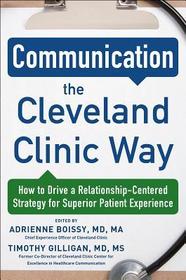
Communication the Cleveland Clinic Way: How to Drive a Relationship-Centered Strategy for Exceptional Patient Experience
Sorozatcím: BUSINESS BOOKS;
-
10% KEDVEZMÉNY?
- A kedvezmény csak az 'Értesítés a kedvenc témákról' hírlevelünk címzettjeinek rendeléseire érvényes.
- Kiadói listaár GBP 35.99
-
16 249 Ft (15 475 Ft + 5% áfa)
Az ár azért becsült, mert a rendelés pillanatában nem lehet pontosan tudni, hogy a beérkezéskor milyen lesz a forint árfolyama az adott termék eredeti devizájához képest. Ha a forint romlana, kissé többet, ha javulna, kissé kevesebbet kell majd fizetnie.
- Kedvezmény(ek) 10% (kb. 1 625 Ft)
- Kedvezményes ár 14 624 Ft (13 928 Ft + 5% áfa)
Iratkozzon fel most és részesüljön kedvezőbb árainkból!
Feliratkozom
16 249 Ft

Beszerezhetőség
Megrendelésre a kiadó utánnyomja a könyvet. Rendelhető, de a szokásosnál kicsit lassabban érkezik meg.
Why don't you give exact delivery time?
A beszerzés időigényét az eddigi tapasztalatokra alapozva adjuk meg. Azért becsült, mert a terméket külföldről hozzuk be, így a kiadó kiszolgálásának pillanatnyi gyorsaságától is függ. A megadottnál gyorsabb és lassabb szállítás is elképzelhető, de mindent megteszünk, hogy Ön a lehető leghamarabb jusson hozzá a termékhez.
A termék adatai:
- Kiadó McGraw Hill
- Megjelenés dátuma 2016. január 16.
- ISBN 9780071845342
- Kötéstípus Keménykötés
- Terjedelem288 oldal
- Méret 236x165x27 mm
- Súly 558 g
- Nyelv angol 0
Kategóriák
Hosszú leírás:
Put relationship-centered communication at the forefront of care
Today, physicians face a hypercompetitive marketplace in which they must meet unique and complex patient needs as efficiently as possible. But in a culture prioritizing clinical outcomes above all, there can be a tendency to lose sight of one of the most critical aspects of providing effective care: the communication skills that build and foster physician-patient relationships.
Studies have shown that good communication between doctors and patients and among all caregivers who interface with patients directly results in better clinical outcomes, reduced costs, greater patient satisfaction, and lower rates of physician burnout.
In Communication the Cleveland Clinic Way, Dr. Adrienne Boissy and her team tell the story of how Cleveland Clinic created and applied the R.E.D.E. to Communicate: Foundations of Healthcare program, making the world-renowned hospital system a leader in relationship-centered care. They provide a step-by-step guide for healthcare leaders and decision-makers to design, develop, and implement communication skills training in their own institutions. Learn how to:
• Craft an effective, colleague-supported communication skills program to include veteran physicians, residents, and medical students
• Leverage creative program design and data transparency to engage and facilitate staff physicians and advanced care providers
• Identify common misperceptions and myths in healthcare communication and respond to them successfully
• Cultivate a true sense of empathy—with patients and fellow caregivers alike—while maintaining professionalism
In a field where difficult conversations and stressful relationships are commonplace, clinicians need a structured approach to enable them to deliver the best care possible. Communication the Cleveland Clinic Way is the blueprint for establishing a relationship-centered program that will improve patient experience, reinvigorate doctors’ passion for their work, and elevate any organization.
Put relationship-centered communication at the forefront of care
Today, physicians face a hypercompetitive marketplace in which they must meet unique and complex patient needs as efficiently as possible. But in a culture prioritizing clinical outcomes above all, there can be a tendency to lose sight of one of the most critical aspects of providing effective care: the communication skills that build and foster physician-patient relationships.
Studies have shown that good communication between doctors and patients and among all caregivers who interface with patients directly results in better clinical outcomes, reduced costs, greater patient satisfaction, and lower rates of physician burnout.
In Communication the Cleveland Clinic Way, Dr. Adrienne Boissy and her team tell the story of how Cleveland Clinic created and applied the R.E.D.E. to Communicate: Foundations of Healthcare program, making the world-renowned hospital system a leader in relationship-centered care. They provide a step-by-step guide for healthcare leaders and decision-makers to design, develop, and implement communication skills training in their own institutions. Learn how to:
• Craft an effective, colleague-supported communication skills program to include veteran physicians, residents, and medical students
• Leverage creative program design and data transparency to engage and facilitate staff physicians and advanced care providers
• Identify common misperceptions and myths in healthcare communication and respond to them successfully
• Cultivate a true sense of empathy—with patients and fellow caregivers alike—while maintaining professionalism
In a field where difficult conversations and stressful relationships are commonplace, clinicians need a structured approach to enable them to deliver the best care possible. Communication the Cleveland Clinic Way is the blueprint for establishing a relationship-centered program that will improve patient experience, reinvigorate doctors’ passion for their work, and elevate any organization.
Több
Tartalomjegyzék:
Chapter 1. “I Already Know This” and “Patients Know I Care”: Designing a Culture That Is Ready for Communication Skills Training
Chapter 2. Leveraging Your Burning Platform
Chapter 3. Keys to Launching a Successful Communication Skills Training Program
Chapter 4. Birth of the R.E.D.E. Model
Chapter 5. Making Communication Resonate with Experienced Clinicians
Chapter 6. Conversations That Haunt Clinicians
Chapter 7. Individual Peer Coaching: What to Do About Dr. Jones?
Chapter 8. Facilitating Staff Physicians Is Not the Same as Teaching Residents or Students . . . Or Is It?
Chapter 9. Who Facilitates Whom?: Advanced Care Provider Training
Chapter 10. Empathic Communication through the Loop Lens: A Surgeon’s Perspective
Chapter 11. “Trust Me, I’m A Doctor!”: Building, Supporting, and Maintaining Professionalism
Chapter 12. The Awesome Power of Vulnerability
Notes
Index
About the Editors

