

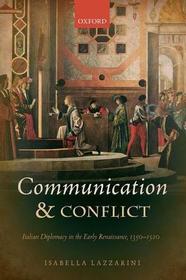
Communication and Conflict
Italian Diplomacy in the Early Renaissance, 1350-1520
Sorozatcím: Oxford Studies In Medieval European History;
-
10% KEDVEZMÉNY?
- A kedvezmény csak az 'Értesítés a kedvenc témákról' hírlevelünk címzettjeinek rendeléseire érvényes.
- Kiadói listaár GBP 132.50
-
59 823 Ft (56 975 Ft + 5% áfa)
Az ár azért becsült, mert a rendelés pillanatában nem lehet pontosan tudni, hogy a beérkezéskor milyen lesz a forint árfolyama az adott termék eredeti devizájához képest. Ha a forint romlana, kissé többet, ha javulna, kissé kevesebbet kell majd fizetnie.
- Kedvezmény(ek) 10% (cc. 5 982 Ft off)
- Kedvezményes ár 53 841 Ft (51 278 Ft + 5% áfa)
Iratkozzon fel most és részesüljön kedvezőbb árainkból!
Feliratkozom
59 823 Ft

Beszerezhetőség
Megrendelésre a kiadó utánnyomja a könyvet. Rendelhető, de a szokásosnál kicsit lassabban érkezik meg.
Why don't you give exact delivery time?
A beszerzés időigényét az eddigi tapasztalatokra alapozva adjuk meg. Azért becsült, mert a terméket külföldről hozzuk be, így a kiadó kiszolgálásának pillanatnyi gyorsaságától is függ. A megadottnál gyorsabb és lassabb szállítás is elképzelhető, de mindent megteszünk, hogy Ön a lehető leghamarabb jusson hozzá a termékhez.
A termék adatai:
- Kiadó OUP Oxford
- Megjelenés dátuma 2015. szeptember 3.
- ISBN 9780198727415
- Kötéstípus Keménykötés
- Terjedelem338 oldal
- Méret 241x173x24 mm
- Súly 654 g
- Nyelv angol 0
Kategóriák
Rövid leírás:
The first overall study of diplomacy in Early Renaissance Italy for 60 years, explaining how Italian diplomacy came to play such a central role in the development of international relations in Europe, in the spread and application of humanism, and in new modes of political and cultural thought.
TöbbHosszú leírás:
Diplomacy has never been a politically-neutral research field, even when it was confined to merely reconstructing the backgrounds of wars and revolutions. In the nineteenth century, diplomacy was integral to the grand narrative of the building of the modern 'nation-State'. This is the first overall study of diplomacy in Early Renaissance Italy since Garrett Mattingly's pioneering work in 1955. It offers an innovative approach to the theme of Renaissance diplomacy, sidestepping the classic dichotomy between medieval and early modern, and re-considering the whole diplomatic process without reducing it to the 'grand narrative' of the birth of resident embassies. Communication and Conflict situates and explains the growth of diplomatic activity from a series of perspectives - political and institutional, cognitive and linguistic, material and spatial - and thus offers a highly sophisticated and persuasive account of causation, change, and impact in respect of a major political and cultural form.
The volume also provides the most complete account to date of how it was that specifically Italian forms of diplomacy came to play such a central role, not only in the development of international relations at the European level, but also in the spread and application of humanism and of the new modes of political thinking and political discussion associated with the generations of Machiavelli and Guicciardini.
[S]uccessfully deconstruct[s] the assumed causal connection between the emergence of diplomacy and modern states while emphasizing that the novelties of Renaissance diplomacy should be contextualized within contemporary values and understandings... A whole new generation of diplomatic historians as well as students at all levels of higher education will greatly benefit from the new research directions
Tartalomjegyzék:
Introduction
Part I: The framework
The political geography of Italian diplomacy
The polygenesis of diplomacy and the trajectories of change
Sources for the study of diplomacy
Part II: Diplomacy as a political action
Information
Negotiation
Communication
Part III: Diplomacy as a practice
Diplomatic agents: an open social field
Forms, actions, and rituals
The spaces of diplomacy
Part IV: Diplomacy as a political language and a cultural process
The forms of diplomatic communication
Argument and emotion
Languages, lexis, and exchanges
Conclusion
Bibliography
Index

