

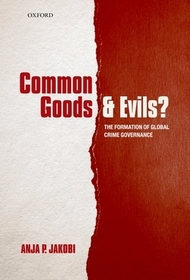
Common Goods and Evils?
The Formation of Global Crime Governance
-
15% KEDVEZMÉNY?
- A kedvezmény csak az 'Értesítés a kedvenc témákról' hírlevelünk címzettjeinek rendeléseire érvényes.
- Kiadói listaár GBP 120.00
-
54 180 Ft (51 600 Ft + 5% áfa)
Az ár azért becsült, mert a rendelés pillanatában nem lehet pontosan tudni, hogy a beérkezéskor milyen lesz a forint árfolyama az adott termék eredeti devizájához képest. Ha a forint romlana, kissé többet, ha javulna, kissé kevesebbet kell majd fizetnie.
- Kedvezmény(ek) 15% (cc. 0 Ft off)
- Kedvezményes ár 46 053 Ft (43 860 Ft + 5% áfa)
- A kedvezmény érvényes eddig: 2026. augusztus 5.
Iratkozzon fel most és részesüljön kedvezőbb árainkból!
Feliratkozom
54 180 Ft

Beszerezhetőség
Megrendelésre a kiadó utánnyomja a könyvet. Rendelhető, de a szokásosnál kicsit lassabban érkezik meg.
Why don't you give exact delivery time?
A beszerzés időigényét az eddigi tapasztalatokra alapozva adjuk meg. Azért becsült, mert a terméket külföldről hozzuk be, így a kiadó kiszolgálásának pillanatnyi gyorsaságától is függ. A megadottnál gyorsabb és lassabb szállítás is elképzelhető, de mindent megteszünk, hogy Ön a lehető leghamarabb jusson hozzá a termékhez.
A termék adatai:
- Kiadó OUP Oxford
- Megjelenés dátuma 2013. július 4.
- ISBN 9780199674602
- Kötéstípus Keménykötés
- Terjedelem330 oldal
- Méret 236x168x25 mm
- Súly 654 g
- Nyelv angol 0
Kategóriák
Rövid leírás:
The book provides an up-to date account to global crime governance, containing in-depth case studies on money laundering, corruption, and human trafficking. It explains why the form of global governance - the institutional design - related to these cases differs widely.
TöbbHosszú leírás:
Global crime governance has emerged as an important component of world politics. It is manifested in national and international agendas, the proliferation of global regulations, growing international budgets, and the enlarged mandates of international organizations. As a result, the definition and prosecution of crime is now increasingly homogenous, but it also shows variance: some crime policies are institutionalized coherently or attached to strong international organizations, while others are weak or dispersed across different forums. Based on sociological institutionalism, this book examines questions of structural variance in the institutional design of global governance. It shows that the interplay of strong actors and rationalization principles lead to more coherent forms of global crime governance, while normative arguments related to crime are more likely to result in fragmented forms. In consequence -- and contrary to many scholars' assumptions -- global crime governance is strongest in those areas that are least attached to moral statements.
The book develops a theory of society and applies this framework to explaining the sources and consequences of institutional design. Drawing on qualitative and quantitative methods, the text analyzes the origins of global regulations, how they are disseminated, and why differences exist. The role of the United States in creating global rules and disseminating them is emphasized. Readers interested in international relations, global governance, globalization studies, world society studies, and criminology will benefit from the theoretical and empirical results of this book.
Tartalomjegyzék:
Introduction
Global Crime Governance in World Society
Part I: Governance in World Society
Power, Change, and Institutions in World Society
Part II: Establishing Global Crime Governance
The Historical Development of Global Anti-Crime Procedures
The Emergence and Diffusion of Global Anti-Crime Regulations
Global Activities against Money Laundering
Global Anti-Corruption Norms
Global Efforts against the Trafficking of Humans
Part III: Comparative Perspectives on Global Crime Governance
The Adoption of Crime Policies: Patterns and Strategies
Non-State Actors in Global Crime Governance
Conclusions
Global Crime Governance: Conclusions, Implications and Outlook

