

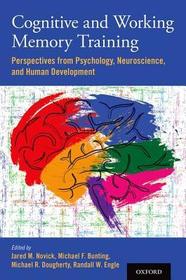
Cognitive and Working Memory Training
Perspectives from Psychology, Neuroscience, and Human Development
-
10% KEDVEZMÉNY?
- A kedvezmény csak az 'Értesítés a kedvenc témákról' hírlevelünk címzettjeinek rendeléseire érvényes.
- Kiadói listaár GBP 96.00
-
43 344 Ft (41 280 Ft + 5% áfa)
Az ár azért becsült, mert a rendelés pillanatában nem lehet pontosan tudni, hogy a beérkezéskor milyen lesz a forint árfolyama az adott termék eredeti devizájához képest. Ha a forint romlana, kissé többet, ha javulna, kissé kevesebbet kell majd fizetnie.
- Kedvezmény(ek) 10% (cc. 4 334 Ft off)
- Kedvezményes ár 39 010 Ft (37 152 Ft + 5% áfa)
Iratkozzon fel most és részesüljön kedvezőbb árainkból!
Feliratkozom
43 344 Ft

Beszerezhetőség
Becsült beszerzési idő: A Prosperónál jelenleg nincsen raktáron, de a kiadónál igen. Beszerzés kb. 3-5 hét..
A Prosperónál jelenleg nincsen raktáron.
Why don't you give exact delivery time?
A beszerzés időigényét az eddigi tapasztalatokra alapozva adjuk meg. Azért becsült, mert a terméket külföldről hozzuk be, így a kiadó kiszolgálásának pillanatnyi gyorsaságától is függ. A megadottnál gyorsabb és lassabb szállítás is elképzelhető, de mindent megteszünk, hogy Ön a lehető leghamarabb jusson hozzá a termékhez.
A termék adatai:
- Kiadó OUP USA
- Megjelenés dátuma 2020. január 9.
- ISBN 9780199974467
- Kötéstípus Keménykötés
- Terjedelem588 oldal
- Méret 145x236x35 mm
- Súly 953 g
- Nyelv angol 40
Kategóriák
Rövid leírás:
Novick, Bunting, Dougherty, and Engle query an interdisciplinary group of distinguished researchers in cognitive science about the efficacy of cognitive and working memory training using a combination of behavioral, neuroimaging, meta-analytic, and computational modeling methods. This edited volume is a defining resource for the field of cognitive training research generally. Importantly, one focus of the book is on the notion of transfer--namely, the extent to which cognitive training generalizes to learning and performance measures that were decidedly not part of the training regimen.
TöbbHosszú leírás:
Cognitive and Working Memory Training assembles an interdisciplinary group of distinguished authors--all experts in the field--who have been testing the efficacy of cognitive and working memory training using a combination of behavioral, neuroimaging, meta-analytic, and computational modelling methods. This edited volume is a defining resource on the practicality and utility of the field of cognitive training research in general, and working memory training in particular. Importantly, one focus of the book is on the notion of transfer--namely, the extent to which cognitive training--be it through music, video-game play, or working memory demanding interventions at school--generalizes to learning and performance measures that were decidedly not part of the training regimen. As most cognitive scientists (and perhaps many casual observers) recognize, the notions of cognitive training and transfer have been widely controversial for many reasons, including disagreement over the reliability of outcomes and consensus on methodological "best practices," and even the ecological validity of laboratory-based tests. This collection does not resolve these debates of course; but its contribution is to address them directly by creating an exchange in a single compendium among scientists who, in separate research publications, do not always reach the same conclusions. The book is organized around comprehensive overview chapters from different disciplinary perspectives--Cognitive Psychology (by Hicks and Engle), Neuroscience (by Kuchinsky and Haarmann), and Development (by Ling and Diamond)--that define major issues, terms, and themes in the field, with a pointed set of challenge questions to which other scientists respond in subsequent chapters. The goal of this volume is to educate. It is designed for students and researchers, and perhaps the armchair psychologist. Crucially, the contributors recognize that it is good for science to persistently confront our understanding of an area: Debate and alternative viewpoints, backed by theory, data, and inferences drawn from the evidence, is what advances scientific knowledge. This book probes established paradigms in cognitive training research, and the long-form of these chapters (not found in scientific journals) allows detailed exploration of the current state of the science. Such breadth intends to invite novel ways of thinking about the nature of cognitive and perceptual plasticity, which may enlighten either new efforts at training, new inferences about prior results, or both.
These well-written, thoroughly researched chapters offer cognitive scientists an exemplary depiction of what scholars have learned and the questions yet to be pursued.
Tartalomjegyzék:
List of Contributors
Prologue
MICHAEL F. BUNTING AND JARED M. NOVICK
Acknowledgements
SECTION I COGNITIVE PERSPECTIVE
1 Cognitive Perspectives of Working Memory: Current Challenges in Working Memory Training
KENNY HICKS AND RANDALL W. ENGLE
2 Working Memory Training from an Individual Differences Perspective: Efficacy in Older Adults
ERIKA BORELLA, BARBARA CARRETTI, CESARE CORNOLDI, AND ROSSANA DE BENI
3 Training Working Memory for 100 Days: The COGITO Study
FLORIAN SCHMIEDEK, MARTIN LÖVDÉN, AND ULMAN LINDENBERGER
4 How Strong is the Evidence for the Effectiveness of Working Memory Training
CLAUDIA C. VON BASTIAN, SABRINA GUYE, AND CARLA DE SIMONI
SECTION II NEUROCOGNITIVE PERSPECTIVE
5 Neuroscience Perspectives on Cognitive Training
STEFANIE E. KUCHINSKY AND HENK J. HAARMANN
6 Working Memory Training and Transcranial Direct Current Stimulation
JACKY AU, SUSANNE M. JAEGGI, AND MARTIN BUSCHKUEHL
7 Cognitive Training: Component Processes and Criteria for Change
KRISTINE B. WALHOVD, ANDERS M. FJELL, AND LARS NYBERG
SECTION III DEVELOPMENTAL PERSPECTIVE
8 Review of the Evidence on, and Fundamental Questions Surrounding Efforts to Improve Executive Functions, Including Working Memory
ADELE DIAMOND AND DAPHNE S. LING
9 Fundamental Questions Surrounding Efforts to Improve Cognitive Function Through Video Game Training
ADAM EICHENBAUM, DAPHNE BAVELIER, AND C. SHAWN GREEN
10 Logical and Methodological Considerations in Cognitive Training Research
BEN KATZ AND PRITI SHAH
11 Music Training: Contributions to Executive Function
BROOKE M. OKADA AND L. ROBERT SLEVC
12 The Effectiveness of Training in Task Switching: New Insights and Open Issues from a Lifespan View
JUTTA KRAY AND SANDRA DÖRRENBÄCHER
Epilogue
MICHAEL DOUGHERTY AND RANDALL W. ENGLE
Name Index
Subject Index

