

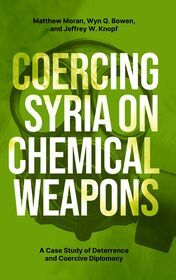
Coercing Syria on Chemical Weapons
A Case Study of Deterrence and Coercive Diplomacy
Sorozatcím: Bridging the Gap;
-
10% KEDVEZMÉNY?
- A kedvezmény csak az 'Értesítés a kedvenc témákról' hírlevelünk címzettjeinek rendeléseire érvényes.
- Kiadói listaár GBP 64.00
-
28 896 Ft (27 520 Ft + 5% áfa)
Az ár azért becsült, mert a rendelés pillanatában nem lehet pontosan tudni, hogy a beérkezéskor milyen lesz a forint árfolyama az adott termék eredeti devizájához képest. Ha a forint romlana, kissé többet, ha javulna, kissé kevesebbet kell majd fizetnie.
- Kedvezmény(ek) 10% (kb. 2 890 Ft)
- Kedvezményes ár 26 006 Ft (24 768 Ft + 5% áfa)
Iratkozzon fel most és részesüljön kedvezőbb árainkból!
Feliratkozom
28 896 Ft

Beszerezhetőség
Megrendelésre a kiadó utánnyomja a könyvet. Rendelhető, de a szokásosnál kicsit lassabban érkezik meg.
Why don't you give exact delivery time?
A beszerzés időigényét az eddigi tapasztalatokra alapozva adjuk meg. Azért becsült, mert a terméket külföldről hozzuk be, így a kiadó kiszolgálásának pillanatnyi gyorsaságától is függ. A megadottnál gyorsabb és lassabb szállítás is elképzelhető, de mindent megteszünk, hogy Ön a lehető leghamarabb jusson hozzá a termékhez.
A termék adatai:
- Kiadó OUP USA
- Megjelenés dátuma 2025. június 11.
- ISBN 9780197770375
- Kötéstípus Keménykötés
- Terjedelem280 oldal
- Méret 234x156x19 mm
- Súly 567 g
- Nyelv angol 595
Kategóriák
Rövid leírás:
Coercing Syria on Chemical Weapons examines efforts by the United States, sometimes acting with France and the United Kingdom, to respond to Syria's possession and use of chemical weapons over the course of its civil war. In particular, they focus on US strategy, which relied heavily on coercion involving both deterrent and compellent variants of that strategy. Deriving lessons from the most significant attempt in the post-Cold War era to deter use of a weapon of mass destruction, this book offers theoretical and practical lessons for both security studies scholars and policymakers.
TöbbHosszú leírás:
In 2012, US President Barack Obama stated that Syrian government usage of chemical weapons on its population would cross a red line that would require the US government to reconsider its approach to the civil war then underway in Syria. Syria subsequently used such weapons, creating a policy dilemma for the United States about how to respond to Syrian President Bashar al-Assad's violation of the red line.
In Coercing Syria on Chemical Weapons, Matthew Moran, Wyn Q. Bowen, and Jeffrey W. Knopf examine efforts by the United States, sometimes acting with France and the United Kingdom, to respond to Syria's possession and use of chemical weapons over the course of its civil war. In particular, they focus on US strategy, covering the presidencies of both Barack Obama and Donald Trump, which relied heavily on coercion involving both deterrent and compellent variants of that strategy. As the authors show, policies directed at the ruling Assad regime in Syria attempted to deter chemical weapons attacks and to compel Syria into giving up its chemical arsenal with mixed outcomes. Drawing on existing literature on deterrence and coercive diplomacy to identify three propositions--involving credibility, motivations, and assurances--the book explains the mixed record of coercive success and failure and examines how effective coercive strategies were at different points and why.
Deriving lessons from the most significant attempt in the post-Cold War era to deter use of a weapon of mass destruction, this book offers theoretical and practical lessons for both security studies scholars and policymakers.
The work reviewed here is an important piece in understanding the calculusstates use in deciding to pursue, develop, and use unconventional weapons.
Tartalomjegyzék:
Preface and Acknowledgments
Postscript
List of Abbreviations
1. Introduction: Responding to a Dictator's Use of Poison Gas
2. Analytical Framework: Credibility, Motivations, and Assurance as Factors in Coercion Outcomes
3. Syria and Chemical Weapons Prior to 2011: Relevant Precedents and the Evolution of Syria's Capability, Motives, and Strategy
4. From the Red Line to Ghouta
5. The Chemical Disarmament Deal
6. The Return to Chemical Weapons Use
7. Conclusion
Epilogue
Index

