

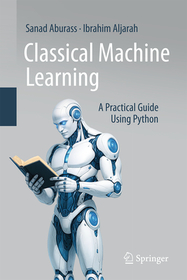
Classical Machine Learning
A Practical Guide Using Python
-
12% KEDVEZMÉNY?
- Kiadói listaár EUR 80.24
-
31 341 Ft (29 849 Ft + 5% áfa)
Az ár azért becsült, mert a rendelés pillanatában nem lehet pontosan tudni, hogy a beérkezéskor milyen lesz a forint árfolyama az adott termék eredeti devizájához képest. Ha a forint romlana, kissé többet, ha javulna, kissé kevesebbet kell majd fizetnie.
- Kedvezmény(ek) 12% (kb. 3 761 Ft)
- Kedvezményes ár 27 580 Ft (26 267 Ft + 5% áfa)
27 580 Ft

Beszerezhetőség
Még nem jelent meg, de rendelhető. A megjelenéstől számított néhány héten belül megérkezik.
Why don't you give exact delivery time?
A beszerzés időigényét az eddigi tapasztalatokra alapozva adjuk meg. Azért becsült, mert a terméket külföldről hozzuk be, így a kiadó kiszolgálásának pillanatnyi gyorsaságától is függ. A megadottnál gyorsabb és lassabb szállítás is elképzelhető, de mindent megteszünk, hogy Ön a lehető leghamarabb jusson hozzá a termékhez.
A termék adatai:
- Kiadó Springer Nature Switzerland
- Megjelenés dátuma 2026. szeptember 9.
- ISBN 9783032043986
- Kötéstípus Keménykötés
- Terjedelem256 oldal
- Méret 235x155 mm
- Nyelv angol
- Illusztrációk VI, 256 p. 53 illus., 47 illus. in color. 700
Kategóriák
Hosszú leírás:
The field of Artificial Intelligence (AI) has rapidly transformed in recent years, with Machine Learning being now one of its most impactful and widely applied branches. From intelligent recommendation systems to self-driving cars, and from language translation to medical diagnosis, Machine Learning now touches nearly every aspect of modern life. Yet, for those beginning their journey into AI, the field can feel daunting?particularly with the increasing complexity of deep learning and generative models. In the midst of this fast-paced evolution, it is easy to overlook the foundational ideas that make these breakthroughs possible.
This book is written to bridge this gap and was born from the belief that a solid understanding of classical machine learning is not just helpful, but essential for truly grasping the advanced and modern models shaping today?s AI landscape. The authors? goal is to explain classical models clearly and intuitively, while also providing hands-on Python implementations that bring these models to life and offering, as such, a balanced practical approach.
The authors cover a wide range of foundational topics, from linear regression and logistic regression to decision trees, ensemble methods, clustering, dimensionality reduction, neural networks, and convolutional operations. Emerging ideas like Cubixel representation in image processing are also presented, providing a forward-looking perspective on evolving practices. Each chapter builds on the last, combining theory, math, and code in a way that is accessible to students, researchers, and professionals alike.
The book assumes a working knowledge of Linear Algebra and Calculus, as many algorithms rely on these mathematical underpinnings. A solid foundation in Python is also recommended, since practical examples and implementations are written in Python with widely used libraries such as NumPy, pandas, scikit-learn, and TensorFlow. Whether you?re an aspiring machine learning engineer, a data scientist transitioning from another field, or an academic looking to refresh your knowledge, this book aims to be a practical companion on your learning journey.
TöbbTartalomjegyzék:
Dedication.- Acknowledgment.- Preface. 1. Data Preprocessing & Feature Engineering.- 2. Regression & Linear Models.- 3. Classification: Logistic Regression to Nai?ve Bayes.- 4. Decision Trees and Random Forests.- 5. Ensemble Learning.- 6. Unsupervised Learning: Clustering & Dimensionality Reduction.- 7. Introduction to Artificial Neural Networks.- 8. Convolutional Operations.- 9. Convolutional Neural Networks.- 10. Recurrent Neural Networks.- 11. Transfer Learning Introduction to Features.- References.
Több
