

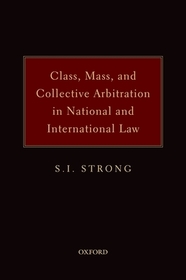
Class, Mass, and Collective Arbitration in National and International Law
-
10% KEDVEZMÉNY?
- A kedvezmény csak az 'Értesítés a kedvenc témákról' hírlevelünk címzettjeinek rendeléseire érvényes.
- Kiadói listaár GBP 245.00
-
110 617 Ft (105 350 Ft + 5% áfa)
Az ár azért becsült, mert a rendelés pillanatában nem lehet pontosan tudni, hogy a beérkezéskor milyen lesz a forint árfolyama az adott termék eredeti devizájához képest. Ha a forint romlana, kissé többet, ha javulna, kissé kevesebbet kell majd fizetnie.
- Kedvezmény(ek) 10% (kb. 11 061 Ft)
- Kedvezményes ár 99 556 Ft (94 815 Ft + 5% áfa)
Iratkozzon fel most és részesüljön kedvezőbb árainkból!
Feliratkozom
110 617 Ft

Beszerezhetőség
Megrendelésre a kiadó utánnyomja a könyvet. Rendelhető, de a szokásosnál kicsit lassabban érkezik meg.
Why don't you give exact delivery time?
A beszerzés időigényét az eddigi tapasztalatokra alapozva adjuk meg. Azért becsült, mert a terméket külföldről hozzuk be, így a kiadó kiszolgálásának pillanatnyi gyorsaságától is függ. A megadottnál gyorsabb és lassabb szállítás is elképzelhető, de mindent megteszünk, hogy Ön a lehető leghamarabb jusson hozzá a termékhez.
A termék adatai:
- Kiadó OUP USA
- Megjelenés dátuma 2013. november 7.
- ISBN 9780199772520
- Kötéstípus Keménykötés
- Terjedelem432 oldal
- Méret 163x236x25 mm
- Súly 734 g
- Nyelv angol 0
Kategóriák
Rövid leírás:
Class, Mass and Collective Arbitration in National and International Law is the first book to discuss various types of large-scale arbitration, where multiple individuals (ranging from several dozen to hundreds of thousands of persons) bring their claims at a single time, in a single arbitral proceeding.
TöbbHosszú leírás:
Class arbitration first developed in the United States in the 1980s as a means of providing large numbers of individuals with the opportunity to assert their claims at the same time and in the same proceeding. Large-scale arbitration has since spread beyond U.S. borders, with collective arbitration being seen in Europe and mass arbitration being used in the international investment regime. Class, Mass and Collective Arbitration in National and International Law considers all three forms of arbitration as a matter of domestic and international law, providing arbitrators, advocates and scholars with the tools they need to evaluate these sorts of procedural mechanisms.
The book covers the best-known decisions in the field - Stolt-Nielsen S.A. v. Animal Feeds International Corp. and AT&T Mobility LLC v. Concepcion from the U.S. Supreme Court and Abaclat v. Argentine Republic from the world of investment arbitration - as well as specialized rules promulgated by the American Arbitration Association, JAMS and the German Institution of Arbitration (DIS). The text introduces dozens of previously undiscussed judicial opinions and covers issues ranging from contractual (or treaty) silence and waiver to regulatory concerns and matters of enforcement. The book discusses the entire timeline of class, mass and collective arbitration, ranging from the devices' historical origins through the present and into the future. Lawyers in a wide variety of jurisdictions will benefit from the material contained in this text, which is the first full-length monograph to address large-scale arbitration as a matter of national and international law.
Strong accomplishes her aim in a thoughtful, lucid, and commendably concise way ... There is no doubt that her taxonomy of the forms of large-scale arbitrations (representative and aggregative arbitration) will continue to inform the debate on the appropriate characterization of multiparty investment arbitration. Abaclat has already relied upon her classification to understand whether mass claims are representative or aggregative in nature; future potential mass claims such as Adamakopolous v Cyprus (initiated by 676 claimants) will continue to gain from her insight.
Tartalomjegyzék:
Chapter 1 Introduction
I. Introduction
II. A Brief History of Large-Scale Arbitration
III. Uses of Class, Mass and Collective Arbitration
Chapter 2 Rules and Procedures
I. Introduction
II. Initiation of Class, Mass or Collective Arbitrations
III. Procedures
Chapter 3 Is Large-Scale Arbitration Really Arbitration?
I. Introduction
II. The Question Arises - Stolt-Nielsen S.A. v. AnimalFeeds International Corp.
III. Distinguishing Class, Mass and Collective Arbitration From Other Multiparty Proceedings
IV. Class, Mass and Collective Proceedings and the Nature of Arbitration
V. Do Class, Mass or Collective Arbitration Change The Nature Of Arbitration?
VI. Forward-Looking Concerns
Chapter 4 Interpreting the Arbitration Agreement
I. Introduction
II. Interpretation of Arbitration Agreements in Cases Involving Class, Mass and Collective Claims
III. Interpreting Agreements That Are Silent or Ambiguous Regarding Class, Mass or Collective Treatment
IV. Waivers of Class, Mass or Collective Treatment
Chapter 5 Regulatory Elements of Class, Mass and Collective Arbitration
I. Introduction
II. Large-Scale Litigation as a Form of Regulation
III. Regulatory Arbitration
IV. Regulatory Arbitration in Context
Chapter 6 The Future of Class, Mass and Collective Arbitration
I. Introduction
II. Relative Benefits of Class, Mass and Collective Proceedings
III. New Forms of Class, Mass and Collective Arbitration
IV. Creating an Enforceable Arbitration Agreement for Class, Mass or Collective Disputes
Chapter 7 Enforcement of Class, Mass and Collective Awards
I. Introduction
II. Issues Regarding International Enforcement of Large-Scale Arbitral Awards
III. Issues Regarding National Enforcement of Large-Scale Arbitral Awards
IV. Conclusion
Appendix
Spanish Statute on Collective Consumer Arbitration

