

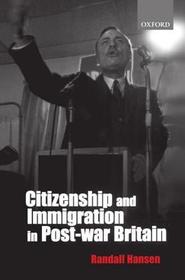
Citizenship and Immigration in Postwar Britain
The Institutional Origins of a Multicultural Nation
-
10% KEDVEZMÉNY?
- A kedvezmény csak az 'Értesítés a kedvenc témákról' hírlevelünk címzettjeinek rendeléseire érvényes.
- Kiadói listaár GBP 105.00
-
47 407 Ft (45 150 Ft + 5% áfa)
Az ár azért becsült, mert a rendelés pillanatában nem lehet pontosan tudni, hogy a beérkezéskor milyen lesz a forint árfolyama az adott termék eredeti devizájához képest. Ha a forint romlana, kissé többet, ha javulna, kissé kevesebbet kell majd fizetnie.
- Kedvezmény(ek) 10% (cc. 4 741 Ft off)
- Kedvezményes ár 42 667 Ft (40 635 Ft + 5% áfa)
Iratkozzon fel most és részesüljön kedvezőbb árainkból!
Feliratkozom
47 407 Ft

Beszerezhetőség
Megrendelésre a kiadó utánnyomja a könyvet. Rendelhető, de a szokásosnál kicsit lassabban érkezik meg.
Why don't you give exact delivery time?
A beszerzés időigényét az eddigi tapasztalatokra alapozva adjuk meg. Azért becsült, mert a terméket külföldről hozzuk be, így a kiadó kiszolgálásának pillanatnyi gyorsaságától is függ. A megadottnál gyorsabb és lassabb szállítás is elképzelhető, de mindent megteszünk, hogy Ön a lehető leghamarabb jusson hozzá a termékhez.
A termék adatai:
- Kiadó OUP Oxford
- Megjelenés dátuma 2000. június 1.
- ISBN 9780199240548
- Kötéstípus Puhakötés
- Terjedelem316 oldal
- Méret 235x156x17 mm
- Súly 467 g
- Nyelv angol 0
Kategóriák
Rövid leírás:
In this contentious and ground-breaking study, the author draws on extensive archival research to provide a new account of the transforamtion of the United Kingdom into a multicultural society through an analysis of the evolution of immigration and citizenship policy since 1945. Against the prevailing academic orthodoxy, he argues that British immigration policy was not racist but both rational and liberal.
TöbbHosszú leírás:
In this ground-breaking book, the author draws extensively on archival material and theortical advances in the social science literature. Citizenship and Immigration in Post-war Britain examines the transformation since 1945 of the UK from a homogeneous into a multicultural society. Rejecting a dominant strain of sociological and historical inquiry emphasizing state racism, Hansen argues that politicians and civil servants were overall liberal relative to the public, to which they owed their office, and that they pursued policies that were rational for any liberal democratic politician. He explains the trajectory of British migration and nationality policy - its exceptional liberality in the 1950s, its restrictiveness after then, and its tortured and seemingly racist definition of citizenship. The combined effect of a 1948 imperial definition of citizenship (adopted independently of immigration), and a primary commitment to migration from the Old Dominions, locked British politicians into a series of policy choices resulting in a migration and nationality regime that was not racist in intention, but was racist in effect. In the context of a liberal elite and an illiberal public, Britain's current restrictive migration policies result not from the faling of its policy-makers but from those of its institutions.
a judicious analysis of the policy-making apparatus of the British state

