

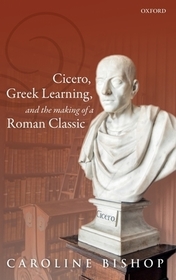
Cicero, Greek Learning, and the Making of a Roman Classic
-
10% KEDVEZMÉNY?
- A kedvezmény csak az 'Értesítés a kedvenc témákról' hírlevelünk címzettjeinek rendeléseire érvényes.
- Kiadói listaár GBP 127.50
-
57 566 Ft (54 825 Ft + 5% áfa)
Az ár azért becsült, mert a rendelés pillanatában nem lehet pontosan tudni, hogy a beérkezéskor milyen lesz a forint árfolyama az adott termék eredeti devizájához képest. Ha a forint romlana, kissé többet, ha javulna, kissé kevesebbet kell majd fizetnie.
- Kedvezmény(ek) 10% (cc. 5 757 Ft off)
- Kedvezményes ár 51 810 Ft (49 343 Ft + 5% áfa)
Iratkozzon fel most és részesüljön kedvezőbb árainkból!
Feliratkozom
57 566 Ft

Beszerezhetőség
Megrendelésre a kiadó utánnyomja a könyvet. Rendelhető, de a szokásosnál kicsit lassabban érkezik meg.
Why don't you give exact delivery time?
A beszerzés időigényét az eddigi tapasztalatokra alapozva adjuk meg. Azért becsült, mert a terméket külföldről hozzuk be, így a kiadó kiszolgálásának pillanatnyi gyorsaságától is függ. A megadottnál gyorsabb és lassabb szállítás is elképzelhető, de mindent megteszünk, hogy Ön a lehető leghamarabb jusson hozzá a termékhez.
A termék adatai:
- Kiadó OUP Oxford
- Megjelenés dátuma 2019. január 10.
- ISBN 9780198829423
- Kötéstípus Keménykötés
- Terjedelem372 oldal
- Méret 241x163x28 mm
- Súly 712 g
- Nyelv angol 0
Kategóriák
Rövid leírás:
The Roman statesman, orator, and author Marcus Tullius Cicero is the embodiment of a classic, though only in part due to his subsequent reception. This volume demonstrates how Cicero's strategic adaptation of classic Greek texts allowed him to envision and create texts with classical authority for a parallel Roman canon.
TöbbHosszú leírás:
The Roman statesman, orator, and author Marcus Tullius Cicero is the embodiment of a classic: his works have been read continuously from antiquity to the present, his style is considered the model for classical Latin, and his influence on Western ideas about the value of humanistic pursuits is both deep and profound. However, despite the significance of subsequent reception in ensuring his canonical status, Cicero, Greek Learning, and the Making of a Roman Classic demonstrates that no one is more responsible for Cicero's transformation into a classic than Cicero himself, and that in his literary works he laid the groundwork for the ways in which he is still remembered today.
The volume presents a new way of understanding Cicero's career as an author by situating his textual production within the context of the growth of Greek classicism: the movement had begun to flourish shortly before his lifetime and he clearly grasped its benefits both for himself and for Roman literature more broadly. By strategically adapting classic texts from the Greek world, and incorporating into his adaptations the interpretations of the Hellenistic philosophers, poets, rhetoricians, and scientists who had helped enshrine those works as classics, he could envision and create texts with classical authority for a parallel Roman canon.
Ranging across a variety of genres - including philosophy, rhetoric, oratory, poetry, and letters - this close study of Cicero's literary works moves from his early translation of Aratus' poetry (and its later reappearance through self-quotation) to Platonizing philosophy, Aristotelian rhetoric, Demosthenic oratory, and even a planned Greek-style letter collection. Juxtaposing incisive analysis of how Cicero consciously adopted classical Greek writers as models and predecessors with detailed accounts of the reception of those figures by Greek scholars of the Hellenistic period, the volume not only offers ground-breaking new insights into Cicero's ascension to canonical status, but also a salutary new account of Greek intellectual life and its effect on Roman literature.
All readers of Cicero will find value in this book, as will anyone interested in the impact of Greek intellectual culture on Roman literature. There is a wealth of detail, and Bishop offers a host of fresh insights into the care and effort Cicero took to make his works into Roman "classics."
Tartalomjegyzék:
Frontmatter
Texts and Abbreviations
Introduction
Cicero's intellectual politics: textual production as a new man
Greek intellectual culture and Roman classicism
^iGraecus et scholasticus: Roman ambivalence towards Greek culture
Intellectual and scholastic culture in Republican Rome
Conclusion and chapter summary
Aratus
Cicero and the virtues of translation
Aratus' Phaenomena
The Phaenomena in Hellenistic Greece
Cicero's Aratea
Conclusion
Plato
The features of Cicero's Plato
Plato in Philo's Academy
Plato in Antiochus' Academy
Scepticism and syncretism in Cicero's Timaeus
Conclusion
Aristotle
The features of Cicero's Aristotle
Aristotle, Philo, and in utramque partem debate
Aristotle in Cicero's rhetorical works
Conclusion
Demosthenes
Demosthenes' Hellenistic reputation
Demosthenes in Cicero's early career
Demosthenes, tyranny, and Atticism in Cicero's late career
Brutus
De Optimo Genere Oratorum and Orator
The Philippics
Letters
Cicero and the world of Greek letters
Greek (and Roman) epistolary theory
Greek letter collections
Cicero's (planned) letter collection
Conclusion
Cicero
Modelling reception in the philosophical dialogues
Hellenistic philosophy and Roman poetry in the philosophical dialogues
The Aratea in De Natura Deorum
Cicero's poetry in De Divinatione
Conclusion
Conclusion
Endmatter
Bibliography
Index

