

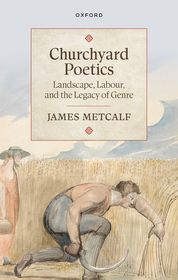
Churchyard Poetics
Landscape, Labour, and the Legacy of Genre
-
20% KEDVEZMÉNY?
- A kedvezmény csak az 'Értesítés a kedvenc témákról' hírlevelünk címzettjeinek rendeléseire érvényes.
- Kiadói listaár GBP 77.00
-
34 765 Ft (33 110 Ft + 5% áfa)
Az ár azért becsült, mert a rendelés pillanatában nem lehet pontosan tudni, hogy a beérkezéskor milyen lesz a forint árfolyama az adott termék eredeti devizájához képest. Ha a forint romlana, kissé többet, ha javulna, kissé kevesebbet kell majd fizetnie.
- Kedvezmény(ek) 20% (cc. 6 953 Ft off)
- Kedvezményes ár 27 812 Ft (26 488 Ft + 5% áfa)
- A kedvezmény érvényes eddig: 2026. június 30.
Iratkozzon fel most és részesüljön kedvezőbb árainkból!
Feliratkozom
34 765 Ft

Beszerezhetőség
Becsült beszerzési idő: A Prosperónál jelenleg nincsen raktáron, de a kiadónál igen. Beszerzés kb. 3-5 hét..
A Prosperónál jelenleg nincsen raktáron.
Why don't you give exact delivery time?
A beszerzés időigényét az eddigi tapasztalatokra alapozva adjuk meg. Azért becsült, mert a terméket külföldről hozzuk be, így a kiadó kiszolgálásának pillanatnyi gyorsaságától is függ. A megadottnál gyorsabb és lassabb szállítás is elképzelhető, de mindent megteszünk, hogy Ön a lehető leghamarabb jusson hozzá a termékhez.
A termék adatai:
- Kiadó OUP Oxford
- Megjelenés dátuma 2025. február 6.
- ISBN 9780198943853
- Kötéstípus Keménykötés
- Terjedelem196 oldal
- Méret 223x145x20 mm
- Súly 378 g
- Nyelv angol 687
Kategóriák
Rövid leírás:
The churchyard is a familiar but little-understood literary landscape in eighteenth-century scholarship. This book recovers work by women and labouring-class poets to argue that the churchyard was an important and revealing site in the cultural imaginary as this period negotiated the transition to capitalism.
TöbbHosszú leírás:
The familiar literary-critical category of 'graveyard poetry' has made the eighteenth-century churchyard a commonplace in the period's cultural imaginary: a location in which melancholy, religious poets get lost in imaginative reveries or didactic visions of the afterlife. By contrast, Churchyard Poetics: Landscape, Labour, and the Legacy of Genre shows how the churchyard takes on a new shape and a fresh importance for a counter-tradition of women and labouring-class poets, for whom this landscape is a resting place with no closure. In work by Mary Leapor, Ann Yearsley, Charlotte Smith, and John Clare-but also for Robert Blair, Thomas Gray, and William Wordsworth-the churchyard emerges as a contested space of social life through a shared focus on the body as the instrument of labour.
Churchyard Poetics focuses on how these poets use genres like georgic, pastoral, topographical poetry, and elegy to locate the churchyard in a broader terrain of laborious life, disarranged in the press towards industrial capitalism. Managing the material of their violently reordered world through genre and other aesthetic strategies, these poets articulate the pressures on working bodies and the associated structures of feeling attendant on the experience of history at its sharpest edge.
The poems examined in Churchyard Poetics thus strain against without resolving the ideal the churchyard is made to express: that collective life is reassuringly organised around places of burial and remembrance. Declining continuity or consolation, the poets at the centre of this book refigure the churchyard as a traumatised landscape and unearth from its wounded ground an affective archive of social injury-of bodies compelled into service by new regimes of labour and dispatched to the churchyard when their usefulness runs out.
The book is both well informed and informative, and acknowledges its debts to previous scholars of landscape poetry, such as Raymond Williams and John Burrow. It will be of undoubted value to all students and teachers of eighteen-century literature.
Tartalomjegyzék:
Introduction: Churchyard Poetics, 1743-1821
'Earthing up': Robert Blair's Churchyard Georgic
The Working Body's Decline: Mary Leapor's Pastoral and Ann Yearsley's Topographical Poetry
Churchyard Collapse: Charlotte Smith and Elegy
'All ploughd & buried now': John Clare's Mixed Genres and the Long Churchyard Poem
Postscript
Bibliography
Index

