

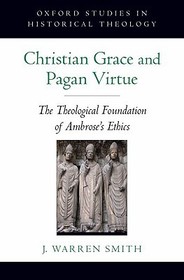
Christian Grace and Pagan Virtue
The Theological Foundation of Ambrose's Ethics
Sorozatcím: Oxford Studies in Historical Theology;
-
10% KEDVEZMÉNY?
- A kedvezmény csak az 'Értesítés a kedvenc témákról' hírlevelünk címzettjeinek rendeléseire érvényes.
- Kiadói listaár GBP 117.50
-
53 051 Ft (50 525 Ft + 5% áfa)
Az ár azért becsült, mert a rendelés pillanatában nem lehet pontosan tudni, hogy a beérkezéskor milyen lesz a forint árfolyama az adott termék eredeti devizájához képest. Ha a forint romlana, kissé többet, ha javulna, kissé kevesebbet kell majd fizetnie.
- Kedvezmény(ek) 10% (kb. 5 305 Ft)
- Kedvezményes ár 47 746 Ft (45 473 Ft + 5% áfa)
Iratkozzon fel most és részesüljön kedvezőbb árainkból!
Feliratkozom
53 051 Ft

Beszerezhetőség
Megrendelésre a kiadó utánnyomja a könyvet. Rendelhető, de a szokásosnál kicsit lassabban érkezik meg.
Why don't you give exact delivery time?
A beszerzés időigényét az eddigi tapasztalatokra alapozva adjuk meg. Azért becsült, mert a terméket külföldről hozzuk be, így a kiadó kiszolgálásának pillanatnyi gyorsaságától is függ. A megadottnál gyorsabb és lassabb szállítás is elképzelhető, de mindent megteszünk, hogy Ön a lehető leghamarabb jusson hozzá a termékhez.
A termék adatai:
- Kiadó OUP USA
- Megjelenés dátuma 2011. január 27.
- ISBN 9780195369939
- Kötéstípus Keménykötés
- Terjedelem344 oldal
- Méret 234x160x30 mm
- Súly 590 g
- Nyelv angol 0
Kategóriák
Rövid leírás:
Warren Smith examines the neglected biblical, liturgical and theological foundations of Ambrose's thought on ethics. Earlier studies have found little that was distinctively Christian in Ambrose's image of the virtuous person. Smith shows that, although like the pagans he emphasized moderation, courage, justice, and prudence, for Ambrose these characteristics were shaped by the church's beliefs about God's salvific economy.
TöbbHosszú leírás:
Ambrose of Milan (340-397) was the first Christian bishop to write a systematic account of Christian ethics, in the treatise De Officiis, variously translated as "on duties" or "on responsibilities." But Ambrose also dealt with the moral life in other works, notably his sermons on the patriarchs and his addresses to catechumens and newly baptized. There is a vast modern literature on Ambrose, but only in recent decades has he begun to be taken seriously as a thinker, not just as a working bishop and ecclesiastical politician. Because Ambrose was one of the few Latin Christian writers in antiquity who knew Greek, another major area of Ambrose scholarship has been the study of his sources, notably the Jewish philosopher Philo, and Christian writers such as Origen of Alexandria.
In this book, Warren Smith examines the neglected biblical, liturgical and theological foundations of Ambrose's thought on ethics. Earlier studies have found little that was distinctively Christian in Ambrose's image of the virtuous person. Smith shows that though, like the pagans, Ambrose emphasized moderation, courage, justice, and prudence, for him these characteristics were shaped by the church's beliefs about God's salvific economy. The courage of a Christian facing persecution, for example, was an expression of faith in Christ's resurrection and the church's eschatological hope. Eschatology, for Ambrose, was not pagan wisdom clothed in pious language, but the very logic upon which virtue rests.
Smith offers a well-researched and compelling study of Ambroses theology that moves through creation, the fall, baptismal restoration, and the conferral of new citizenship. In this volume the reader is treated to a synthetic and systematic account of Ambrose as a theologian and careful exegete of Scripture
Tartalomjegyzék:
Preface
Prolegomena: The Ritual Context for Ambrose's Soteriology
Part I - The Loss of Harmonic Unity: Ambrose's Account of the Fallen Human Condition
The Soul: Ambrose's True Self
Essential Unity of Soul and Body: Ambrose's Hylomorphic Theory
The Body of Death: The Legacy of the Fall
Part II - Raised to New Life: Ambrose's Theology of Baptism
Baptism: Sacrament of Justification
Resurrection and Regeneration
Baptismal Regeneration: Participation in the New Humanity
The Inner Man's New Desire
Epilogue
Bibliography

