

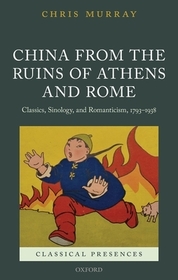
China from the Ruins of Athens and Rome
Classics, Sinology, and Romanticism, 1793-1938
Sorozatcím: Classical Presences;
-
10% KEDVEZMÉNY?
- A kedvezmény csak az 'Értesítés a kedvenc témákról' hírlevelünk címzettjeinek rendeléseire érvényes.
- Kiadói listaár GBP 93.00
-
44 430 Ft (42 315 Ft + 5% áfa)
Az ár azért becsült, mert a rendelés pillanatában nem lehet pontosan tudni, hogy a beérkezéskor milyen lesz a forint árfolyama az adott termék eredeti devizájához képest. Ha a forint romlana, kissé többet, ha javulna, kissé kevesebbet kell majd fizetnie.
- Kedvezmény(ek) 10% (cc. 4 443 Ft off)
- Kedvezményes ár 39 988 Ft (38 084 Ft + 5% áfa)
Iratkozzon fel most és részesüljön kedvezőbb árainkból!
Feliratkozom
44 430 Ft

Beszerezhetőség
Becsült beszerzési idő: A Prosperónál jelenleg nincsen raktáron, de a kiadónál igen. Beszerzés kb. 3-5 hét..
A Prosperónál jelenleg nincsen raktáron.
Why don't you give exact delivery time?
A beszerzés időigényét az eddigi tapasztalatokra alapozva adjuk meg. Azért becsült, mert a terméket külföldről hozzuk be, így a kiadó kiszolgálásának pillanatnyi gyorsaságától is függ. A megadottnál gyorsabb és lassabb szállítás is elképzelhető, de mindent megteszünk, hogy Ön a lehető leghamarabb jusson hozzá a termékhez.
A termék adatai:
- Kiadó OUP Oxford
- Megjelenés dátuma 2020. augusztus 13.
- ISBN 9780198767015
- Kötéstípus Keménykötés
- Terjedelem278 oldal
- Méret 148x23x22 mm
- Súly 22 g
- Nyelv angol 37
Kategóriák
Rövid leírás:
Fascinated and often baffled by China, Anglophone writers have turned to classics to provide interpretative paradigms and narrative shape to inform their understanding. This volume reveals key insights into British cosmopolitanism, which sought its bearings in the ancient past in encounters with Qing Dynasty China.
TöbbHosszú leírás:
Fascinated and often baffled by China, Anglophone writers turned to classics for answers. In poetry, essays, and travel narratives, ancient Greece and Rome lent interpretative paradigms and narrative shape to Britain's information on the Middle Kingdom. While memoirists of the diplomatic missions in 1793 and 1816 used classical ideas to introduce Chinese concepts, Roman history held ominous precedents for Sino-British relations according to Edward Gibbon and Samuel Taylor Coleridge. John Keats illuminated how peculiar such contemporary processes of Orientalist knowledge-formation were. In Britain, popular opinion on Chinese culture wavered during the nineteenth century, as Charles Lamb and Joanna Baillie demonstrated in ekphrastic responses to chinoiserie. A former reverence for China yielded gradually to hostility, and the classical inheritance informed a national identity-crisis over whether Britain's treatment of China was civilized or barbaric.
Amidst this uncertainty, the melancholy conclusion to Virgil's Aeneid became the master-text for discussion of British conduct at the Summer Palace in 1860. Yet if Rome was to be the model for the British Empire, Tennyson, Sara Coleridge, and Thomas de Quincey found closer analogues for the Opium Wars in Greek tragedy and Homeric epic. Meanwhile, Sinology advanced considerably during the Victorian age. Britain broadened its horizons by interrogating the cultural past anew as it turned to Asia; Anglophone readers were cosmopolitans in time as well as space, aggregating knowledge of Periclean Athens, imperial Rome, and many other polities in their encounters with Qing Dynasty China.
Rich and interesting ... this is not a work in classical reception, nor yet in the reception of China in Europe, but those interested in either field will read this book with profit and pleasure.
Tartalomjegyzék:
A Classical Cathay and a Real China
'Ancestral Voices Prophesying War': Samuel Taylor Coleridge, Edward Gibbon, and the Warnings of History
The White Snake, Apollonius of Tyana, and John Keats's Lamia
Charles Lamb, Roast Pork, and Willow Crockery
Better fifty years of Europe than a cycle of Cathay': British Progress, the Opium Trade, and Tennyson's Retrospection
A Greek Tragedy in China: Thomas de Quincey's Opium Wars Journalism
'From those flames no light': The Summer Palace in 1860 and Beyond
Coda: 'All things fall and are built again': Yeats's Daoist Optimism and the Fall of the Qing Empire
Appendix: Sara Coleridge, 'Tennyson's "Lotos-Eaters" with a New Conclusion'

