

-
10% KEDVEZMÉNY?
- A kedvezmény csak az 'Értesítés a kedvenc témákról' hírlevelünk címzettjeinek rendeléseire érvényes.
- Kiadói listaár GBP 89.00
-
40 183 Ft (38 270 Ft + 5% áfa)
Az ár azért becsült, mert a rendelés pillanatában nem lehet pontosan tudni, hogy a beérkezéskor milyen lesz a forint árfolyama az adott termék eredeti devizájához képest. Ha a forint romlana, kissé többet, ha javulna, kissé kevesebbet kell majd fizetnie.
- Kedvezmény(ek) 10% (cc. 4 018 Ft off)
- Kedvezményes ár 36 165 Ft (34 443 Ft + 5% áfa)
Iratkozzon fel most és részesüljön kedvezőbb árainkból!
Feliratkozom
40 183 Ft

Beszerezhetőség
Megrendelésre a kiadó utánnyomja a könyvet. Rendelhető, de a szokásosnál kicsit lassabban érkezik meg.
Why don't you give exact delivery time?
A beszerzés időigényét az eddigi tapasztalatokra alapozva adjuk meg. Azért becsült, mert a terméket külföldről hozzuk be, így a kiadó kiszolgálásának pillanatnyi gyorsaságától is függ. A megadottnál gyorsabb és lassabb szállítás is elképzelhető, de mindent megteszünk, hogy Ön a lehető leghamarabb jusson hozzá a termékhez.
A termék adatai:
- Kiadó OUP Oxford
- Megjelenés dátuma 2006. február 9.
- ISBN 9780199273287
- Kötéstípus Keménykötés
- Terjedelem300 oldal
- Méret 242x161x24 mm
- Súly 600 g
- Nyelv angol 0
Kategóriák
Rövid leírás:
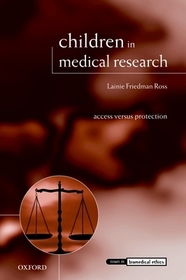
Lainie Ross presents a rigorous critical investigation of the development of policy governing the involvement of children in medical research. She examines the shift in focus from protection of medical research subjects, enshrined in post-World War II legislation, to the current era in which access is assuming greater precedence. Infamous studies such as Willowbrook (where mentally retarded children were infected with hepatitis) are evidence that before the policy shift protection was not always adequate, even for the most vulnerable groups. Additional safeguards for children were first implemented in many countries in the 1970s and 1980s; more recent policies and guidelines are trying to promote greater participation. Ross examines whether the safeguards work, whether they are fair, and how they apply in actual research practice, and she offers specific recommendations to modify current policies and guidelines.
TöbbHosszú leírás:
Lainie Ross presents a rigorous critical investigation of the development of policy governing the involvement of children in medical research. She examines the shift in focus from protection of medical research subjects, enshrined in post-World War II legislation, to the current era in which access is assuming greater precedence. Infamous studies such as Willowbrook (where mentally retarded children were infected with hepatitis) are evidence that before the policy shift protection was not always adequate, even for the most vulnerable groups. Additional safeguards for children were first implemented in many countries in the 1970s and 1980s; more recent policies and guidelines are trying to promote greater participation. Ross considers whether the safeguards work, whether they are fair, and how they apply in actual research practice. She goes on to offer specific recommendations to modify current policies and guidelines.
Ross examines the regulatory structures (e.g. federal regulations and institutional review boards), the ad hoc policies (e.g. payment in pediatric research and the role of schools as research venues), the actual practices of researchers (e.g. the race/ethnicity of enrolled research subjects or the decision to enroll newborns) as well as the decision-making process (both parental permission and the child's assent), in order to provide a broad critique. Some of her recommendations will break down current barriers to the enrolment of children (e.g. permitting the payment of child research subjects; allowing healthy children to be exposed to research that entails more than minimal risk without requiring recourse to 407 panels); whereas other recommendations may create new restrictions (e.g., the need for greater protection for research performed in schools; restrictions on what research should be done in the newborn nursery). The goal is to ensure that medical research is done in a way that promotes the health of current and future children without threatening, to use the words of Hans Jonas, 'the erosion of those moral values whose loss . . . would make its most dazzling triumphs not worth having'.
[A] very informative publication...The book presents an excellent overview over problems in paediatric research and the ethical and legal issues to be addressed.
Tartalomjegyzék:
I. Access versus Protection
From 1966 to 2005: Balancing Protection and Access in Pediatric Research
Access versus Protection: Minority Representation in Pediatric Research
II. Challenges to the Regulations
Overview of the Common Rule and Subpart D
Should We Provide Healthy Children with Greater Protection in Medical Research?
Informed Consent in Pediatric Research
Phase I Research and the Meaning of 'Prospect of Direct Benefit'
III. Strengths and Limits of Current Regulations
Human Subjects Protections in Published Pediatric Research
Payment in Pediatric Research
Research in Schools
IV. Case Studies
Minimizing Risks: Diabetes Research in Newborns
Diabetes Prediction and Prevention Research in Childhood
Lead Abatement Research
Clinical Asthma Trials
Research Not Otherwise Approvable: A Look at One Protocol
Evolution of the 407 Process
Epilogue

