

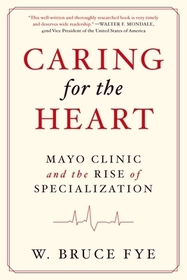
Caring for the Heart
Mayo Clinic and the Rise of Specialization
-
10% KEDVEZMÉNY?
- A kedvezmény csak az 'Értesítés a kedvenc témákról' hírlevelünk címzettjeinek rendeléseire érvényes.
- Kiadói listaár GBP 51.00
-
23 026 Ft (21 930 Ft + 5% áfa)
Az ár azért becsült, mert a rendelés pillanatában nem lehet pontosan tudni, hogy a beérkezéskor milyen lesz a forint árfolyama az adott termék eredeti devizájához képest. Ha a forint romlana, kissé többet, ha javulna, kissé kevesebbet kell majd fizetnie.
- Kedvezmény(ek) 10% (kb. 2 302 Ft)
- Kedvezményes ár 20 724 Ft (19 737 Ft + 5% áfa)
Iratkozzon fel most és részesüljön kedvezőbb árainkból!
Feliratkozom
23 026 Ft

Beszerezhetőség
Megrendelésre a kiadó utánnyomja a könyvet. Rendelhető, de a szokásosnál kicsit lassabban érkezik meg.
Why don't you give exact delivery time?
A beszerzés időigényét az eddigi tapasztalatokra alapozva adjuk meg. Azért becsült, mert a terméket külföldről hozzuk be, így a kiadó kiszolgálásának pillanatnyi gyorsaságától is függ. A megadottnál gyorsabb és lassabb szállítás is elképzelhető, de mindent megteszünk, hogy Ön a lehető leghamarabb jusson hozzá a termékhez.
A termék adatai:
- Kiadó OUP USA
- Megjelenés dátuma 2015. április 2.
- ISBN 9780199982356
- Kötéstípus Keménykötés
- Terjedelem704 oldal
- Méret 239x163x35 mm
- Súly 1089 g
- Nyelv angol 0
Kategóriák
Rövid leírás:
This groundbreaking book describes developments in the diagnosis and treatment of heart disease, explains how the Mayo Clinic became a world-famous medical center, and reveals how new technologies and procedures promoted medical specialization. It is written for general readers as well as health care professionals, historians, and policy analysts.
TöbbHosszú leírás:
This groundbreaking book weaves together three important themes. It describes major developments in the diagnosis and treatment of heart disease in the twentieth century, explains how the Mayo Clinic evolved from a family practice in Minnesota into one of the world's leading medical centers, and reveals how the invention of new technologies and procedures promoted specialization among physicians and surgeons.
Caring for the Heart is written for general readers as well as health care professionals, historians, and policy analysts. Unlike traditional institutional or disease-focused histories, this book places individuals and events in national and international contexts that emphasize the interplay of medical, scientific, technological, social, political, and economic forces that have resulted in contemporary heart care. Patient stories and media perspectives are included throughout to help general readers understand the medical and technological developments that are described.
The book is a synthetic study, but it is written so that readers may pick and choose the chapters of most interest to them. Another feature of the book is that readers may follow the stories without looking at the notes. Those who are interested in delving deeper into the main topics will find a wealth of carefully chosen references that offer greater detail and additional perspectives. The descriptions and interpretations that fill the book benefit from the fact that the author has been a practicing cardiologist and medical historian for almost four decades.
This is mainly a twentieth-century story, but it begins earlier--before physicians who were identified as cardiologists, a time when medical specialization was just emerging in America. The final chapter, which addresses present-day concerns about health care costs, counterbalances earlier ones that might be read as celebrations of new technologies.
This is now the definitive history of the Mayo Clinic, and a valuable resource for a wide range of historians.
Tartalomjegyzék:
List of Figures and Tables
Foreword by Rosemary A. Stevens
Preface (with Acknowledgements)
Introduction
Section One: Inventing the Mayo Clinic and Cardiology
Chapter 1 The Nineteenth-Century Origins of the Mayo Practice
Chapter 2 The Mayos' Invention of Multispecialty Group Practice
Chapter 3 The Development of an Academic Medical Center in Rochester
Chapter 4 Patient Care and Clinical Research in the 1920s
Chapter 5 The Electrocardiograph and the Birth of Cardiology
Chapter 6 Challenges and Changes during the Depression
Section Two: Developments in the Diagnosis and Treatment of Heart Disease
Chapter 7 President Roosevelt's Secret Hypertensive Heart Disease
Chapter 8 The Reinvention of the American Heart Association, and the Invention of Cardiac Catheterization
Chapter 9 Surgeons Begin Trying to Treat Heart Disease
Chapter 10 Pioneering Open-Heart Surgery at the University of Minnesota and the Mayo Clinic
Chapter 11 The Expansion of Open-Heart Surgery and Cardiac Catheterization
Chapter 12 Beyond Mid-Century: Two Decades of Growth and Change
Section Three: Technologies Transform Heart Care and Stimulate Subspecialization
Chapter 13 Creating Coronary Care Units and Empowering Nurses
Chapter 14 Coronary Angiography: The Cleveland Clinic Leads the Way
Chapter 15 Coronary Artery Bypass Surgery Stimulates the Growth of Angiography
Chapter 16 Transforming Cardiac Catheters into Treatment Tools
Chapter 17 Analyzing and Managing Abnormal Heart Rhythms
Chapter 18 Seeing the Heart: Echocardiography and Other Imaging Technologies
Chapter 19 Treating Heart Failure and Preventing Cardiovascular Disease
Chapter 20 Challenges and Opportunities around the New Millennium
Appendix Alphabetical List of the Subjects of Oral Histories
Notes
Index

