

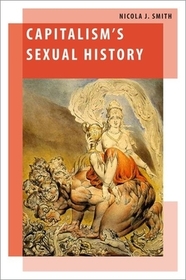
Capitalism's Sexual History
Sorozatcím: Oxford Studies in Gender and International Relations;
-
10% KEDVEZMÉNY?
- A kedvezmény csak az 'Értesítés a kedvenc témákról' hírlevelünk címzettjeinek rendeléseire érvényes.
- Kiadói listaár GBP 98.00
-
44 247 Ft (42 140 Ft + 5% áfa)
Az ár azért becsült, mert a rendelés pillanatában nem lehet pontosan tudni, hogy a beérkezéskor milyen lesz a forint árfolyama az adott termék eredeti devizájához képest. Ha a forint romlana, kissé többet, ha javulna, kissé kevesebbet kell majd fizetnie.
- Kedvezmény(ek) 10% (kb. 4 425 Ft)
- Kedvezményes ár 39 822 Ft (37 926 Ft + 5% áfa)
Iratkozzon fel most és részesüljön kedvezőbb árainkból!
Feliratkozom
44 247 Ft

Beszerezhetőség
Megrendelésre a kiadó utánnyomja a könyvet. Rendelhető, de a szokásosnál kicsit lassabban érkezik meg.
Why don't you give exact delivery time?
A beszerzés időigényét az eddigi tapasztalatokra alapozva adjuk meg. Azért becsült, mert a terméket külföldről hozzuk be, így a kiadó kiszolgálásának pillanatnyi gyorsaságától is függ. A megadottnál gyorsabb és lassabb szállítás is elképzelhető, de mindent megteszünk, hogy Ön a lehető leghamarabb jusson hozzá a termékhez.
A termék adatai:
- Kiadó OUP USA
- Megjelenés dátuma 2020. október 6.
- ISBN 9780197530276
- Kötéstípus Keménykötés
- Terjedelem202 oldal
- Méret 159x241x15 mm
- Súly 422 g
- Nyelv angol 27
Kategóriák
Rövid leírás:
Sexuality is often understood to be uniquely private and intimate--something that can and should be protected from capitalism's influence. This book argues, in contrast, that the histories of capitalism and sexuality are closely intertwined. Integral to this story has been the illusion that economic and sexual practices are tied to fundamentally different realms. Focusing on the history of sex work in Britain, the book shows that capitalism has long needed the construction of artificial boundaries around sex and work in order to extract profit from sexual labor, both paid and unpaid.
TöbbHosszú leírás:
As ongoing controversies over commercial sex attest, the relationship between capitalism and sexuality is deeply contentious. Economic and sexual practices are assumed to be not only separable but antithetical, hence why paid sex is so often criminalized and morally condemned. Yet, while sexuality is highly politicized in moral terms, it has largely been overlooked in the discipline devoted to the study of global capitalism, international political economy (IPE). Likewise, the prevailing field in sexuality studies, queer theory, has frequently sidelined questions of political economy. This book calls for critical scholarship to challenge the economy/sexuality dichotomy as it not only structures disciplinary debates but is part and parcel of capitalism itself.
Capitalism's Sexual History brings IPE and queer theory into close dialogue to explore how the division between economy and sexuality has been historically produced to appear both natural and moral. By examining sex work in Britain, Nicola J. Smith draws on in-depth archival research to chart a history of capitalism's sexual relations from medieval times to the present day. She shows how capitalist development was made possible by the appropriation of unpaid sexual labor that relied, in turn, on the repression and production of paid sex. By tracing the historical construction of boundaries around sex and work, this book exposes how capitalism has long profited from the notion that the sexual and economic spheres can and must be kept apart. In so doing, it offers a distinctive contribution to the study of sex and work as well as to wider scholarly, activist, and policy debates about political economy, reproductive labor, gender equality, and sexual justice.
Smith identifies a gap in scholarship on political economy: queer theory has not heretofore contributed to analysis of global political and economic relations. Smith offers her analysis as remediation, with fruitful results.
Tartalomjegyzék:
Acknowledgements
Introduction
1. Queer Political Economy
2. The Rise of a New Sexual Order
3. Sex, Work, and the Victorians
4. Buying Love in the Twentieth Century
5. Deviant Heterosexuality in Austere Times
Conclusion
Notes
Bibliography
Index

