

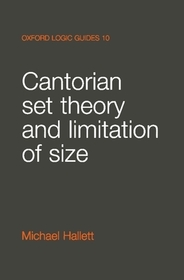
Cantorian Set Theory and Limitation of Size
Sorozatcím: Oxford Logic Guides; 10;
-
10% KEDVEZMÉNY?
- A kedvezmény csak az 'Értesítés a kedvenc témákról' hírlevelünk címzettjeinek rendeléseire érvényes.
- Kiadói listaár GBP 207.50
-
93 686 Ft (89 225 Ft + 5% áfa)
Az ár azért becsült, mert a rendelés pillanatában nem lehet pontosan tudni, hogy a beérkezéskor milyen lesz a forint árfolyama az adott termék eredeti devizájához képest. Ha a forint romlana, kissé többet, ha javulna, kissé kevesebbet kell majd fizetnie.
- Kedvezmény(ek) 10% (kb. 9 368 Ft)
- Kedvezményes ár 84 318 Ft (80 303 Ft + 5% áfa)
Iratkozzon fel most és részesüljön kedvezőbb árainkból!
Feliratkozom
93 686 Ft

Beszerezhetőség
Megrendelésre a kiadó utánnyomja a könyvet. Rendelhető, de a szokásosnál kicsit lassabban érkezik meg.
Why don't you give exact delivery time?
A beszerzés időigényét az eddigi tapasztalatokra alapozva adjuk meg. Azért becsült, mert a terméket külföldről hozzuk be, így a kiadó kiszolgálásának pillanatnyi gyorsaságától is függ. A megadottnál gyorsabb és lassabb szállítás is elképzelhető, de mindent megteszünk, hogy Ön a lehető leghamarabb jusson hozzá a termékhez.
A termék adatai:
- Kiadó OUP Oxford
- Megjelenés dátuma 1986. november 27.
- ISBN 9780198532835
- Kötéstípus Puhakötés
- Terjedelem368 oldal
- Méret 233x155x23 mm
- Súly 592 g
- Nyelv angol 0
Kategóriák
Rövid leírás:
This volume presents the philosophical and heuristic framework Cantor developed and explores its lasting effect on modern mathematics. "Establishes a new plateau for historical comprehension of Cantor's monumental contribution to mathematics." --The American Mathematical Monthly
TöbbHosszú leírás:
Cantor's ideas formed the basis for set theory and also for the mathematical treatment of the concept of infinity. The philosophical and heuristic framework he developed had a lasting effect on modern mathematics, and is the recurrent theme of this volume. Hallett explores Cantor's ideas and, in particular, their ramifications for Zermelo-Frankel set theory.
'...the first full-length study of Cantor that does justice both to the mathematical importance of his work and to the philosophical ideas which governed it...'

