

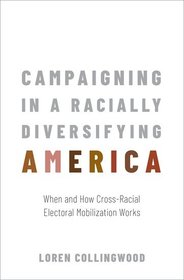
Campaigning in a Racially Diversifying America
When and How Cross-Racial Electoral Mobilization Works
-
10% KEDVEZMÉNY?
- A kedvezmény csak az 'Értesítés a kedvenc témákról' hírlevelünk címzettjeinek rendeléseire érvényes.
- Kiadói listaár GBP 72.00
-
32 508 Ft (30 960 Ft + 5% áfa)
Az ár azért becsült, mert a rendelés pillanatában nem lehet pontosan tudni, hogy a beérkezéskor milyen lesz a forint árfolyama az adott termék eredeti devizájához képest. Ha a forint romlana, kissé többet, ha javulna, kissé kevesebbet kell majd fizetnie.
- Kedvezmény(ek) 10% (kb. 3 251 Ft)
- Kedvezményes ár 29 257 Ft (27 864 Ft + 5% áfa)
Iratkozzon fel most és részesüljön kedvezőbb árainkból!
Feliratkozom
32 508 Ft

Beszerezhetőség
Becsült beszerzési idő: A Prosperónál jelenleg nincsen raktáron, de a kiadónál igen. Beszerzés kb. 3-5 hét..
A Prosperónál jelenleg nincsen raktáron.
Why don't you give exact delivery time?
A beszerzés időigényét az eddigi tapasztalatokra alapozva adjuk meg. Azért becsült, mert a terméket külföldről hozzuk be, így a kiadó kiszolgálásának pillanatnyi gyorsaságától is függ. A megadottnál gyorsabb és lassabb szállítás is elképzelhető, de mindent megteszünk, hogy Ön a lehető leghamarabb jusson hozzá a termékhez.
A termék adatai:
- Kiadó OUP USA
- Megjelenés dátuma 2020. március 10.
- ISBN 9780190073350
- Kötéstípus Keménykötés
- Terjedelem240 oldal
- Méret 155x239x27 mm
- Súly 454 g
- Nyelv angol 0
Kategóriák
Rövid leírás:
As the voting public continues to diversify across the United States, political candidates, and particularly white candidates, increasingly recognize the importance of making appeals to voters who do not look like themselves. As history has shown, this has been accomplished with varying degrees of success. In this book, Loren Collingwood develops a theory of Cross-Racial Electoral Mobilization (CRM) to explain why, when, and how candidates of one race or ethnicity act to mobilize voters of another race or ethnicity. The book looks at CRM trends and case studies over the past seventy years to gauge how politics in various places have changed as the American electorate has diversified.
TöbbHosszú leírás:
As the voting public continues to diversify across the United States, political candidates, and particularly white candidates, increasingly recognize the importance of making appeals to voters who do not look like themselves. As history has shown, this has been accomplished with varying degrees of success. During the 2016 election, for example, both Hillary Clinton and Bernie Sanders campaigned vociferously among Latino voters in Nevada's early primary, where nineteen percent of the Democratic caucus consisted of Latinos. Clinton released a campaign message to these voters stating that she was just like their abuela (or grandmother). The message, widely panned, came across as insincere, and Clinton, who otherwise performed well among Latinos nationally, lost by a wide margin to Sanders. On the other hand, in 2013, Bill de Blasio, campaigning for mayor of New York City, appeared with his black son in a commercial aimed against stop and frisk policies. His appeal came across as authentic, and he received a high level of support among black voters.
In Campaigning in a Racially Diversifying America, Loren Collingwood develops a theory of Cross-Racial Electoral Mobilization (CRM) to explain why, when, and how candidates of one race or ethnicity act to mobilize voters of another race or ethnicity. Specifically, Collingwood examines how and when white candidates mobilize Latino voters, and why some candidates are more succesful than others. He argues that candidates strategize by weighing the potential costs and benefits of conducting CRM based on the size of the minority electorate (the benefit) and the overall level of white racial hostility (the cost). Extensive cross-racial mobilization is most likely to occur when elections are competitive, institutional barriers to the vote are low, candidates have previously developed a welcoming racial reputation with target voters, whites' attitudes are racially liberal, and the Latino electorate is large and growing. Moreover, candidates who can demonstrate cultural competence and do so repeatedly are much more likely to be successful at making such appeals. The book looks at CRM trends and case studies over the past seventy years to gauge how politics in various places have changed as the American electorate has diversified. It draws on the author's research in over thirty archives in nine states, candidate and survey data, and experimental approaches to assess causality in voter responses to candidate behavior.
Loren Collingwood's book addresses a timely and important question of the strategies used by White candidates to appeal to the increasingly diverse electorate in the U.S. His theory of crossracial mobilization offers a nuanced approach to understanding the conditions under which this strategy can be successful in appealing to Latino voters. His research encourages future scholars to consider how future campaigns will evolve due to the nation's changing demographics.
Tartalomjegyzék:
Chapter 1: Introducing and Theorizing Cross-Racial Mobilization
Chapter 2: Early Evidence of Cross-Racial Mobilization: White Candidates and Black Voters in the U.S. South 1940-1970
Chapter 3: The Origins of Latino-Targeted Cross-Racial mobilization: The Case of Texas
Chapter 4: Contemporary Cross-Racial Mobilization: CRM in the 2010-2012 U.S. Senate Elections
Chapter 5: Why CandidatesWin: Assessing Latino Voter Response to Anglo Candidate Characteristics
Chapter 6: Cross-Racial Mobilization in Perspective
Appendix A: The Data Collected to Analyze Cross-Racial Mobilization
Notes
References
Index

