

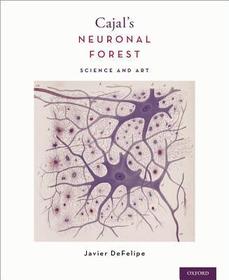
Cajal's Neuronal Forest
Science and Art
-
10% KEDVEZMÉNY?
- A kedvezmény csak az 'Értesítés a kedvenc témákról' hírlevelünk címzettjeinek rendeléseire érvényes.
- Kiadói listaár GBP 100.00
-
45 150 Ft (43 000 Ft + 5% áfa)
Az ár azért becsült, mert a rendelés pillanatában nem lehet pontosan tudni, hogy a beérkezéskor milyen lesz a forint árfolyama az adott termék eredeti devizájához képest. Ha a forint romlana, kissé többet, ha javulna, kissé kevesebbet kell majd fizetnie.
- Kedvezmény(ek) 10% (kb. 4 515 Ft)
- Kedvezményes ár 40 635 Ft (38 700 Ft + 5% áfa)
Iratkozzon fel most és részesüljön kedvezőbb árainkból!
Feliratkozom
45 150 Ft

Beszerezhetőség
Megrendelésre a kiadó utánnyomja a könyvet. Rendelhető, de a szokásosnál kicsit lassabban érkezik meg.
Why don't you give exact delivery time?
A beszerzés időigényét az eddigi tapasztalatokra alapozva adjuk meg. Azért becsült, mert a terméket külföldről hozzuk be, így a kiadó kiszolgálásának pillanatnyi gyorsaságától is függ. A megadottnál gyorsabb és lassabb szállítás is elképzelhető, de mindent megteszünk, hogy Ön a lehető leghamarabb jusson hozzá a termékhez.
A termék adatai:
- Kiadó OUP USA
- Megjelenés dátuma 2017. december 21.
- ISBN 9780190842833
- Kötéstípus Keménykötés
- Terjedelem512 oldal
- Méret 282x229x30 mm
- Súly 2059 g
- Nyelv angol 0
Kategóriák
Rövid leírás:
Cajal's Neuronal Forest: Science and Art continues the tradition set forth by its sister volume Cajal's Butterflies of the Soul (OUP, 2009). This new collection contains hundreds of beautiful rarely-seen-before figures produced throughout the nineteenth century and the beginning of the twentieth century by famed father-of-modern-neuroscience Santiago Ramón y Cajal (1852-1934) and his contemporaries. Cajal was captivated by the beautiful shapes of the cells of the nervous system. He and his fellow scientists saw neurons as trees and glial cells as bushes. Given their high density and arrangement, neurons and glial resembled a thick forest, a seemingly impenetrable terrain of interacting cells mediating cognition and behavior. In unraveling the mysteries of the brain, these researchers encountered an almost infinite number of cellular forms with an extraordinary beauty, which they could not help but put pen to paper, allowing them to discover a new artistic world- the neuronal forest- that gave free rein not only to their imagination, but to a new way of viewing the brain as well.
TöbbHosszú leírás:
Cajal's Neuronal Forest: Science and Art continues the tradition set forth by its sister volume Cajal's Butterflies of the Soul (OUP, 2009). This new collection contains hundreds of beautiful rarely-seen-before figures produced throughout the nineteenth century and the beginning of the twentieth century by famed father-of-modern-neuroscience Santiago Ramón y Cajal (1852-1934) and his contemporaries. Cajal was captivated by the beautiful shapes of the cells of the nervous system. He and his fellow scientists saw neurons as trees and glial cells as bushes. Given their high density and arrangement, neurons and glial resembled a thick forest, a seemingly impenetrable terrain of interacting cells mediating cognition and behavior. In unraveling the mysteries of the brain, these researchers encountered an almost infinite number of cellular forms with an extraordinary beauty, which they could not help but put pen to paper, allowing them to discover a new artistic world- the neuronal forest- that gave free rein not only to their imagination, but to a new way of viewing the brain as well.
This book has been divided into two parts. The first focuses on the scientific atmosphere in Cajal's times, on the history of the neuron, and the anatomical challenge posed in studying neuronal connections. It also delves into the artistic skills of Cajal and other important pioneers in neuroscience and how the neuronal forests have served as an unlimited source of artistic inspiration. The second consists of 275 original drawings by Cajal. All were published over the course of his scientific career and cover virtually all of his research fields of interest, including the spinal cord, the optic lobe and retina, cerebral cortex, and many other regions of the brain.
Cajal's Neuronal Forest: Science and Art is a testament to the natural beauty found in science. Despite the common misconception that the drawings of Cajal and other scientists of the time are pieces of art, these drawings are in fact copies of histological preparations and contributed greatly to the discoveries made in the field of neuroscience. This book is a gem in any library, whether serving as a medical history or a gallery of stunning sketches.
This beautiful book would grace any coffee table, and grace a neurologists coffee table most of all. Its illustrations are truly captivating, and the reproductions of Ramon y Cajals work can be appreciated all the more because they are presented alongside many other historic drawings, as well as photographs and artworks.
Tartalomjegyzék:
Table of Contents
Foreword Ramon Areces Foundation
Foreword Spanish Foundation to Science and Technology
Foreword Tatiana Perez De Guzman El Bueno Foundation
Foreword by Pasko Rakic
Preface
Part I: Introduction
Introductory Remarks
A Note on Microphotography and Illustrations of Histological Preparations
The Anatomical Challenge of the Study of Neuronal Connections
Section A: The Scientific Atmosphere in Cajal's Times
The Discovery of the Reazione Nera: Commencing the Detailed Study of the Structure of the Nervous System
The Discovery of the Golgi Method by Cajal and the Influence of Maestre De San Juan and Simarro
Drawing as a Tool to Illustrate Microscopic Images
Differences in the Interpretation of the Microscopic World
Neuron Doctrine versus the Reticular Theory
The Reticular Theory and Precursors of the Neuron Theory
Golgi, Cajal and the Nobel Prize Lectures in 1906
The Law of Dynamic Polarization of Nerve Cells
Introduction of the Term “Neuron” and the Renascence of Reticularism
Confirmation of the Free Ending of the Nervous Processes: The Discovery
of the Synaptic Cleft
Neoreticularism and the Neuron Doctrine in the Present Day
Dendritic Spines: True Anatomical Structures versus Artifact
Dendritic Spines and the Methylene Blue Method
Other Interpretations of the Dendritic Spines
Dendritic Spines and Cajal's 'Final Lesson'
Confirmation that Dendritic Spines are Postsynaptic Structures
Combination of the Golgi Method and Electron Microscopy
Dendritic Spines: Their Features and Role as a Key Component in Microcircuits
Section B: The Golden Era for Artistic Creativity in Neuroscience
Artistic Skills and Emotions of Cajal and Other Early Neuroanatomists
Verification of the Drawings of Cajal and Other Scientists
The Neuronal Forest as a Source of Artistic Inspiration
Summary, Final Considerations and Concluding Remarks
Notes
Bibliography
Part II: Gallery of Cajal's Drawings
Section A: Spinal Cord
Section B: Medulla Oblongata
Section C: Cerebellum and Deep Cerebellar Nuclei
Section D: Midbrain and Thalamus
Section E: Optic Lobe of Lower Vertebrates
Section F: Retina of Vertebrates
Section G: Cerebral Cortex and Olfactory Apparatus
Section H: Degeneration and Regeneration of the Nervous System
Section I: Retina and Optic Centers of Cephalopods
Section J: Insect Brain: Visual System
Section K: Supplementary Figures
Author Index

