

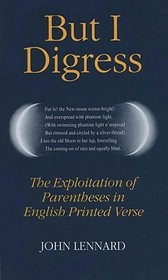
But I Digress
The Exploitation of Parentheses in English Printed Verse
-
10% KEDVEZMÉNY?
- A kedvezmény csak az 'Értesítés a kedvenc témákról' hírlevelünk címzettjeinek rendeléseire érvényes.
- Kiadói listaár GBP 227.50
-
102 716 Ft (97 825 Ft + 5% áfa)
Az ár azért becsült, mert a rendelés pillanatában nem lehet pontosan tudni, hogy a beérkezéskor milyen lesz a forint árfolyama az adott termék eredeti devizájához képest. Ha a forint romlana, kissé többet, ha javulna, kissé kevesebbet kell majd fizetnie.
- Kedvezmény(ek) 10% (cc. 10 272 Ft off)
- Kedvezményes ár 92 445 Ft (88 043 Ft + 5% áfa)
Iratkozzon fel most és részesüljön kedvezőbb árainkból!
Feliratkozom
102 716 Ft

Beszerezhetőség
Megrendelésre a kiadó utánnyomja a könyvet. Rendelhető, de a szokásosnál kicsit lassabban érkezik meg.
Why don't you give exact delivery time?
A beszerzés időigényét az eddigi tapasztalatokra alapozva adjuk meg. Azért becsült, mert a terméket külföldről hozzuk be, így a kiadó kiszolgálásának pillanatnyi gyorsaságától is függ. A megadottnál gyorsabb és lassabb szállítás is elképzelhető, de mindent megteszünk, hogy Ön a lehető leghamarabb jusson hozzá a termékhez.
A termék adatai:
- Kiadó Clarendon Press
- Megjelenés dátuma 1991. november 21.
- ISBN 9780198112471
- Kötéstípus Keménykötés
- Terjedelem340 oldal
- Méret 241x161x24 mm
- Súly 714 g
- Nyelv angol
- Illusztrációk 9 illustrations of manuscripts and typography, 1 figure, 1 table 0
Kategóriák
Rövid leírás:
Dr Johnson and whole hosts of grammarians disapproved of parentheses, but for countless poets they have been essential to their work. John Lennard provides a history of the poetic use of lunulae (the marks of parentheses) from their first appearance in England in 1494 to the present day, and shows how in each period the patterns of literary use have reflected technological, philosophical, and political developments.
TöbbHosszú leírás:
Dr Johnson disapproved of parentheses and wouldn't use them; and for three centuries grammarians have argued that they are subordinate, additional, unnecessary, irrelevant, and damaging to the clarity of argument. But for Marlowe, Marvell, Swift, Coleridge, Byron, Browning, Eliot, Geoffrey Hill, and Derek Walcott (to name only poets) parentheses have been emphatic, original, necessary, relevant, and essential to the clarity of argument. They also intensify satire. Dr Lennard offers both a new history of the poetic use of lunulae (the marks of parenthesis) from their first appearance in England in 1494 to the present day, and detailed case-studies of individual poets who exploited lunulae. In combination the historical development of use and the individual's practice in a given period reveal the impact on literary composition of technological, philosophical, and political pressures, and the importance for the reader of regarding punctuation as a resource.
`subtle and wide-ranging investigation of the parenthesis in English poetry ... The excellences of Lennard's study are too many and, in many cases, too delicate to be easily stated. In its combination of the interpretive and historical study of punctuation, it may prove to be one of those rare books actually to invent, rather than merely to further, a field of study ... such a rich and rare one that the verve of his readings occasionally outstrips their self-evident cogency.'
Durham University Journal

