

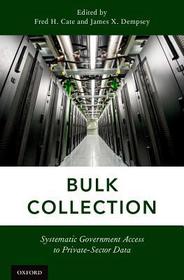
Bulk Collection
Systematic Government Access to Private-Sector Data
-
10% KEDVEZMÉNY?
- A kedvezmény csak az 'Értesítés a kedvenc témákról' hírlevelünk címzettjeinek rendeléseire érvényes.
- Kiadói listaár GBP 110.00
-
49 665 Ft (47 300 Ft + 5% áfa)
Az ár azért becsült, mert a rendelés pillanatában nem lehet pontosan tudni, hogy a beérkezéskor milyen lesz a forint árfolyama az adott termék eredeti devizájához képest. Ha a forint romlana, kissé többet, ha javulna, kissé kevesebbet kell majd fizetnie.
- Kedvezmény(ek) 10% (kb. 4 967 Ft)
- Kedvezményes ár 44 699 Ft (42 570 Ft + 5% áfa)
Iratkozzon fel most és részesüljön kedvezőbb árainkból!
Feliratkozom
49 665 Ft

Beszerezhetőség
Becsült beszerzési idő: A Prosperónál jelenleg nincsen raktáron, de a kiadónál igen. Beszerzés kb. 3-5 hét..
A Prosperónál jelenleg nincsen raktáron.
Why don't you give exact delivery time?
A beszerzés időigényét az eddigi tapasztalatokra alapozva adjuk meg. Azért becsült, mert a terméket külföldről hozzuk be, így a kiadó kiszolgálásának pillanatnyi gyorsaságától is függ. A megadottnál gyorsabb és lassabb szállítás is elképzelhető, de mindent megteszünk, hogy Ön a lehető leghamarabb jusson hozzá a termékhez.
A termék adatai:
- Kiadó OUP USA
- Megjelenés dátuma 2017. november 2.
- ISBN 9780190685515
- Kötéstípus Keménykötés
- Terjedelem504 oldal
- Méret 236x152x33 mm
- Súly 885 g
- Nyelv angol 0
Kategóriák
Rövid leírás:
This book is the culmination of a nearly six-year project to examine the systematic government access of private information from companies and other private-sector organizations. It provides twelve updated country reports to present both descriptive and normative frameworks for analyzing national surveillance laws, and to focus on international law, human rights law, and oversight mechanisms. It also explores the concept of accountability and the role of encryption in shaping the surveillance debate. Cate and Dempsey conclude the book by offering recommendations for both government and industry.
TöbbHosszú leírás:
This is an open access title available under the terms of a CC BY-NC-ND 4.0 International licence. It is free to read at Oxford Scholarship Online and offered as a free PDF download from OUP and selected open access locations. This book is the culmination of nearly six years of research initiated by Fred Cate and Jim Dempsey to examine national practices and laws regarding systematic government access to personal information held by private-sector companies. Leading an effort sponsored by The Privacy Projects, they commissioned a series of country reports, asking national experts to uncover what they could about government demands on telecommunications providers and other private-sector companies to disclose bulk information about their customers. Their initial research found disturbing indications of systematic access in countries around the world. These data collection programs, often undertaken in the name of national security, were cloaked in secrecy and largely immune from oversight, posing serious threats to personal privacy. After the Snowden leaks confirmed these initial findings, the project morphed into something more ambitious: an effort to explore what should be the rules for government access to private-sector data, and how companies should respond to government demands for access. initiated by Fred Cate and James Dempsey to examine the This book contains twelve updated country reports plus eleven analytic chapters that present descriptive and normative frameworks for assessing national surveillance laws, survey evolving international law and human rights principles applicable to government surveillance, and describe oversight mechanisms. It also explores the concept of accountability and the role of encryption in shaping the surveillance debate. Cate and Dempsey conclude by offering recommendations for both governments and industry.
Jim Dempsey and Fred Cate have compiled both a remarkable survey of surveillance practices around the world and a pragmatic framework of accountability and oversight principles that can protect human rights while defending national security.
Tartalomjegyzék:
List of Contributors
Acknowledgments
Glossary of Acronyms and Abbreviations
Introduction and Background
Fred H. Cate and James X. Dempsey
Part I: Country Reports
Overview
1. Systematic Government Access to Private-Sector Data: a Comparative Analysis
Ira S. Rubinstein, Gregory T. Nojeim and Ronald D. Lee
Europe and the Middle East
2. Systematic Government Access to Private-Sector Data in France
Winston Maxwell
3. Systematic Government Access to Private-Sector Data in Germany
Paul M. Schwartz
4. Systematic Government Access to Private Sector Data in Israel
Omer Tene
5. Systematic Government Access to Private-Sector Data in Italy
Giorgio Resta
The Americas
6. Systematic Government Access to Private-Sector Data in Brazil
Bruno Magrani
7. Systematic Government Access to Private-Sector Data in Canada
Jane Bailey and Sara Shayan
8. Systematic Government Access to Private-Sector Data in the United States I
Stephanie Pell
9. Systematic Government Access to Private-Sector Data in the United States II: The US Supreme Court and Information Privacy
Fred H. Cate and Beth E. Cate
Asia and the Pacific
10. Systematic Government Access to Private-Sector Data in Australia
Dan Jerker B. Svantesson
11. Systematic Government Access to Private-Sector Data in China
Zhizheng Wang
12. Systematic Government Access to Private-Sector Data in India
Sunil Abraham
13. Systematic Government Access to Private-Sector Data in Japan
Motohiro Tsuchiya
14. Systematic Government Access to Private-Sector Data in the Republic of Korea
Sang Jo Jong
Part II: Governance and Oversight
15. Chapter 5: Organisational Accountability, Government Use of Private Sector Data, National Security, and Individual Privacy
James X. Dempsey, Fred H. Cate, and Martin Abrams
16. Chapter 6: Surveillance and Privacy Protection in Latin America: Examples, Principles, and Suggestions
Eduardo Bertoni and Collin Kurre
17. Trust But Verify: The Importance of Oversight and Transparency in the Pursuit of Public Safety and National Security
Scott Charney
18. Regulating Foreign Surveillance through International Law
Ashley Deeks
19. Preventing the Police State: International Human Rights Laws Concerning Systematic Government Access to Communications Held or Transmitted by the Private Sector
Sarah St. Vincent
20. Standards for Independent Oversight: the European Perspective
Nico van Eijk
21. Stakeholders in Reform of the Global System for Mutual Legal Assistance [New 5550 words]
Peter Swire
Justin Hemmings
22. From Real-Time Intercepts to Stored Records: Why Encryption Drives the Government to Seek Access to the Cloud
Peter Swire
Part III: Conclusion
23. Recommendations for Government and Industry
James X. Dempsey and Fred H. Cate
Part IV: Appendices
Participants, Washington, April 3, 2012
Participants, London, June 3, 2013
Participants, Brussels, November 12, 2013
Participants, Montreal, May 9, 2014
Participants, London, May 30, 2014
Participants, London, March 1-2, 2016
Index

