

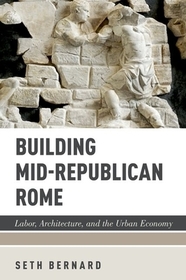
Building Mid-Republican Rome
Labor, Architecture, and the Urban Economy
-
10% KEDVEZMÉNY?
- A kedvezmény csak az 'Értesítés a kedvenc témákról' hírlevelünk címzettjeinek rendeléseire érvényes.
- Kiadói listaár GBP 29.99
-
14 327 Ft (13 645 Ft + 5% áfa)
Az ár azért becsült, mert a rendelés pillanatában nem lehet pontosan tudni, hogy a beérkezéskor milyen lesz a forint árfolyama az adott termék eredeti devizájához képest. Ha a forint romlana, kissé többet, ha javulna, kissé kevesebbet kell majd fizetnie.
- Kedvezmény(ek) 10% (cc. 1 433 Ft off)
- Kedvezményes ár 12 895 Ft (12 281 Ft + 5% áfa)
Iratkozzon fel most és részesüljön kedvezőbb árainkból!
Feliratkozom
14 327 Ft

Beszerezhetőség
Megrendelésre a kiadó utánnyomja a könyvet. Rendelhető, de a szokásosnál kicsit lassabban érkezik meg.
Why don't you give exact delivery time?
A beszerzés időigényét az eddigi tapasztalatokra alapozva adjuk meg. Azért becsült, mert a terméket külföldről hozzuk be, így a kiadó kiszolgálásának pillanatnyi gyorsaságától is függ. A megadottnál gyorsabb és lassabb szállítás is elképzelhető, de mindent megteszünk, hogy Ön a lehető leghamarabb jusson hozzá a termékhez.
A termék adatai:
- Kiadó OUP USA
- Megjelenés dátuma 2021. október 12.
- ISBN 9780197608265
- Kötéstípus Puhakötés
- Terjedelem336 oldal
- Méret 159x238x20 mm
- Súly 490 g
- Nyelv angol
- Illusztrációk 36 illustrations 153
Kategóriák
Rövid leírás:
Building Mid-Republican Rome provides the first interdisciplinary account of a seminal phase of Rome's history, when the early stages of imperial conquest radically transformed the city's physical appearance along with its socioeconomic institutions.
TöbbHosszú leírás:
Building Mid-Republican Rome offers a holistic treatment of the development of the Mid-Republican city from 396 to 168 BCE. As Romans established imperial control over Italy and beyond, the city itself radically transformed from an ambitious central Italian settlement into the capital of the Mediterranean world. Seth Bernard describes this transformation in terms of both new urban architecture, much of it unprecedented in form and extent, and new socioeconomic structures, including slavery, coinage, and market-exchange. These physical and historical developments were closely linked: building the Republican city was expensive, and meeting such costs had significant implications for urban society. Building Mid-Republican Rome brings both architectural and socioeconomic developments into a single account of urban change. Bernard, a specialist in the period's history and archaeology, assembles a wide array of evidence, from literary sources to coins, epigraphy, and especially archaeological remains, revealing the period's importance for the decline of the Roman state's reliance on obligation and dependency and the rise of slavery and an urban labor market. This narrative is told through an investigation of the evolving institutional frameworks shaping the organization of public construction. A quantitative model of the costs of the Republican city walls reconstructs their economic impact. A new account of building technology in the period allows for a better understanding of the social and demographic profile of the city's builders. Building Mid-Republican Rome thus provides an innovative synthesis of a major Western city's spatial and historical aspects, shedding much-needed light on a seminal period in Rome's development.
Bernard's study offers a cogent argument for the reappraisal of the period prior to the Second Punic War, weaving disparate developments together into a coherent narrative to reopen the debate on the changing social makeup and economic mentalities operating in the Early and Mid-Republican city. He presents an original model for reconstructing the formative process of economic institutions commonly associated with Rome's later history.... His expert use of buildings and construction processes as historical sources in their own right opens the way for a more nuanced exploration of Republican urbanism in Italy and will prompt further quantitative research on the demographic and economic effects of urban development in higher-order settlements. Already a classic, the book is its own building block for future work.
Tartalomjegyzék:
Chapter 1: Introduction: Building as historical process
Chapter 2: Materials and supply
Chapter 3: Rome from the Sack of Veii to the Gallic Sack
Chapter 4: A cost analysis of the Republican circuit walls
Chapter 5: The nobilitas and economic innovation: censors, coinage, and contracts
Chapter 6: The labor supply of Mid-Republican Rome
Chapter 7: Technological change in Roman stonemasonry before concrete
Chapter 8: Conclusion
Appendix 1: Cost analysis of ashlar masonry in volcanic tuff
Appendix 2: Catalog of public building projects, 396 - 168 BCE
Bibliography and Abbreviations

