

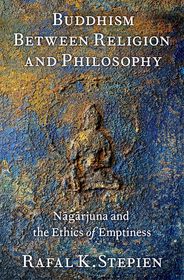
Buddhism Between Religion and Philosophy
Nāgārjuna and the Ethics of Emptiness
-
10% KEDVEZMÉNY?
- A kedvezmény csak az 'Értesítés a kedvenc témákról' hírlevelünk címzettjeinek rendeléseire érvényes.
- Kiadói listaár GBP 78.00
-
35 217 Ft (33 540 Ft + 5% áfa)
Az ár azért becsült, mert a rendelés pillanatában nem lehet pontosan tudni, hogy a beérkezéskor milyen lesz a forint árfolyama az adott termék eredeti devizájához képest. Ha a forint romlana, kissé többet, ha javulna, kissé kevesebbet kell majd fizetnie.
- Kedvezmény(ek) 10% (cc. 3 522 Ft off)
- Kedvezményes ár 31 695 Ft (30 186 Ft + 5% áfa)
Iratkozzon fel most és részesüljön kedvezőbb árainkból!
Feliratkozom
35 217 Ft

Beszerezhetőség
Megrendelésre a kiadó utánnyomja a könyvet. Rendelhető, de a szokásosnál kicsit lassabban érkezik meg.
Why don't you give exact delivery time?
A beszerzés időigényét az eddigi tapasztalatokra alapozva adjuk meg. Azért becsült, mert a terméket külföldről hozzuk be, így a kiadó kiszolgálásának pillanatnyi gyorsaságától is függ. A megadottnál gyorsabb és lassabb szállítás is elképzelhető, de mindent megteszünk, hogy Ön a lehető leghamarabb jusson hozzá a termékhez.
A termék adatai:
- Kiadó OUP USA
- Megjelenés dátuma 2024. augusztus 29.
- ISBN 9780197771303
- Kötéstípus Keménykötés
- Terjedelem416 oldal
- Méret 231x130x38 mm
- Súly 862 g
- Nyelv angol 533
Kategóriák
Rövid leírás:
Nāgārjuna is the most influential of all Buddhist thinkers following the Buddha himself. Throughout his works, Nāgārjuna calls on us to completely abandon all our views. But how could anyone possibly do that? This book shows not only how Nāgārjuna's truly radical teaching of “abelief” makes perfect sense within his Buddhist philosophy, but how it stands at the summit of his religious mission to care for all living beings. Rather than treating any one aspect of Nāgārjuna's ideas in isolation, here he emerges as forging a single system of thought and practice, one that challenges the very ways in which we think about religion and philosophy.
TöbbHosszú leírás:
Nāgārjuna (c. 150-250), founder of the Madhyamaka or Middle Way school of Buddhist philosophy and the most influential of all Buddhist thinkers aside from the Buddha himself, concludes his masterpiece, Fundamental Verses on the Middle Way, with these baffling verses:
For the abandonment of all views
He taught the true teaching
By means of compassion
I salute him, Gautama
But how could anyone possibly abandon all views? In Buddhism between Religion and Philosophy, Rafal K. Stepien shows not only how Nāgārjuna's radical teaching of no-view or “abelief” makes sense within his Buddhist philosophy, but also how it stands at the summit of his religious mission to care for all living beings. Rather than treating any one aspect of Nāgārjuna's ideas in isolation, here his metaphysics, epistemology, and ethics emerge as a single coherent and convincing philosophical-religious system of thought and practice.
Grounded in meticulous study of original texts from classical India and China but innovating on the theories and methods underpinning contemporary scholarship East and West, this study shows how profoundly important voices from the diverse religious and philosophical traditions of the world have until now been diminished, distorted, and silenced. In opening up truly global horizons of existing and co-existing in the world, this work challenges the very ways in which we think about religion and philosophy.
Stepien presents a detailed, clearly argued critique of much of the contemporary Western intellectual engagement with Nāgārjuna and describes how Nāgārjuna's Madhyamaka can be understood as the source of an approach that is simultaneously religious, philosophical, and ethical in nature. Scholars working on the historical, religious, and philosophical aspects of Nāgārjuna's works have much to gain from engaging closely with Stepien's arguments.
Tartalomjegyzék:
Acknowledgments
Introduction: Emptiness Between the Lines: Reading Buddhist Philosophy of/and/as Religion
0.0. The Dream is Over
0.1. Nāgārjuna and the Ethics of Emptiness
0.2. Believing Between the Lines
0.3. Buddhism Between Religion and Philosophy
0.4. Contexts and Texts
Chapter 1: Orienting Reason: A Religious Critique of Philosophizing Nāgārjuna
1.1. The Unimaginative Question
1.2. Unveiling the East
1.3. Orientalizing Reasons
1.4. Reimagining Religion and Philosophy
Chapter 2: Logical, Buddhological, Buddhist: A Critical Study of the Tetralemma
2.1. Matters & Methods
2.2. The Logical Tetralemma
2.3. The Buddhological Tetralemma
2.4. The Buddhist Tetralemma
Chapter 3: Nāgārjuna's Tetralemma: Tetrāletheia & Tathāgata, Utterance & Anontology
3.1 The Dilemma of the Tetralemma
3.2 The Exhaustive Tetralemma
3.3 Tetralemma as Tetrāletheia
3.4 Tetrāletheia as Tathāgata
3.5 Utterance and Anontology
3.6 Tetralemma and No-Teaching
3.7 Silencing Nothing
Chapter 4: Abandoning All Views: A Buddhist Critique of Belief
4.1. Views on Abandoning Views
4.2. Nāgārjuna's Abandoning Views
4.3. Abandoning Nāgārjuna's Views
Chapter 5: All-Embracing Emptiness: Nāgārjuna and the Ethics of Emptiness
5.1. The Abandonment of Ethics?
5.2. The Ethics of Abandonment
5.3. From Ethics to Eirenics
5.4. Abandoning All, Embracing All
Bibliography
Index

