

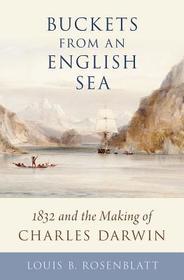
Buckets from an English Sea
1832 and the Making of Charles Darwin
-
10% KEDVEZMÉNY?
- A kedvezmény csak az 'Értesítés a kedvenc témákról' hírlevelünk címzettjeinek rendeléseire érvényes.
- Kiadói listaár GBP 39.49
-
18 866 Ft (17 967 Ft + 5% áfa)
Az ár azért becsült, mert a rendelés pillanatában nem lehet pontosan tudni, hogy a beérkezéskor milyen lesz a forint árfolyama az adott termék eredeti devizájához képest. Ha a forint romlana, kissé többet, ha javulna, kissé kevesebbet kell majd fizetnie.
- Kedvezmény(ek) 10% (cc. 1 887 Ft off)
- Kedvezményes ár 16 979 Ft (16 170 Ft + 5% áfa)
Iratkozzon fel most és részesüljön kedvezőbb árainkból!
Feliratkozom
18 866 Ft

Beszerezhetőség
Megrendelésre a kiadó utánnyomja a könyvet. Rendelhető, de a szokásosnál kicsit lassabban érkezik meg.
Why don't you give exact delivery time?
A beszerzés időigényét az eddigi tapasztalatokra alapozva adjuk meg. Azért becsült, mert a terméket külföldről hozzuk be, így a kiadó kiszolgálásának pillanatnyi gyorsaságától is függ. A megadottnál gyorsabb és lassabb szállítás is elképzelhető, de mindent megteszünk, hogy Ön a lehető leghamarabb jusson hozzá a termékhez.
A termék adatai:
- Kiadó OUP USA
- Megjelenés dátuma 2018. március 1.
- ISBN 9780190654405
- Kötéstípus Keménykötés
- Terjedelem216 oldal
- Méret 239x157x22 mm
- Súly 386 g
- Nyelv angol
- Illusztrációk 7 0
Kategóriák
Rövid leírás:
Buckets from an English Sea offers a new view of what inspired Darwin and provoked his work. Stunning events early in the voyage of the Beagle challenged his deeply held conviction that people are innately good. This study of 1832 highlights the resources available to the young Darwin as he worked to secure humanity's innate goodness, most especially matters of historical criticism.
TöbbHosszú leírás:
Darwin did not discover evolution. He didn't trip over it on the way to somewhere else the way Columbus discovered the New World. Like the atom, planetary orbits, and so many other scientific constructs, evolution was invented in order to explain striking phenomena. And it has been most successful. A century and a half has not simply confirmed Darwin's work, it has linked evolution to the mechanisms of life on the molecular scale. It is what life does. Where Darwin had drawn his theories from forest and field, we now set them in the coiling and uncoiling of twists of DNA, linking where they might, with a host of molecular bits and pieces scurrying about.
Darwin, himself, however, has been a closed story. A century and a half of study of the man and his work, including close readings of his books, his notebooks and letters, and even the books he read, has led to a working appreciation of his genius. The 'success' of this account has, however, kept us from seeing several important issues: most notably, why did he pursue evolution in the first place?
Buckets from an English Sea offers a new view of what inspired Darwin and provoked his work. Stunning events early in the voyage of the Beagle challenged his deeply held conviction that people are innately good. This study of 1832 highlights the resources available to the young Darwin as he worked to secure humanity's innate goodness.
This is not, by any stretch, an ordinary book about Darwin... even seasoned veterans of the Darwin literature will likely find many drops from these buckets to be unexpected and novel, and the story that Rosenblatt weaves from them is a pleasurable read, sure to increase one's appreciation for Darwin and his cultural milieu.
Tartalomjegyzék:
Contents
Acknowledgments
1. A Word on Beginnings and Ends:
Buckets from an English Sea
2. Prelude: Outrageous to Morality, Pernicious to Government:
Parliamentary Reform -When change is Visible
3. Prelude: A Meeting at the Athenaeum:
Thirlwall -History as Conceptual Device
4. Prelude: A Banker's Son and a Philosophic Radical:
Grote and the March of Mind
5. Prelude: The Victorian Idea of Science:
Adam Sedgwick -The Idea within Systems
6. Prelude: The Child is Father to the Man:
Charles Lyell-By Reference to Causes Now in Operation
7. Prelude: Is the Map any good?
Bentham, Coleridge and Shadows Cast
8. Prelude: In the Wild
Charles Darwin and Bergeret's Lemma
9. And so...
Appendix: Our Bucket List
Bibliography
Index

