

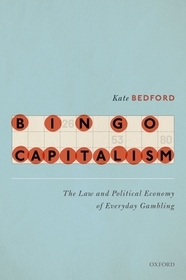
Bingo Capitalism
The Law and Political Economy of Everyday Gambling
-
10% KEDVEZMÉNY?
- A kedvezmény csak az 'Értesítés a kedvenc témákról' hírlevelünk címzettjeinek rendeléseire érvényes.
- Kiadói listaár GBP 127.50
-
57 566 Ft (54 825 Ft + 5% áfa)
Az ár azért becsült, mert a rendelés pillanatában nem lehet pontosan tudni, hogy a beérkezéskor milyen lesz a forint árfolyama az adott termék eredeti devizájához képest. Ha a forint romlana, kissé többet, ha javulna, kissé kevesebbet kell majd fizetnie.
- Kedvezmény(ek) 10% (cc. 5 757 Ft off)
- Kedvezményes ár 51 810 Ft (49 343 Ft + 5% áfa)
Iratkozzon fel most és részesüljön kedvezőbb árainkból!
Feliratkozom
57 566 Ft

Beszerezhetőség
Megrendelésre a kiadó utánnyomja a könyvet. Rendelhető, de a szokásosnál kicsit lassabban érkezik meg.
Why don't you give exact delivery time?
A beszerzés időigényét az eddigi tapasztalatokra alapozva adjuk meg. Azért becsült, mert a terméket külföldről hozzuk be, így a kiadó kiszolgálásának pillanatnyi gyorsaságától is függ. A megadottnál gyorsabb és lassabb szállítás is elképzelhető, de mindent megteszünk, hogy Ön a lehető leghamarabb jusson hozzá a termékhez.
A termék adatai:
- Kiadó OUP Oxford
- Megjelenés dátuma 2019. szeptember 27.
- ISBN 9780198845225
- Kötéstípus Keménykötés
- Terjedelem378 oldal
- Méret 240x162x28 mm
- Súly 774 g
- Nyelv angol 0
Kategóriák
Rövid leírás:
This work explores the legal and political history of bingo and how gender shapes, and is shaped by, gambling regulation. The author argues that bingo can provide new insight into three areas of political economy: more-than-capitalist' economies; the role of regulation in shaping those economies; and the gendered nature of that regulation.
TöbbHosszú leírás:
Casinos are often used by political economists, and popular commentators, to think critically about capitalism. Bingo - an equal chance numbers game played in many parts of the world - is overlooked in these conversations about gambling and political economy. Bingo Capitalism challenges that omission by asking what bingo in England and Wales can teach us about capitalism and the regulation of everyday gambling economies. The book draws on official records of parliamentary debate, case law, regulations and in-depth interviews with both bingo players and workers to offer the first socio-legal account of this globally significant and immensely popular pastime. It explores the legal and political history of bingo and how gender shapes, and is shaped by, diverse state rules on gambling. It also sheds light on the regulation of workers, players, products, places, and technologies. In so doing it adds a vital new dimension to accounts of UK gambling law and regulation.
Through Bingo Capitalism, Bedford makes a key theoretical contribution to our understanding of the relationship between gambling and political economy, showing the role of the state in supporting and then eclipsing environments where gambling played a key role as mutual aid. In centring the regulatory entanglement between vernacular play forms, self-organised membership activity, and corporate leisure experiences, she offers a fresh vision of gambling law from the everyday perspective of bingo.
The enormous volume of work embodied in the book... is astounding, and it all comes together to say something much bigger about the relationship between socio-legal studies and IPE. Not only is it strikingly original in almost every respect, it is also a real page-turner and breath of fresh air. In sum, Bingo Capitalism is an instant classic, and entirely worthy of this year's prize.
Tartalomjegyzék:
Part 1: Why Bother with Bingo?
Introduction
Why Bother with Bingo?
Part 2: National Bingo Visions: Mutual Aid, Commerce, and Gender in British Gambling Debates 1900-2005
Eyes Down: Early State Attention to Bingo (1900-1968)
Maggie's Den: Commercial Deregulation, Charity, and Adapted Gambling Moralities (1968-1997)
'Something Rather Perverse': Gambling Reform and the Sidelining of Bingo under New Labour (1997-2005)
Part 3: Regulating People: Entry Rules for Workers and Players
Death of the Ex-Policeman: Gender, Class and Personnel Licensing in the Era of Self-Regulation
The Socio-Legal Significance of Membership: Snowballs, Strangers, Virgins, and Regulars
Part 4: Constituting Bingo and Its Harms: Worker and Player Adaptation in the Face Of New Technologies and State Definitional Practices
State Optics and Bingo Definitions: Bringing Workers back in to the Regulation of Technologies, Mechanics, and Places of Play
Innovation Framing, Regulation, and User Adaptation Online: why there are no flasks in online bingo
Social Responsibility, New Technologies, and Problem Gambling in Bingo: Where to point the dabber?
Conclusion
Appendix 1 Note on Methodology
Appendix 2 Table of Interviews
References

