

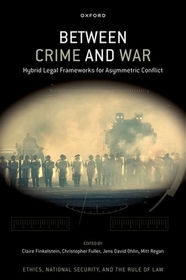
Between Crime and War
Hybrid Legal Frameworks for Asymmetric Conflict
Sorozatcím: ETHICS NATIONAL SECURITY RULE LAW SERIES;
-
10% KEDVEZMÉNY?
- A kedvezmény csak az 'Értesítés a kedvenc témákról' hírlevelünk címzettjeinek rendeléseire érvényes.
- Kiadói listaár GBP 98.00
-
46 819 Ft (44 590 Ft + 5% áfa)
Az ár azért becsült, mert a rendelés pillanatában nem lehet pontosan tudni, hogy a beérkezéskor milyen lesz a forint árfolyama az adott termék eredeti devizájához képest. Ha a forint romlana, kissé többet, ha javulna, kissé kevesebbet kell majd fizetnie.
- Kedvezmény(ek) 10% (cc. 4 682 Ft off)
- Kedvezményes ár 42 138 Ft (40 131 Ft + 5% áfa)
Iratkozzon fel most és részesüljön kedvezőbb árainkból!
Feliratkozom
46 819 Ft

Beszerezhetőség
Becsült beszerzési idő: A Prosperónál jelenleg nincsen raktáron, de a kiadónál igen. Beszerzés kb. 3-5 hét..
A Prosperónál jelenleg nincsen raktáron.
Why don't you give exact delivery time?
A beszerzés időigényét az eddigi tapasztalatokra alapozva adjuk meg. Azért becsült, mert a terméket külföldről hozzuk be, így a kiadó kiszolgálásának pillanatnyi gyorsaságától is függ. A megadottnál gyorsabb és lassabb szállítás is elképzelhető, de mindent megteszünk, hogy Ön a lehető leghamarabb jusson hozzá a termékhez.
A termék adatai:
- Kiadó OUP USA
- Megjelenés dátuma 2023. február 7.
- ISBN 9780197638798
- Kötéstípus Keménykötés
- Terjedelem592 oldal
- Méret 163x238x43 mm
- Súly 975 g
- Nyelv angol 285
Kategóriák
Rövid leírás:
The threat posed by the recent rise of transnational non-state armed groups does not fit easily within either of the two basic paradigms for state responses to violence. The civilian paradigm focuses on the interception of demonstrable immediate threats to the safety of others. The military paradigm focuses on threats posed by collective actors who pose a danger to the state's ability to maintain basic social order and, at times, the state. The book suggests, that we need not see the options as confined to this binary choice as it evaluates the philosophical and ethical implications of using both military and non-military frameworks for pursuing counterterrorism operations.
TöbbHosszú leírás:
The threat posed by the recent rise of transnational non-state armed groups does not fit easily within either of the two basic paradigms for state responses to violence. The civilian paradigm focuses on the interception of demonstrable immediate threats to the safety of others. The military paradigm focuses on threats posed by collective actors who pose a danger to the state's ability to maintain basic social order and, at times, the very existence of the state. While the United States has responded to the threat posed by non-state armed groups by using tools from both paradigms, it has placed substantially more emphasis on the military paradigm than have other states. While several reasons may contribute to this approach, one may be the assumption that a state must use each set of tools strictly according in accordance with the principles that underlie each paradigm. Implicit in this assumption may be the sense that the only alternative to the civilian paradigm is the unqualified military one.
The chapters in this book suggest, however that we need not see the options as confined to this binary choice. It may be profitable to consider borrowing elements from each paradigm on some occasions to act more expansively than the conventional civilian paradigm allows, but less expansively than the conventional military paradigm would permit. At the same time, the mixing of the categories comes with its own ethical and legal risks that should be scrutinized.
Tartalomjegyzék:
Forward
Lieutenant General Charles N. Pede
Introduction
Jens David Ohlin & Mitt Regan
Part I: The Framework Problem in Modern Conflict: Can we Still Distinguish War From Crime?
Chapter 1. Non-State Actors, Terrorism, and the War Paradigm Revisited
Seth Cantey
Chapter 2. The Limits of Law and the Value of Rights in Addressing Terrorism: A Study of the UN Counter-Terrorism Architecture
Fionnuala Ní Aoláin
Chapter 3. The Paradox of Discrimination: When More Violence Triggers Fewer Legal Constraints
Jens David Ohlin
Chapter 4. Fighting Terrorism under All Applicable Law
Joshua Andresen
Chapter 5. When Conflict Recurs: Classification of Conflict when Hostilities Break Out Anew
Laurie Blank
Part II: War as Criminal Enforcement
Chapter 6. Non-State Actors in a Post-War World: Conceptualizing War as Criminal Enforcement
Claire Finkelstein
Chapter 7. Urban Warfare: Policing Conflict
Ken Watkin
Chapter 8. Ratchet Down or Ramp Up? Contemporary Threats, Armed Conflict, and Tailored Authority
Geoff Corn
Chapter 9. Using Law as a Weapon Against Nuclear Proliferation and Terrorism: The U.S. Government's Financial Lawfare Against Iran
Orde F. Kittrie
Chapter 10. Human Rights Law as an Alternative to Jus in Bello
Christopher J. Fuller
Part III: Fighting Crime as War
Chapter 11. National Security Policymaking in the Shadow of International Law
Laura Dickinson
Chapter 12. Emerging Transnational Self-Defense Norms and Unrealized Liberal Values
John Dehn
Chapter 13. Finding Peace in the Law of War
Lieutenant Colonel Bailey Brown
Chapter 14. From Armed Conflict to Countering Threat Networks: Counterterrorism and Social Network Analysis
Todd Huntley & Mitt Regan
Part IV: crime and war: prosecuting terrorism and war crimes
Chapter 15. Counting the Ripples: The Challenge of Extraterritorial Jurisdiction to Prosecute Non-State Actors
Evan R. Seamone
Chapter 16. Diversifying the Sources of Evidence in Terrorism Cases Before Criminal Courts in (Post-)Conflict and High-Risk Situations: The Role of The Military
Bibi Van Ginkel, Christophe Paulussen, & Tanya Mehra
Chapter 17. U.S. Military Prosecutions During Non-International Armed Conflict
Chris Jenks

