

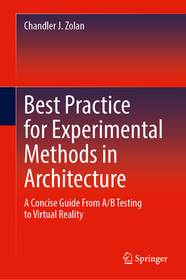
Best Practice for Experimental Methods in Architecture
A Concise Guide From A/B Testing to Virtual Reality
-
12% KEDVEZMÉNY?
- Kiadói listaár EUR 139.09
-
57 687 Ft (54 940 Ft + 5% áfa)
Az ár azért becsült, mert a rendelés pillanatában nem lehet pontosan tudni, hogy a beérkezéskor milyen lesz a forint árfolyama az adott termék eredeti devizájához képest. Ha a forint romlana, kissé többet, ha javulna, kissé kevesebbet kell majd fizetnie.
- Kedvezmény(ek) 12% (cc. 6 922 Ft off)
- Kedvezményes ár 50 765 Ft (48 347 Ft + 5% áfa)
50 765 Ft

Beszerezhetőség
Még nem jelent meg, de rendelhető. A megjelenéstől számított néhány héten belül megérkezik.
Why don't you give exact delivery time?
A beszerzés időigényét az eddigi tapasztalatokra alapozva adjuk meg. Azért becsült, mert a terméket külföldről hozzuk be, így a kiadó kiszolgálásának pillanatnyi gyorsaságától is függ. A megadottnál gyorsabb és lassabb szállítás is elképzelhető, de mindent megteszünk, hogy Ön a lehető leghamarabb jusson hozzá a termékhez.
A termék adatai:
- Kiadó Springer Nature Switzerland
- Megjelenés dátuma 2026. április 10.
- ISBN 9783032158833
- Kötéstípus Keménykötés
- Terjedelem142 oldal
- Méret 235x155 mm
- Nyelv angol
- Illusztrációk XI, 142 p. 27 illus., 23 illus. in color. 700
Kategóriák
Hosszú leírás:
This book provides a comprehensive guide to designing and conducting survey experiments in architecture, focusing on the intersection of research methodology and human interaction with the built environment. It covers a wide range of essential experimental techniques tailored to the architectural field, starting with foundational concepts like A/B testing and factorial design. It further provides clear, step-by-step strategies for implementing experimental designs, empowering architects, designers, and researchers to make data-driven decisions that enhance the spaces we live and work in. The chapters on within-subjects and between-subjects designs provide a deeper dive into how to measure responses to various environmental factors, such as lighting, room layout, and acoustics. Another key focus of the book is the use of emerging technologies like virtual reality (VR) in experimental design. With VR becoming an increasingly important tool in architectural testing, the book explores how virtual environments can be used to simulate real-world conditions, creating highly controlled experiments that can provide rich, actionable insights. The use of pilot testing is also emphasized to ensure that experiments are designed effectively before large-scale implementation. Ethics and Institutional Review Board (IRB) considerations are thoroughly discussed, ensuring that readers understand the importance of safeguarding participants' rights and privacy in any experimental study. The book doesn’t stop at the methodology; it gives practical advice on how to report results, interpret data, and address challenges like external validity, providing readers with a robust framework for translating experimental findings into actionable insights for architectural practice, ensuring that research contributes meaningfully to the design process and the improvement of built environments.
TöbbTartalomjegyzék:
"
Introduction to Experimental Methods in Architecture.- What Are Experimental Methods?.- A/B Testing: A Practical Guide.- Factorial Design: Managing Multiple Variables.- Within-Subjects Design: Understanding Individual Responses.- Between-Subjects Design: Testing Different Groups.- Variable Design: Identifying and Controlling Variables.- Robustness Checks: Validating Your Findings.- Virtual Reality in Architectural Experiments.- Pilot Testing: Why It Matters.- Ethics and the IRB: Ensuring Ethical Research Practices.- Experimental Processes: From Setup to Launch.- Reporting Results: Communicating Findings Effectively.- External Validity and Other Arguments.- Conclusion: The Future of Survey Experiments in Architecture.
" Több
