

-
10% KEDVEZMÉNY?
- A kedvezmény csak az 'Értesítés a kedvenc témákról' hírlevelünk címzettjeinek rendeléseire érvényes.
- Kiadói listaár GBP 9.99
-
4 772 Ft (4 545 Ft + 5% áfa)
Az ár azért becsült, mert a rendelés pillanatában nem lehet pontosan tudni, hogy a beérkezéskor milyen lesz a forint árfolyama az adott termék eredeti devizájához képest. Ha a forint romlana, kissé többet, ha javulna, kissé kevesebbet kell majd fizetnie.
- Kedvezmény(ek) 10% (cc. 477 Ft off)
- Kedvezményes ár 4 295 Ft (4 091 Ft + 5% áfa)
Iratkozzon fel most és részesüljön kedvezőbb árainkból!
Feliratkozom
4 772 Ft

Beszerezhetőség
Becsült beszerzési idő: A Prosperónál jelenleg nincsen raktáron, de a kiadónál igen. Beszerzés kb. 3-5 hét..
A Prosperónál jelenleg nincsen raktáron.
Why don't you give exact delivery time?
A beszerzés időigényét az eddigi tapasztalatokra alapozva adjuk meg. Azért becsült, mert a terméket külföldről hozzuk be, így a kiadó kiszolgálásának pillanatnyi gyorsaságától is függ. A megadottnál gyorsabb és lassabb szállítás is elképzelhető, de mindent megteszünk, hogy Ön a lehető leghamarabb jusson hozzá a termékhez.
A termék adatai:
- Kiadó OUP Oxford
- Megjelenés dátuma 2017. január 26.
- ISBN 9780198754992
- Kötéstípus Puhakötés
- Terjedelem176 oldal
- Méret 173x117x10 mm
- Súly 131 g
- Nyelv angol
- Illusztrációk 8 black and white images 0
Kategóriák
Rövid leírás:
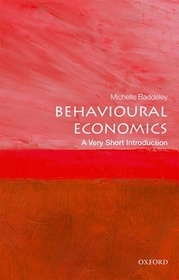
Behavioural economics blends insights from economics and psychology to explain how people make everyday decisions. Analysing the forces that drive everyone's behaviour it helps us understand what people are motivated by, our impulse purchases, why we struggle to save, and how supermarkets can manipulate what and how much we buy.
TöbbHosszú leírás:
Traditionally economists have based their economic predictions on the assumption that humans are super-rational creatures, using the information we are given efficiently and generally making selfish decisions that work well for us as individuals. Economists also assume that we're doing the very best we can possibly do - not only for today, but over our whole lifetimes too. But increasingly the study of behavioural economics is revealing that our lives are not that simple. Instead, our decisions are complicated by our own psychology. Each of us makes mistakes every day. We don't always know what's best for us and, even if we do, we might not have the self-control to deliver on our best intentions. We struggle to stay on diets, to get enough exercise and to manage our money. We misjudge risky situations. We are prone to herding: sometimes peer pressure leads us blindly to copy others around us; other times copying others helps us to learn quickly about new, unfamiliar situations.
This Very Short Introduction explores the reasons why we make irrational decisions; how we decide quickly; why we make mistakes in risky situations; our tendency to procrastination; and how we are affected by social influences, personality, mood and emotions. The implications of understanding the rationale for our own financial behaviour are huge. Behavioural economics could help policy-makers to understand the people behind their policies, enabling them to design more effective policies, while at the same time we could find ourselves assaulted by increasingly savvy marketing. Michelle Baddeley concludes by looking forward, to see what the future of behavioural economics holds for us.
ABOUT THE SERIES: The Very Short Introductions series from Oxford University Press contains hundreds of titles in almost every subject area. These pocket-sized books are the perfect way to get ahead in a new subject quickly. Our expert authors combine facts, analysis, perspective, new ideas, and enthusiasm to make interesting and challenging topics highly readable.
Behavioural Economics is a valuable addition to Oxford University Press's Very Short Introduction series, being well-suited to an intelligent and curious reader with limited background in the area. Baddeley offers a broad range of concepts, thinkers, experiments and implications. The book made me curious: I found myself looking up more detailed explanations of key experiments as I moved across concepts and chapters. This is perhaps the biggest compliment of all.
Tartalomjegyzék:
Introduction
Motivation and incentives
Quick thinking
Risky choices
Taking time
Social influences
Personality and emotions
Behavioural macroeconomics
Behavioural public policy
Behavioural economics: future prospects
References
Further Reading
Index

