

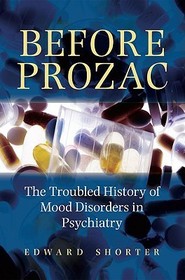
Before Prozac
The Troubled History of Mood Disorders in Psychiatry
-
10% KEDVEZMÉNY?
- A kedvezmény csak az 'Értesítés a kedvenc témákról' hírlevelünk címzettjeinek rendeléseire érvényes.
- Kiadói listaár GBP 43.99
-
19 861 Ft (18 915 Ft + 5% áfa)
Az ár azért becsült, mert a rendelés pillanatában nem lehet pontosan tudni, hogy a beérkezéskor milyen lesz a forint árfolyama az adott termék eredeti devizájához képest. Ha a forint romlana, kissé többet, ha javulna, kissé kevesebbet kell majd fizetnie.
- Kedvezmény(ek) 10% (kb. 1 986 Ft)
- Kedvezményes ár 17 875 Ft (17 024 Ft + 5% áfa)
Iratkozzon fel most és részesüljön kedvezőbb árainkból!
Feliratkozom
19 861 Ft

Beszerezhetőség
Megrendelésre a kiadó utánnyomja a könyvet. Rendelhető, de a szokásosnál kicsit lassabban érkezik meg.
Why don't you give exact delivery time?
A beszerzés időigényét az eddigi tapasztalatokra alapozva adjuk meg. Azért becsült, mert a terméket külföldről hozzuk be, így a kiadó kiszolgálásának pillanatnyi gyorsaságától is függ. A megadottnál gyorsabb és lassabb szállítás is elképzelhető, de mindent megteszünk, hogy Ön a lehető leghamarabb jusson hozzá a termékhez.
A termék adatai:
- Kiadó OUP USA
- Megjelenés dátuma 2008. november 6.
- ISBN 9780195368741
- Kötéstípus Keménykötés
- Terjedelem320 oldal
- Méret 236x157x27 mm
- Súly 567 g
- Nyelv angol 0
Kategóriák
Hosszú leírás:
Psychiatry today is a barren tundra, writes medical historian Edward Shorter, where drugs that don't work are used to treat diseases that don't exist. In this provocative volume, Shorter illuminates this dismal landscape, in a revealing account of why psychiatry is "losing ground" in the struggle to treat depression.
Naturally, the book looks at such culprits as the pharmaceutical industry, which is not inclined to market drugs once the patent expires, leading to the endless introduction of new--but not necessarily better--drugs. But the heart of the book focuses on an unexpected villain: the FDA, the very agency charged with ensuring drug safety and effectiveness. Shorter describes how the FDA permits companies to test new products only against placebo. If you can beat sugar pills, you get your drug licensed, whether or not it is actually better than (or even as good as) current medications, thus sweeping from the shelves drugs that may be superior but have lost patent protection. The book also examines the FDA's early power struggles against the drug industry, an influence-grab that had little to do with science, and which left barbiturates, opiates, and amphetamines all underprescribed, despite the fact that under careful supervision they are better at treating depression, with fewer side effects, than the newer drugs in the Prozac family. Shorter also castigates academia, showing how two forms of depression, melancholia and nonmelancholia--"as different from each other as chalk and cheese"--became squeezed into one dubious classification, major depression, which was essentially a political artifact born of academic infighting.
An astonishing and troubling look at modern psychiatry, Losing Ground is a book that is sure to spark controversy for years to come.
Tartalomjegyzék:
Introduction
Before Psychopharmacology
The First Drug Set
Power Play
Killer Drugs!
Death Sentences
"This Plague of Affective Disorders"
Losing Ground
What Now?
Glossary
Notes

