

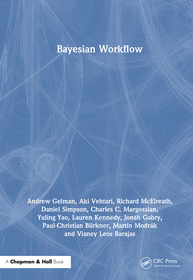
Bayesian Workflow
-
10% KEDVEZMÉNY?
- Kiadói listaár GBP 120.00
-
54 180 Ft (51 600 Ft + 5% áfa)
Az ár azért becsült, mert a rendelés pillanatában nem lehet pontosan tudni, hogy a beérkezéskor milyen lesz a forint árfolyama az adott termék eredeti devizájához képest. Ha a forint romlana, kissé többet, ha javulna, kissé kevesebbet kell majd fizetnie.
- Kedvezmény(ek) 10% (kb. 5 418 Ft)
- Kedvezményes ár 48 762 Ft (46 440 Ft + 5% áfa)
48 762 Ft

Beszerezhetőség
Becsült beszerzési idő: A Prosperónál jelenleg nincsen raktáron, de a kiadónál igen. Beszerzés kb. 3-5 hét..
A Prosperónál jelenleg nincsen raktáron.
Why don't you give exact delivery time?
A beszerzés időigényét az eddigi tapasztalatokra alapozva adjuk meg. Azért becsült, mert a terméket külföldről hozzuk be, így a kiadó kiszolgálásának pillanatnyi gyorsaságától is függ. A megadottnál gyorsabb és lassabb szállítás is elképzelhető, de mindent megteszünk, hogy Ön a lehető leghamarabb jusson hozzá a termékhez.
A termék adatai:
- Kiadás sorszáma 1
- Kiadó Chapman and Hall
- Megjelenés dátuma 2026. június 25.
- ISBN 9780367490188
- Kötéstípus Keménykötés
- Terjedelem552 oldal
- Méret 254x178 mm
- Súly 1180 g
- Nyelv angol
- Illusztrációk 53 Illustrations, black & white; 190 Illustrations, color; 53 Line drawings, black & white; 190 Line drawings, color 690
Kategóriák
Rövid leírás:
Explores the intricate workflows of applied Bayesian statistics, aiming to uncover the tacit knowledge often overlooked in published papers and textbooks. By systematizing the process of Bayesian model development, the book seeks to improve applied analyses and inspire future innovations in theory, methods, and software.
TöbbHosszú leírás:
Bayesian statistics and statistical practice have evolved over the years, driven by advancements in theory, methods, and computational tools. Bayesian Workflow explores the intricate workflows of applied Bayesian statistics, aiming to uncover the tacit knowledge often overlooked in published papers and textbooks. By systematizing the process of Bayesian model development, the book seeks to improve applied analyses and inspire future innovations in theory, methods, and software. It emphasizes the importance of iterative model building, model checking, computational troubleshooting, and simulated-data experimentation, offering a comprehensive perspective on statistical analysis.
Through detailed examples and practical guidance, the book bridges the gap between theory and application, empowering practitioners and researchers to navigate the complexities of Bayesian inference. It is not a checklist or cookbook but a flexible framework for understanding and resolving challenges in statistical modeling and decision-making under uncertainty.
Features
- Covers all aspects of Bayesian statistical workflow, including model building, inference, validation, troubleshooting, and understanding
- Demonstrates iterative model development and computational problem-solving through real-world case studies
- Explores computational challenges, calibration checking, and connections between modeling and computation
- Highlights the importance of checking models under diverse conditions to understand their limitations and improve their robustness
- Discusses how Bayesian principles apply to non-Bayesian methods in statistics and machine learning
- Includes code snippets, exercises, and links to full datasets and code in R and Stan, with applicability to other programming environments like Python and Julia
This book is designed for practitioners of applied Bayesian statistics, particularly users of probabilistic programming languages such as Stan, as well as developers of methods and software tailored to these users. It also targets researchers in Bayesian theory and methods, offering insights into understudied aspects of statistical workflows. Instructors and students will find adaptable exercises and case studies to enhance their learning experience. Beyond Bayesian inference, the book’s principles are relevant to users of non-Bayesian methods, making it a valuable resource for statisticians, data scientists, and machine learning professionals seeking to improve their modeling and decision-making processes.
“This is an important book…The text magnificently achieves its aim of leading the reader through this workflow, which involves iterative model building, model checking, validation and troubleshooting of computational problems, as well as model understanding and model comparison. These aspects of the workflow are considered in the context of several, diverse examples…Despite its length, the book is beautifully structured, as a series of 31 chapters, each a relatively short and carefully crafted essay on some aspect of the Bayesian workflow. Each chapter includes a set of quite open-ended exercises, so the text would serve as an excellent basis for an extensive advanced course on contemporary applied Bayesian data analysis…The book is ‘not a checklist, not a cookbook’ but fully achieves its aim of presenting a flexible framework for understanding and analysing challenges in Bayesian statistical modelling and decision-making under uncertainty…The authors have produced a tour-de-force. By elegantly systematizing the processes of Bayesian model development and criticism, they have provided a work which provides a road map for improved applied Bayesian data analysis. It is certain to influence developments in applied statistical analysis, as well as inspire future innovations in Bayesian theory, methodology and computational software.”
~Alastair Young, Imperial College, UK, published in International Statistical Review, July 2026
“An outstanding, protocol-driven guide for Bayesian data analysis, Bayesian Workflow by Gelman, Vehtari, McElreath and co-authors delivers a practical and comprehensive framework for iterative modeling, emphasizing simulation, diagnostic checks, and rigorous empirical validation, and with a long and impressive list of case studies. By treating data analysis as a structured, verifiable workflow, it provides an indispensable toolkit for diagnosing model failures, refining priors, and building reliable data analysis systems for reproducible conclusions, useful for beginning and veteran data analysts alike.”
~Bin Yu, CDSS Chancellor’s Distinguished Professor of Statistics, Electrical Engineering and Computer Sciences, and Center for Computational Biology, UC Berkeley, USA
“This is not a typical methods textbook, but instead it guides the reader through the whole process of fitting, critiquing and adapting statistical models to real-world problems. It is full of the accumulated wisdom of skilled practitioners, teaching through demonstration rather than theory, with both basic and highly sophisticated examples. I strongly recommend this book to statisticians who really want to understand what they can learn from their data.”
~Sir David Spiegelhalter, University of Cambridge, UK
"A bravura performance...Gelman, Vehtari, McElreath and friends develop in detail a practical Bayesian data analysis workflow, from acquisition to final report, including full computational guidance.”
~Brad Efron, Stanford University, USA
"This original, thought-provoking, and transformative book is much much more than an implementation manual for Bayesian Data Analysis, even though it shares almost the same perspective. (The first sentence of the book states that the authors' "conceptions of statistical practice, and of Bayesian statistics, have changed over the years".) By providing a modus vivendi for undertaking Bayesian modelling from scratch in realistic settings where models are not magicked out of the blue, the authors explicit and rationalise the many steps required by such a bottom-up modelling protocol ("not a checklist, not a cookbook", and not a flowchart!) in real situations. The contents read very well and very smoothly, with a seamless conjunction of intuition, modelling advices, computational details, and comparison tools. While unsurprisingly Bayesian, the perspective adopted therein remains both open and inclusive, with a welcome humility about the limitations and challenges of Bayesian workflows. This book should thus appeal to and profit a wide variety of readers, as providing guidance through an extensive collection of highly detailed examples, with shared code and exercises.”
~Christian P. Robert, Université Paris Dauphine PSL, Paris, France
“Some statistics books show you how to beat an egg, others are recipe books: if this, then that style. This book teaches you how to cook. Written by authors who established so much of how we do Bayesian statistics, this new book is an indispensable guide for analyzing data in a trustworthy way. It walks you through the actual steps involved in building models to explore and understand datasets. Part 4 is particularly excellent – the authors provide many end-to-end case studies that will be useful for both practitioners and students. It highlights the value of their workflow-based approach. Filled with chatty asides, the book introduces the Bayesian workflow to a broad audience. It embraces the frustrations and complexities of actually doing Bayesian statistics and provides specific guidance throughout. Each chapter contains exercises and it could be the basis of an upper-year undergraduate course, or a first-year grad course, in applied statistics. It will be used for many years to come.”
~Rohan Alexander, University of Toronto, Canada
“What makes Bayesian Workflow so exceptional is how it seamlessly pairs profound ideas about modeling with the adoption of modern computational practice. By centering the messy, iterative process of modeling through real-world case studies, the authors reject rigid cookbooks and checklists in favor of building deep situational awareness. Because the ideas are so clearly articulated and deeply applied, this book serves as an invaluable pedagogical resource. With its practical exercises, individual chapters or the text as a whole can easily be integrated into upper-level undergraduate or graduate courses, while also remaining accessible for self-guided readers. It is an indispensable read for anyone with foundational knowledge in Bayesian methods, regardless of whether they are applied practitioners, software developers, or methodologists.”
~Mine Doğucu, Senior Lecturer on Statistics, Harvard University, USA
Tartalomjegyzék:
Part 1: From Bayesian inference to Bayesian workflow. 1 Bayesian theory and Bayesian practice. 2 Statistical modeling and workflow. 3 Computational tools. 4 Introduction to workflow: Modeling performance on a multiple choice exam. Part 2: Statistical workflow. 5 Building statistical models. 6 Using simulations to capture uncertainty. 7 Prediction, generalization, and causal inference/ 8 Visualizing and checking fitted models. 9 Comparing and improving models. 10 Statistical inference and scientific inference. Part 3: Computational workflow. 11 Fitting statistical models. 12 Diagnosing and fixing problems with fitting. 13 Approximate algorithms and approximate models. 14 Simulation-based calibration checking. 15 Statistical modeling as software development. Part 4: Case studies. 16 Coding a series of models: Simulated data of movie ratings. 17 Prior specification for regression models: Reanalysis of a sleep study.18 Predictive model checking and comparison: Clinical trial. 19 Building up to a hierarchical model: Coronavirus testing. 20 Using a fitted model for decision analysis: Mixture model for time series competition. 21 Posterior predictive checking: Stochastic learning in dogs. 22 Incremental development and testing: Black cat adoptions. 23 Debugging a model: World Cup football. 24 Leave-one-out cross validation model checking and comparison: Roaches. 25 Model building and expansion: Golf putting. 26 Model building with latent variables: Markov models for animal movement. 27 Model building: Time-series decomposition for birthdays. 28 Models for regression coefficients and variable selection: Student grades. 29 Funnel problem with latent variables: No vehicles in the park. 30 Computational challenge of multimodality: Differential equation for planetary motion. 31 Simulation-based calibration checking in model development workflow.
Több
