

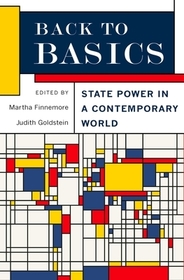
Back to Basics
State Power in a Contemporary World
-
10% KEDVEZMÉNY?
- A kedvezmény csak az 'Értesítés a kedvenc témákról' hírlevelünk címzettjeinek rendeléseire érvényes.
- Kiadói listaár GBP 43.99
-
21 016 Ft (20 015 Ft + 5% áfa)
Az ár azért becsült, mert a rendelés pillanatában nem lehet pontosan tudni, hogy a beérkezéskor milyen lesz a forint árfolyama az adott termék eredeti devizájához képest. Ha a forint romlana, kissé többet, ha javulna, kissé kevesebbet kell majd fizetnie.
- Kedvezmény(ek) 10% (cc. 2 102 Ft off)
- Kedvezményes ár 18 914 Ft (18 014 Ft + 5% áfa)
Iratkozzon fel most és részesüljön kedvezőbb árainkból!
Feliratkozom
21 016 Ft

Beszerezhetőség
Megrendelésre a kiadó utánnyomja a könyvet. Rendelhető, de a szokásosnál kicsit lassabban érkezik meg.
Why don't you give exact delivery time?
A beszerzés időigényét az eddigi tapasztalatokra alapozva adjuk meg. Azért becsült, mert a terméket külföldről hozzuk be, így a kiadó kiszolgálásának pillanatnyi gyorsaságától is függ. A megadottnál gyorsabb és lassabb szállítás is elképzelhető, de mindent megteszünk, hogy Ön a lehető leghamarabb jusson hozzá a termékhez.
A termék adatai:
- Kiadó OUP USA
- Megjelenés dátuma 2013. április 25.
- ISBN 9780199970094
- Kötéstípus Puhakötés
- Terjedelem392 oldal
- Méret 231x155x30 mm
- Súly 522 g
- Nyelv angol 0
Kategóriák
Rövid leírás:
Edited by Martha Finnemore and Judith Goldstein, Back to Basics asks scholars to reflect on the role power plays in contemporary politics and how a power politics approach is influential today.
TöbbHosszú leírás:
No scholar better exemplifies the intellectual challenges foisted on the Neorealist school of international relations than prominent scholar Stephen Krasner (Graham H. Stuart Professor of International Studies, the Senior Associate Dean for the Social Sciences, School of Humanities & Sciences, and Director of Policy Planning at the US State Department 2005-2007). Throughout his career he has wrestled with realism's promises and limitations. Krasner has always been a prominent defender of realism and the importance of power understood in material terms, whether military or economic. Yet realist frameworks rarely provided a complete explanation for outcomes, in Krasner's analyses, and much of his work involved understanding power's role in situations not well explained by realism. If states seek power, why do we see cooperation? If hegemony promotes cooperation why does cooperation continue in the face of America's decline? Do states actually pursue their national interests or do domestic structures and values derail the rational pursuit of material objectives? Krasner's explanations were as diverse as were the problems. They pushed, to use his phrase, "the limits of realism."
Edited by Martha Finnemore and Judith Goldstein, Back to Basics asks scholars to reflect on the role power plays in contemporary politics and how a power politics approach is influential today. The arguments made by the authors in this volume speak to one of three themes that run through Krasner's work: state power and hegemony; the relationship between states and markets; conceptions of the nation state in international politics. These themes appeared regularly in Krasner's scholarship as he wrestled, over his career, with fundamental questions of inter-state politics. Contributors largely agree on the centrality of power but diverge substantially on the ways power is manifest and should be measured and understood. Many of the contributors confronted the same intellectual dilemmas as Krasner in struggling to define power and its relationship to interests, yet their responses are different. Together, these essays explore new ways of thinking about power's role in contemporary politics and demonstrate the concepts continued relevance for both policy and theory.
In sum, this is an inspiring volume reminding us of the continued importance of state power in the contemporary world order. Just as important, it reminds us that thinking creatively and critically about international relations is indispensable if we are to understand the nature and consequences of world politics.
Tartalomjegyzék:
Contents
Introductory Essays: Realism as an Intellectual Tradition
1 Puzzles about Power
Martha Finnemore and Judith Goldstein
2 Power Politics in the Contemporary World:
Lessons from the Scholarship of Stephen Krasner
Martha Finnemore and Judith Goldstein
3 Stephen Krasner: Subversive Realist
Robert O. Keohane
Theoretical Reflections on Power, States, and Sovereignty
4 Authority, Coercion, and Power in International Relations
David A. Lake
5 Governance under Limited Sovereignty
Thomas Risse
6 Three Scenes of Sovereignty and Power
Etel Solingen
7 States and Power as Ur-Force: Domestic Traditions and Embedded Actors in
World Politics
Peter J. Katzenstein
State Power and the Global Economy
8 Currency and State Power
Benjamin J. Cohen
9 International Trade Law as a Mechanism for State Transformation
Richard H. Steinberg
10 Choice and Constraint in the Great Recession of 2008
Peter Gourevitch
The Subversive Effects of Globalization
11 Power Politics and the Powerless
Arthur A. Stein
12 Globalization and Openness: Would a Rational Hegemon Still Prefer Openness?
Lloyd Gruber
13 The Tragedy of the Global Institutional Commons
Daniel W. Drezner
Parting Thoughts: Causation and Complexity
14 Causation and Responsibility in a Complex World
Robert Jervis
15 Power, Bargaining, and Persuasion: Unevenly Mapped Terrain
Stephen D. Krasner

