

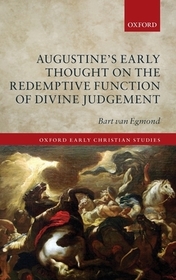
Augustine's Early Thought on the Redemptive Function of Divine Judgement
Sorozatcím: Oxford Early Christian Studies;
-
10% KEDVEZMÉNY?
- A kedvezmény csak az 'Értesítés a kedvenc témákról' hírlevelünk címzettjeinek rendeléseire érvényes.
- Kiadói listaár GBP 110.00
-
52 552 Ft (50 050 Ft + 5% áfa)
Az ár azért becsült, mert a rendelés pillanatában nem lehet pontosan tudni, hogy a beérkezéskor milyen lesz a forint árfolyama az adott termék eredeti devizájához képest. Ha a forint romlana, kissé többet, ha javulna, kissé kevesebbet kell majd fizetnie.
- Kedvezmény(ek) 10% (cc. 5 255 Ft off)
- Kedvezményes ár 47 297 Ft (45 045 Ft + 5% áfa)
Iratkozzon fel most és részesüljön kedvezőbb árainkból!
Feliratkozom
52 552 Ft

Beszerezhetőség
Megrendelésre a kiadó utánnyomja a könyvet. Rendelhető, de a szokásosnál kicsit lassabban érkezik meg.
Why don't you give exact delivery time?
A beszerzés időigényét az eddigi tapasztalatokra alapozva adjuk meg. Azért becsült, mert a terméket külföldről hozzuk be, így a kiadó kiszolgálásának pillanatnyi gyorsaságától is függ. A megadottnál gyorsabb és lassabb szállítás is elképzelhető, de mindent megteszünk, hogy Ön a lehető leghamarabb jusson hozzá a termékhez.
A termék adatai:
- Kiadó OUP Oxford
- Megjelenés dátuma 2018. december 13.
- ISBN 9780198834922
- Kötéstípus Keménykötés
- Terjedelem304 oldal
- Méret 240x164x24 mm
- Súly 614 g
- Nyelv angol 0
Kategóriák
Rövid leírás:
This study examines the relationship between Augustine's account of God's judgment and his theology of grace in his early works.
TöbbHosszú leírás:
Augustine's Early Thought on the Redemptive Function of Divine Judgement considers the relationship between Augustine's account of God's judgment and his theology of grace in his early works. How does God use his law and the penal consequences of its transgression in the service of his grace, both personally and through his 'agents' on earth? Augustine reflected on this question from different perspectives. As a teacher and bishop, he thought about the nature of discipline and punishment in the education of his pupils, brothers, and congregants. As a polemicist against the Manichaeans and as a biblical expositor, he had to grapple with issues regarding God's relationship to evil in the world, the violence God displays in the Old Testament, and in the death of his own Son. Furthermore, Augustine meditated on the way God's judgment and grace related in his own life, both before and after his conversion.
Bart van Egmond follows the development of Augustine's early thought on judgment and grace from the Cassiacum writings to the Confessions. The argument is contextualized both against the background of the earlier Christian tradition of reflection on the providential function of divine chastisement, and the tradition of psychagogy that Augustine inherited from a variety of rhetorical and philosophical sources. This study expertly contributes to the ongoing scholarly discussion on the development of Augustine's doctrine of grace, and to the conversation on the theological roots of his justification of coercion against the Donatists.
Three praiseworthy aspects of this study include the way in which van Egmond shows the importance of divine justice for understanding Augustine's soteriology in this early period; his analysis of the intertwined philosophical influences and polemical concerns, the emerging biblical spirituality and ecclesiastical considerations contributing to the development of Augustine's thought; and the rare concision and lucid prose with which he presents his multifaceted project. The book is well-organised as a chronological study containing clear summaries and efficiently addressing the many literatures, secondary and primary, which bear upon its contents.
Tartalomjegyzék:
Introduction
Cassiciacum: The Discipline of Fortune and Dialogue
God's Pedagogy of the Embodied Soul: Augustine before his Ordination (387-391)
Reappropriating Paul and Exercising Discipline: Augustine During his Presbyterate (391-397)
Confessions: God's Lawsuit with Augustine between the Deferral and the Reception of Baptism
Conclusions
Bibliography

