

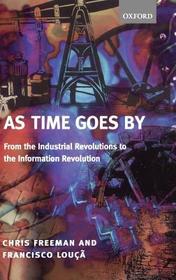
As Time Goes By
From the Industrial Revolutions to the Information Revolution
-
10% KEDVEZMÉNY?
- A kedvezmény csak az 'Értesítés a kedvenc témákról' hírlevelünk címzettjeinek rendeléseire érvényes.
- Kiadói listaár GBP 222.50
-
100 458 Ft (95 675 Ft + 5% áfa)
Az ár azért becsült, mert a rendelés pillanatában nem lehet pontosan tudni, hogy a beérkezéskor milyen lesz a forint árfolyama az adott termék eredeti devizájához képest. Ha a forint romlana, kissé többet, ha javulna, kissé kevesebbet kell majd fizetnie.
- Kedvezmény(ek) 10% (kb. 10 045 Ft)
- Kedvezményes ár 90 413 Ft (86 108 Ft + 5% áfa)
Iratkozzon fel most és részesüljön kedvezőbb árainkból!
Feliratkozom
100 458 Ft

Beszerezhetőség
Megrendelésre a kiadó utánnyomja a könyvet. Rendelhető, de a szokásosnál kicsit lassabban érkezik meg.
Why don't you give exact delivery time?
A beszerzés időigényét az eddigi tapasztalatokra alapozva adjuk meg. Azért becsült, mert a terméket külföldről hozzuk be, így a kiadó kiszolgálásának pillanatnyi gyorsaságától is függ. A megadottnál gyorsabb és lassabb szállítás is elképzelhető, de mindent megteszünk, hogy Ön a lehető leghamarabb jusson hozzá a termékhez.
A termék adatai:
- Kiadó OUP Oxford
- Megjelenés dátuma 2001. február 15.
- ISBN 9780199241071
- Kötéstípus Keménykötés
- Terjedelem424 oldal
- Méret 242x163x28 mm
- Súly 764 g
- Nyelv angol
- Illusztrációk numerous black and white figures, tables 0
Kategóriák
Rövid leírás:
The Internet and mobile telephones have made everyone more aware than ever of the computer revolution and its effects on the economy and society. 'As Time Goes By' puts this revolution in the perspective of previous waves of technical change: steam-powered mechanization, electrification, and motorization. It argues for a theory of reasoned economic history which assigns a central place to these successive technological revolutions.
TöbbHosszú leírás:
How can we best understand the impact of revolutionary technologies on the business cycle, the economy, and society? Why is economics meaningless without history and without an understanding of institutional and technical change? Does the 'new economy' mean the 'end of history'?an we best understand the impact of revolutionary technologies on business organization and the business cycle?
These are some of the questions addressed in this authoritative analysis of modern economic growth from the Industrial Revolution to the 'New Economy' of today. Chris Freeman has been one of the foremost researchers on innovation for a long time and his colleague Francisco Louçã is an outstanding historian of economic theory and an analyst of econometric models and methods. Together they chart the history of five technological revolutions: water-powered mechanization, steam-powered mechanization, electrification, motorization, and computerization. They demonstrate the necessity to take account of politics, culture, organizational change, and entrepreneurship, as well as science and technology in the analysis of economic growth.
This is an well-informed, highly topical, and persuasive study of interest across all the social sciences.
This is a very good and important book that is must reading for anyone interested in evolutionary economics and/or the relationship between history and economics. In addition, you get a very well documented and argued interpretation of long run capitalist development from the industrial revolution to the present that will be a standard reference ... a first rate contribution to the discussion of how evolutionary economics should (may) develop.
Tartalomjegyzék:
Part I: History and Economics
Introduction: The Fundamental Things Apply
Restless Clio: A Story of the Economic Historians' Assessment of History in Economics
Schumpeter's Plea for Reasoned History
Nikolai Kondratiev: A New Approach to History and Statistics
The Strange Attraction of Tides and Waves
Conclusions: A Theory of Reasoned History
Part II: Successive Industrial Revolutions
Introduction: Technical Change and Long Waves in Economic Development
The British Industrial Revolution: The Age of Cotton, Iron, and Water Power
The Second Kondratiev Wave: The Age of Iron Railways, Steam Power, and Mechanization
The Third Kondratiev Wave: The Age of Steel, Heavy Engineering, and Electrification
The Fourth Kondratiev Wave: The Great Depression and the Age of Oil, Automobiles, Motorization, and Mass Production
The Emergence of a New Techno-economic Paradigm: The Age of Information and Communication Technology
Conclusions: Recurrent Phenomena of the Long Waves of Capitalist Development

