

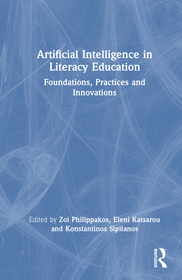
Artificial Intelligence in Literacy Education
Foundations, Practices and Innovations
-
10% KEDVEZMÉNY?
- Kiadói listaár GBP 171.99
-
77 653 Ft (73 955 Ft + 5% áfa)
Az ár azért becsült, mert a rendelés pillanatában nem lehet pontosan tudni, hogy a beérkezéskor milyen lesz a forint árfolyama az adott termék eredeti devizájához képest. Ha a forint romlana, kissé többet, ha javulna, kissé kevesebbet kell majd fizetnie.
- Kedvezmény(ek) 10% (kb. 7 766 Ft)
- Kedvezményes ár 69 887 Ft (66 560 Ft + 5% áfa)
69 887 Ft

Beszerezhetőség
Becsült beszerzési idő: A Prosperónál jelenleg nincsen raktáron, de a kiadónál igen. Beszerzés kb. 3-5 hét..
A Prosperónál jelenleg nincsen raktáron.
Why don't you give exact delivery time?
A beszerzés időigényét az eddigi tapasztalatokra alapozva adjuk meg. Azért becsült, mert a terméket külföldről hozzuk be, így a kiadó kiszolgálásának pillanatnyi gyorsaságától is függ. A megadottnál gyorsabb és lassabb szállítás is elképzelhető, de mindent megteszünk, hogy Ön a lehető leghamarabb jusson hozzá a termékhez.
A termék adatai:
- Kiadás sorszáma 1
- Kiadó Routledge
- Megjelenés dátuma 2026. június 29.
- ISBN 9781041117407
- Kötéstípus Keménykötés
- Terjedelem266 oldal
- Méret 229x152 mm
- Súly 650 g
- Nyelv angol
- Illusztrációk 29 Illustrations, black & white; 3 Halftones, black & white; 26 Line drawings, black & white; 14 Tables, black & white 699
Kategóriák
Rövid leírás:
This collection addresses AI in literacy education, exploring the challenges, opportunities, and pedagogical applications of the use of large language models in the education field. It is ideal for scholars, researchers, and graduate students in the fields of literacy education, educational technology and teacher education.
TöbbHosszú leírás:
This edited collection addresses Artificial Intelligence in literacy education, exploring the challenges, opportunities, and pedagogical applications of the use of large language models in the education field.
Artificial Intelligence has dynamically emerged in our lives, especially in the last five years, and is gradually transforming them. Undoubtedly, AI influences both education and the cultivation of literacies in the modern school and society at large. Recognizing the evolving nature of the educational dashboard, this book provides possible AI applications in educational settings, such as schools and classrooms, and it holistically examines AI technologies within societal and educational contexts. Considering that school is part of a broader organism that is societal, the book also examines AI applications beyond classes but also offers realistic possibilities and challenges in AI technologies as they evolve before us, rapidly. Chapters in the book cover the use of AI in language learning, writing studies, reading and writing assessment, curriculum research, teacher preparation, and more.
Bringing together new scholarship and voices in the field of AI literacy, this book is ideal for scholars, researchers, and graduate students in the fields of literacy education as well as educational technology and teacher education.
“Philippakos, Katsarou, and Sipitanos’s edited volume approaches the topic of AI literacy by posing questions and challenges raised in response to the emergence of recent AI advances as they apply to the broad landscape of assessment, instruction, and teacher training. As some of the most striking advances in AI capabilities are related to language competence, we see embodied in this volume opportunities for new capabilities and tools to be taken up and applied especially in writing instruction. The interdisciplinary and international collection of author teams bring unique perspectives, research, teaching tools, and resources to illustrate shifts in practices across the educational frontier.”
— Carolyn Rose, Professor of Language Technologies and Human-Computer Interaction, Human-Computer Interaction Institute
“To achieve the benefits of generative AI while minimizing its problems, we must unlearn conventional approaches to literacy and reinvent learning and teaching. This book provides a rich description of GenAI as a sociotechnical system in which literacy goes far beyond prompt engineering and fluency in using AI tools. The chapters provide theory- and evidence-based strategies for reconceptualizing reading, writing, language learning, curriculum development, and teacher capacity building. The authors demonstrate that the best form of AI literacy is not improving educational efficiency by doing things better, but increasing excellence and equity by doing better things that AI empowers teachers and students to accomplish.
— Christopher Dede, Senior Research Fellow, Harvard Graduate School of Education
“A timely and thought-provoking collection that brings together distinguished scholars to explore the implications of AI for education. The contributors offer a wealth of perspectives on a topic that is rapidly transforming research and policy alike.”
— Daniel Willingham, Professor of Psychology, University of Virginia
“In this thoughtful and timely collection, editors and contributors provide much-needed frameworks for understanding AI's complexities and nuances in educational contexts. Moving beyond polarized debates and binaries, the chapters highlight how thoughtful exploration and integration of AI can enhance, rather than diminish, the human dimensions of teaching and learning.”
— George Veletsianos, Professor of Learning Technologies, Bonnie Westby Huebner Chair in Education and Technology, University of Minnesota
“This essential volume, Artificial Intelligence in Literacy Education, arrives at a critical moment. The editors have compiled an impressive collection that establishes theoretical foundations and maps the practical realities of integrating AI into the study and practice of literacy.
The chapters offer rigorous analysis and groundbreaking empirical research, tackling some of the most pressing challenges facing educators today. The contributions move seamlessly across conceptual clarity, such as defining the dual need for a new pedagogy and research culture, to specific, impactful applications. Highlights include chapters that focus on using AI to support both reading and writing skills, revising with AI, and teachers’ AI literacy skills.
Assembled by preeminent and internationally renowned experts, this book will help readers navigate teaching and research of literacy in the era of AI, moving past questions of “good” and “bad” and arriving at illustrations and suggestions of sound, innovative practice.”
— Joshua Wilson, Associate professor CEHHS, University of Delaware
“Artificial Intelligence in Literacy Education offers a thought-provoking and timely set of contributions that critically examine the role of AI in literacy education. This collection challenges us to reimagine pedagogies and competencies that better prepare learners to thoughtfully and responsibly engage with AI-systems across literacy domains.”
— Panayiota (Pani) Kendeou, Distinguished McKnight University Professor and Guy Bond Chair in Reading, University of Minnesota
“This work offers a clear and forward-looking perspective on how AI holds the potential of truly enhancing learning. Rather than treating AI as a shortcut, it positions it as a partner that can deepen inquiry, sharpen reasoning, and support meaningful engagement with complex ideas. The volume underscores that AI literacy is not simply about knowing how to use the tools, but about Socratically learning to question, interpret, and refine their outputs with intellectual rigor. It provides thoughtful and practical approaches for integrating AI in ways that elevate critical thinking, metacognitive awareness, and human agency. Timely and insightful, this work contributes a confident and constructive voice to the future of AI-augmented education.”
— Vasileios Maroulas, Ph.D., Professor, Associate Vice Chancellor, Director of AI Tennessee Initiative
“Artificial Intelligence in Literacy Education gathers diverse scholars to frame AI literacy as reflective, ethical, and critical engagement, not mere tool use. It confronts the illusion of fluency, misinformation, and bias, and warns against cognitive offloading and automation complacency. Grounded in practical wisdom and a pedagogy of discernment, it offers frameworks and classroom-facing applications that treat AI as co-intelligence while keeping human judgment central, especially in language and writing-related learning.”
— Savvas A. Chatzichristofis, Professor of Artificial Intelligence and Vice-Rector for Research and Innovation, Neapolis University Pafos
TöbbTartalomjegyzék:
Preface Foreword Part I: Theoretical Considerations and Foundational 1. Contextual AI Meets Generative AI: Addressing the Literacy Crisis 2. AI in Education: The Dual Need for a New Pedagogy and a New Research Culture Part II: AI Learning and Instruction 3. Writing Coach, Reading Tutor, and Conversation Partner: Insights from PapyrusAI Implementation 4. AI Literacy and Statistics Learning: Building Students' Active Participation from Teacher Knowledge and Adaptation 5. Reading and Writing Assessment in the Age of Generative AI Or, Dealing with Future Shock 6. AI writing: Practices, Challenges, and Opportunities 7. Revising with Generative AI: Supporting Writing Instruction Through Validated Cohesion Metrics Part III: AI and Innovative Educational Research 8. The Contribution of Ontologies to Language Curriculum Research: Semantic Structuring for Interoperability and Analysis 9. AI Literacy in Teacher Education: Challenging Preparedness and Ethical Responsibility for AI Integration 10. Navigating the AI Literacy Era: From Instructor to Facilitator-The Impact of AI on Educational Practices 11. Educating With and Through Generative AI: Toward an Ecological Pedagogy of Teacher Competence
Több
