

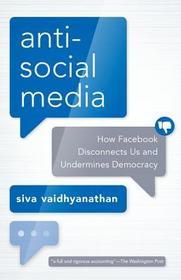
Antisocial Media
How Facebook Disconnects Us and Undermines Democracy
-
10% KEDVEZMÉNY?
- A kedvezmény csak az 'Értesítés a kedvenc témákról' hírlevelünk címzettjeinek rendeléseire érvényes.
- Kiadói listaár GBP 16.49
-
7 445 Ft (7 090 Ft + 5% áfa)
Az ár azért becsült, mert a rendelés pillanatában nem lehet pontosan tudni, hogy a beérkezéskor milyen lesz a forint árfolyama az adott termék eredeti devizájához képest. Ha a forint romlana, kissé többet, ha javulna, kissé kevesebbet kell majd fizetnie.
- Kedvezmény(ek) 10% (cc. 745 Ft off)
- Kedvezményes ár 6 700 Ft (6 381 Ft + 5% áfa)
Iratkozzon fel most és részesüljön kedvezőbb árainkból!
Feliratkozom
7 445 Ft

Beszerezhetőség
Becsült beszerzési idő: A Prosperónál jelenleg nincsen raktáron, de a kiadónál igen. Beszerzés kb. 3-5 hét..
A Prosperónál jelenleg nincsen raktáron.
Why don't you give exact delivery time?
A beszerzés időigényét az eddigi tapasztalatokra alapozva adjuk meg. Azért becsült, mert a terméket külföldről hozzuk be, így a kiadó kiszolgálásának pillanatnyi gyorsaságától is függ. A megadottnál gyorsabb és lassabb szállítás is elképzelhető, de mindent megteszünk, hogy Ön a lehető leghamarabb jusson hozzá a termékhez.
A termék adatai:
- Kiadó OUP USA
- Megjelenés dátuma 2022. január 13.
- ISBN 9780190056544
- Kötéstípus Puhakötés
- Terjedelem336 oldal
- Méret 235x156x22 mm
- Súly 485 g
- Nyelv angol 170
Kategóriák
Rövid leírás:
This is the story of how Facebook devolved from an innocent social site hacked together by Harvard students into a force that, while it may make personal life just a little more pleasurable, makes democracy a lot more challenging. It's an indictment of how "social media" has fostered the deterioration of democratic culture around the world, from facilitating Russian meddling in support of Trump's election to the exploitation of it by murderous authoritarians in Burma and the Philippines.
TöbbHosszú leírás:
If you wanted to build a machine that would distribute propaganda to millions of people, distract them from important issues, energize hatred and bigotry, erode social trust, undermine respectable journalism, foster doubts about science, and engage in massive surveillance all at once, you would make something a lot like Facebook. Of course, none of that was part of the plan. In this fully updated paperback edition of Antisocial Media, Siva Vaidhyanathan explains how Facebook devolved from an innocent social site hacked together by Harvard students into a force that, while it may make personal life just a little more pleasurable, makes democracy a lot more challenging. It's an account of the hubris of good intentions, a missionary spirit, and an ideology that sees computer code as the universal solvent for all human problems. And it's an indictment of how "social media" has fostered the deterioration of democratic culture around the world, from facilitating Russian meddling in support of Trump's election to the exploitation of the platform by murderous authoritarians in Burma and the Philippines. Both authoritative and trenchant, Antisocial Media shows how Facebook's mission went so wrong.
Fortunately, finally, we seem ready to have the necessary conversations about how social media has changed our hearts and minds and politics, including the hard conversations. And this is the right book for our moment. It lays out, in crisp, compelling language, why Facebook may be good for some individuals but not good for democracy. Antisocial Media is not negative or defeatist. But it does not sugarcoat the facts. We can only remake technology to conform to new social values if we do the hard work of committing to what they are. That's a problem that Facebook can't solve. This is history, philosophy, and a call to action." -Sherry Turkle, Professor of the Social Studies of Science and Technology, MIT, and author of Reclaiming Conversation and Alone Together
Tartalomjegyzék:
Introduction
Chapter 1: The Pleasure Machine
Chapter 2: The Surveillance Machine
Chapter 3: The Attention Machine
Chapter 4: The Benevolence Machine
Chapter 5: The Protest Machine
Chapter 6: The Politics Machine
Chapter 7: The Disinformation Machine
Conclusion: The Nonsense Machine
Acknowledgements

