

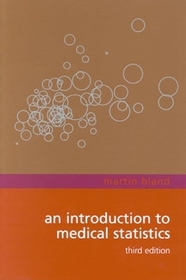
An Introduction to Medical Statistics
Sorozatcím: Oxford Medical Publications;
-
10% KEDVEZMÉNY?
- A kedvezmény csak az 'Értesítés a kedvenc témákról' hírlevelünk címzettjeinek rendeléseire érvényes.
- Kiadói listaár GBP 34.49
-
15 572 Ft (14 830 Ft + 5% áfa)
Az ár azért becsült, mert a rendelés pillanatában nem lehet pontosan tudni, hogy a beérkezéskor milyen lesz a forint árfolyama az adott termék eredeti devizájához képest. Ha a forint romlana, kissé többet, ha javulna, kissé kevesebbet kell majd fizetnie.
- Kedvezmény(ek) 10% (kb. 1 558 Ft)
- Kedvezményes ár 14 014 Ft (13 347 Ft + 5% áfa)
Iratkozzon fel most és részesüljön kedvezőbb árainkból!
Feliratkozom
15 572 Ft

Beszerezhetőség
A kiadónál véglegesen elfogyott, nem rendelhető. Érdemes újra keresni a címmel, hátha van újabb kiadás.
Why don't you give exact delivery time?
A beszerzés időigényét az eddigi tapasztalatokra alapozva adjuk meg. Azért becsült, mert a terméket külföldről hozzuk be, így a kiadó kiszolgálásának pillanatnyi gyorsaságától is függ. A megadottnál gyorsabb és lassabb szállítás is elképzelhető, de mindent megteszünk, hogy Ön a lehető leghamarabb jusson hozzá a termékhez.
A termék adatai:
- Kiadás sorszáma 3
- Kiadó OUP Oxford
- Megjelenés dátuma 2000. augusztus 3.
- ISBN 9780192632692
- Kötéstípus Puhakötés
- Terjedelem432 oldal
- Méret 231x155x23 mm
- Súly 641 g
- Nyelv angol
- Illusztrációk line figures and tables 0
Kategóriák
Rövid leírás:
This is a new edition of a popular textbook which describes the design and analysis of medical research studies, using many real examples. It includes many questions of readers to test their knowledge.
TöbbHosszú leírás:
Now in its Third Edition, An Introduction to Medical Statistics continues to be an invaluable textbook for medical students, doctors, medical researchers, nurses, members of professions allied to medicine as well as all those concerned with medical data. The material covered includes all the statistical work that would be required for a course in medicine and for the examinations of most of the Royal Colleges. It includes the design of clinical trials and
epidemiological studies, data collection, summarizing and presenting data, probability, standard error, confidence intervals and significance tests, techniques of data analysis including multifactorial methods and the choice of statistical method, problems of medical measurement and diagnosis, vital
statistics, and calculation of sample size. The new edition describes the design and analysis of medical research studies in a clear and user friendly manner. The Third Edition includes new topics such as consent in clinical trials, design and analysis of cluster-randomized trials, ecological studies, conditional probability, repeated testing, random effects models, intraclass correlation, and conditional odds ratios. Material which is encountered only at the postgraduate level has been
indicated clearly in the text to facilitate ease of use. The book is firmly grounded in medical data, particularly in medical research, and includes real illustrative examples. There are 100 multiple choice questions and 17 long questions involving calculations to which fully explained solutions are
provided. A new companion volume, Statistical questions in evidence-based medicine (Bland & Peacock, 2000) refers directly to this new edition. This new book of questions and answers includes no calculations and is complementary to the exercises given here. Reviewers comments 'If you want to understand some of the statistical ideas important to medicine but fear being overwhelmed by mathematics you will welcome An Introduction to Medical Statistics.' British Medical
Journal 'At last I have a book on medical statistics that I can safely recommend to my students!...One of the pleasures of the book is that it contains real data...' Journal of the Royal Statistical Society
The material covered includes all the statistical work that would be required in a course in medicine.
Tartalomjegyzék:
Introduction
The design of experiments
Sampling and observational studies
Summarizing data
Presenting data
Probability
The normal distribution
Estimation
Significance tests
Comparing the means of small samples
Regression and correlation
Methods based on rank order
The analysis of cross-tabulations
Choosing the statistical method
Clinical measurement
Mortality statistics and population structure
Multifactorial methods
Determination of sample size
Solutions to exercises
References
Index

