

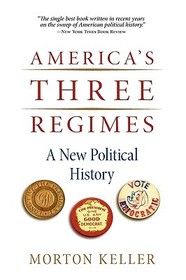
America's Three Regimes
A New Political History
-
10% KEDVEZMÉNY?
- A kedvezmény csak az 'Értesítés a kedvenc témákról' hírlevelünk címzettjeinek rendeléseire érvényes.
- Kiadói listaár GBP 15.99
-
7 219 Ft (6 875 Ft + 5% áfa)
Az ár azért becsült, mert a rendelés pillanatában nem lehet pontosan tudni, hogy a beérkezéskor milyen lesz a forint árfolyama az adott termék eredeti devizájához képest. Ha a forint romlana, kissé többet, ha javulna, kissé kevesebbet kell majd fizetnie.
- Kedvezmény(ek) 10% (cc. 722 Ft off)
- Kedvezményes ár 6 497 Ft (6 188 Ft + 5% áfa)
Iratkozzon fel most és részesüljön kedvezőbb árainkból!
Feliratkozom
7 219 Ft

Beszerezhetőség
A kiadónál véglegesen elfogyott, nem rendelhető. Érdemes újra keresni a címmel, hátha van újabb kiadás.
Why don't you give exact delivery time?
A beszerzés időigényét az eddigi tapasztalatokra alapozva adjuk meg. Azért becsült, mert a terméket külföldről hozzuk be, így a kiadó kiszolgálásának pillanatnyi gyorsaságától is függ. A megadottnál gyorsabb és lassabb szállítás is elképzelhető, de mindent megteszünk, hogy Ön a lehető leghamarabb jusson hozzá a termékhez.
A termék adatai:
- Kiadó Oxford University Press
- Megjelenés dátuma 2007. november 1.
- ISBN 9780195325027
- Kötéstípus Keménykötés
- Terjedelem348 oldal
- Méret 234x155x27 mm
- Súly 711 g
- Nyelv angol 0
Kategóriák
Rövid leírás:
When historians take the long view, they look at "ages" or "eras", but in this groundbreaking new book, Keller divides our America's history into three regimes, each lasting many decades, allowing us to appreciate the steady evolution of public life, and must be as much about continuity, persistence, and evolution as transformation and revolution.
TöbbHosszú leírás:
When historians take the long view, they look at "ages" or "eras" (the Age of Jackson, the Progressive Era). But these time spans last no longer than a decade or so. In this groundbreaking new book, Morton Keller divides our nation's history into three regimes, each of which lasts many, many decades, allowing us to appreciate, as never before, the slow steady evolution of American public life.
Americans like to think of our society as eternally young and effervescent. But the reality is very different. A proper history of America must be as much about continuity, persistence, and evolution as about transformation and revolution. To provide this proper history, Keller groups America's past into three long regimes--Deferential and Republican, from the colonial period to the 1820s; Party and Democratic, from the 1830s to the 1930s; and Populist and Bureaucratic, from the 1930s to
the present.
This approach yields many new insights. We discover, for instance, that the history of colonial America, the Revolution, and the Early Republic is a more unified story than usually assumed. The Civil War, industrialization, and the Progressive era did relatively little to alter the character of the democratic-party regime that lasted from the 1830s to the 1930s. And the populist-bureaucratic regime in which we live today has seen changes in politics, government, and law as profound as
those that occurred in the late 18th and early 19th centuries.
As Keller underscores the sheer staying power of America's public institutions, he sheds light on current concerns as well: in particular, will the current political polarization continue or will more moderate forces prevail.
Here then is a major contribution to United States history--an entirely new way to look at our past, our present, and our future--packed with provocative and original observations about American public life.
Tartalomjegyzék:
Introduction: The American Polity and Its Regimes
Part One: The Deferential-Republican Regime
Old Ways and News
The Republican Revolution
From Factions to Parties
Part Two: The Party-Democratic Regime: The Democratic Polity
The Culture of Party Politics
Governing a Democratic Polity
Crisis
Part Three: The Party-Democratic Regime: The Industrial Polity
The Age of the Polticos
A State of Parties and Courts
The Progressive Challenge
Part Four: The Bureaucratic-Populist Regime
The Rise of the Bureaucratic-Populist Regime
Bureaucracy and Democracy
Populism and Party
Conclusion: Today and Tomorrow

