

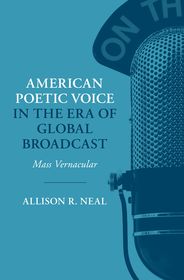
American Poetic Voice in the Era of Global Broadcast
Mass Vernacular
-
10% KEDVEZMÉNY?
- A kedvezmény csak az 'Értesítés a kedvenc témákról' hírlevelünk címzettjeinek rendeléseire érvényes.
- Kiadói listaár GBP 64.00
-
30 576 Ft (29 120 Ft + 5% áfa)
Az ár azért becsült, mert a rendelés pillanatában nem lehet pontosan tudni, hogy a beérkezéskor milyen lesz a forint árfolyama az adott termék eredeti devizájához képest. Ha a forint romlana, kissé többet, ha javulna, kissé kevesebbet kell majd fizetnie.
- Kedvezmény(ek) 10% (cc. 3 058 Ft off)
- Kedvezményes ár 27 518 Ft (26 208 Ft + 5% áfa)
Iratkozzon fel most és részesüljön kedvezőbb árainkból!
Feliratkozom
30 576 Ft

Beszerezhetőség
Becsült beszerzési idő: A Prosperónál jelenleg nincsen raktáron, de a kiadónál igen. Beszerzés kb. 3-5 hét..
A Prosperónál jelenleg nincsen raktáron.
Why don't you give exact delivery time?
A beszerzés időigényét az eddigi tapasztalatokra alapozva adjuk meg. Azért becsült, mert a terméket külföldről hozzuk be, így a kiadó kiszolgálásának pillanatnyi gyorsaságától is függ. A megadottnál gyorsabb és lassabb szállítás is elképzelhető, de mindent megteszünk, hogy Ön a lehető leghamarabb jusson hozzá a termékhez.
A termék adatai:
- Kiadó OUP USA
- Megjelenés dátuma 2026. február 18.
- ISBN 9780197806135
- Kötéstípus Keménykötés
- Terjedelem232 oldal
- Méret 237x166x25 mm
- Súly 449 g
- Nyelv angol 688
Kategóriák
Rövid leírás:
American Poetic Voice in the Era of Global Broadcast situates American poetry within a world of global media to reveal the broad institutional, technological, and cultural resonances of poetic voice.
TöbbHosszú leírás:
American Poetic Voice in the Era of Global Broadcast situates American poetry within a world of global media to reveal the broad institutional, technological, and cultural resonances of poetic voice. Reading work by Marianne Moore, W.H. Auden, Frank O'Hara, Adrienne Rich, and Audre Lorde, it traces how poetry intersects with both specific sound technologies, like the phonograph, the telephone, the radio, and the tape recorder, and a variety of vocal practices and institutions, including elocution instruction, poetry reading circuits, and radio-based forms of cultural diplomacy.
Forging a representative American poetic voice had long posed a conceptual obstacle in a country of competing accents and languages. However, new twentieth-century sound technologies and vocal institutions produced an American voice generated via mass circulation. In the process, American English transformed from the heterogenous, spoken counterpart of a standardized, literary British English to a network standard heard around the globe. This synthetic American voice sparked a parallel American poetic voice that was likewise globally and technologically mediated. Routing their poetry through modern circuits of communication, American poets created a paradoxically intimate and global “mass vernacular,” as they envisioned lyric voices circulating in ways similar to other official and mass voices. In this context, the formal poetic elements that we often associate with the lyric -not just voice, but also tone, apostrophe, address, and prosopopoeia-in fact reveal a complex history of American cultural consolidation and global distribution. By bridging the figurative and material dimensions of voice, this book ultimately highlights the competing cultural currents that underlie lyric address in an age of global English.
Tartalomjegyzék:
Introduction: American Poetry's Mass Vernacular
Marianne Moore's Tone Technologies
W. H. Auden's Audience Research: Poetry in the Era of National Radio
Frank O'Hara's Voice of America
Adrienne Rich's Poetic Re-Sources
Conclusion: An "Articulated Power": Audre Lorde, Poetry, and Rhetoric

