

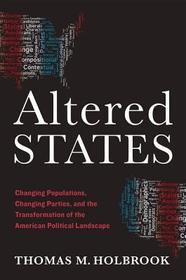
Altered States
Changing Populations, Changing Parties, and the Transformation of the American Political Landscape
-
10% KEDVEZMÉNY?
- A kedvezmény csak az 'Értesítés a kedvenc témákról' hírlevelünk címzettjeinek rendeléseire érvényes.
- Kiadói listaár GBP 100.00
-
45 150 Ft (43 000 Ft + 5% áfa)
Az ár azért becsült, mert a rendelés pillanatában nem lehet pontosan tudni, hogy a beérkezéskor milyen lesz a forint árfolyama az adott termék eredeti devizájához képest. Ha a forint romlana, kissé többet, ha javulna, kissé kevesebbet kell majd fizetnie.
- Kedvezmény(ek) 10% (cc. 4 515 Ft off)
- Kedvezményes ár 40 635 Ft (38 700 Ft + 5% áfa)
Iratkozzon fel most és részesüljön kedvezőbb árainkból!
Feliratkozom
45 150 Ft

Beszerezhetőség
Megrendelésre a kiadó utánnyomja a könyvet. Rendelhető, de a szokásosnál kicsit lassabban érkezik meg.
Why don't you give exact delivery time?
A beszerzés időigényét az eddigi tapasztalatokra alapozva adjuk meg. Azért becsült, mert a terméket külföldről hozzuk be, így a kiadó kiszolgálásának pillanatnyi gyorsaságától is függ. A megadottnál gyorsabb és lassabb szállítás is elképzelhető, de mindent megteszünk, hogy Ön a lehető leghamarabb jusson hozzá a termékhez.
A termék adatai:
- Kiadó OUP USA
- Megjelenés dátuma 2016. július 28.
- ISBN 9780190269128
- Kötéstípus Keménykötés
- Terjedelem236 oldal
- Méret 164x244x22 mm
- Súly 652 g
- Nyelv angol 0
Kategóriák
Rövid leírás:
In Altered States, Thomas Holbrook looks at electoral change in presidential elections since 1972, documenting the magnitude, direction and consequences of changes in party support in the states. He finds that the Democrats do not have a "lock" on the Electoral College, but that their position has improved dramatically over the past forty years in a number of formerly competitive or Republican-leaning states in the Northeast, Southeast, and Southwest.
TöbbHosszú leírás:
The 2012 presidential elections represented the second consecutive defeat for the Republican Party, and the fourth defeat out of the last six presidential elections. In recent years both Republican and Democratic strategists and pundits have spoken of an emerging Democratic Party "lock" on the Electoral College and speculated that even in the wake of Republican victories in Congress, presidential candidates are still at a major disadvantage due to the party's increasing demographic and geographic isolation. This prediction flies in the face of population shifts of the last several decades from Democratic regions (Upper-Midwest and Northeast) to Republican-leaning regions (South and Southwest); at the same time, it seems to follow from demographic changes favoring an increase in the minority vote. In fact, there is an initiative to convert Texas to a Democratic state by mobilizing Latino and Black voters. In Altered States, Thomas Holbrook looks at electoral change in presidential elections since 1972, documenting the magnitude, direction, and consequences of changes in party support in the states. He finds that the Democrats do not have a "lock" on the Electoral College, but that their position has improved dramatically over the past forty years in a number of formerly competitive or Republican-leaning states in the Northeast, Southeast, and Southwest. Republican candidates have made many fewer gains, mostly improving their position in "misplaced," formerly Democratic states, such as Kentucky and West Virginia, or in already deeply Republican states in the Plains and Mountain West. Holbrook looks at the ways that changes in the racial and ethnic composition of the state electorates, migratory patterns from large Democratic states to Republican-leaning states, and changes in the public's level of education and occupational status, state party identification, and ideology drive these changes. Additionally, he explores the extent to which the Republican "problem" stems from the geographic concentration of party support. While Democratic concentration in major metropolitan areas tends to put them at a disadvantage in House races, as Republican votes increasingly are concentrated in fewer states where they win by wider margins, they may be "wasting" more Electoral College votes than Democrats, whose supporters are more efficiently distributed.
TöbbTartalomjegyzék:
Acknowledgments
List of Figures
List of Tables
Chapter 1: The Changing Political Landscape
Chapter 2: How Does Political Change Occur?
Chapter 3: Population Migration and Political Change
Chapter 4: Compositional Change and Political Change
Chapter 5: Changing Political Context and Changing State Outcomes
Chapter 6: Demographic and Political Change
Appendix
Notes
References
Index

