

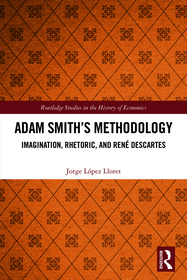
Adam Smith’s Methodology
Imagination, Rhetoric, and Rene Descartes
Sorozatcím: Routledge Studies in the History of Economics;
-
10% KEDVEZMÉNY?
- Kiadói listaár GBP 171.99
-
77 653 Ft (73 955 Ft + 5% áfa)
Az ár azért becsült, mert a rendelés pillanatában nem lehet pontosan tudni, hogy a beérkezéskor milyen lesz a forint árfolyama az adott termék eredeti devizájához képest. Ha a forint romlana, kissé többet, ha javulna, kissé kevesebbet kell majd fizetnie.
- Kedvezmény(ek) 10% (cc. 1 Ft off)
- Kedvezményes ár 69 887 Ft (66 560 Ft + 5% áfa)
69 887 Ft

Beszerezhetőség
Még nem jelent meg, de rendelhető. A megjelenéstől számított néhány héten belül megérkezik.
Why don't you give exact delivery time?
A beszerzés időigényét az eddigi tapasztalatokra alapozva adjuk meg. Azért becsült, mert a terméket külföldről hozzuk be, így a kiadó kiszolgálásának pillanatnyi gyorsaságától is függ. A megadottnál gyorsabb és lassabb szállítás is elképzelhető, de mindent megteszünk, hogy Ön a lehető leghamarabb jusson hozzá a termékhez.
A termék adatai:
- Kiadás sorszáma 1
- Kiadó Routledge
- Megjelenés dátuma 2026. július 31.
- ISBN 9781041100775
- Kötéstípus Keménykötés
- Terjedelem234 oldal
- Méret 234x156 mm
- Nyelv angol 700
Kategóriák
Rövid leírás:
Most previous studies of Adam Smith’s methodology, with a few exceptions, have placed considerable emphasis on the undeniable influence of Newtonian physics and Humean empiricism.
TöbbHosszú leírás:
Most previous studies of Adam Smith’s methodology, with a few exceptions, have placed considerable emphasis on the undeniable influence of Newtonian physics and Humean empiricism.
This book argues that other sources are at least as important: Smith’s own didactic rhetoric and the methodological writings of René Descartes. Smith began his public life in 1748, lecturing on rhetoric in Edinburgh. During this time he also wrote a history of astronomy, tracing its development from the age of mythical thought to Descartes (later incorporating Newton’s ideas). In his History of Astronomy, he was less concerned with the truth value of theories than with their ability to quiet the human imagination by systematically combining numerous phenomena under a few unifying principles. In his lectures on rhetoric, he considered this approach to be the best method of didactic exposition. In both cases, he attached the greatest importance to one of the authors he cited most often between 1748 and 1763, Descartes. As such, Descartes and rhetoric were central to the young Smith’s thinking prior to the publication of The Theory of Moral Sentiments. Consequently, any methodological examination of Smith’s published works must be framed as a question of didactic exposition seen through a Cartesian lens.
This book will appeal particularly to historians of philosophy and economic theory, as well as to scholars of Adam Smith’s life and work.
TöbbTartalomjegyzék:
1. Introduction. Adam Smith and Rhetoric 2. Smith’s Connection to Descartes: Basic Evidence 3. Wonder: From Descartes to Smith Case study 1: The Invisible Hand as an Effect of Wonder 4. Imagination as the Core of Smith’s Thought Case Study 2: Instrumental Music and Philosophical Method 5. Smithian Method: Between Rhetorical Arrangement and Philosophical Methodology Case Study 3: Language as Historical Machine 6. Conclusion: Smith as Global Rhetorician Index

