

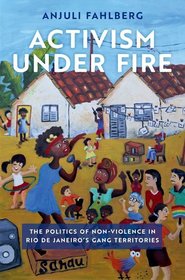
Activism under Fire
The Politics of Non-Violence in Rio de Janeiro's Gang Territories
Sorozatcím: GLOBAL AND COMPARATIVE ETHNOGRAPHY SER;
-
10% KEDVEZMÉNY?
- A kedvezmény csak az 'Értesítés a kedvenc témákról' hírlevelünk címzettjeinek rendeléseire érvényes.
- Kiadói listaár GBP 20.99
-
9 476 Ft (9 025 Ft + 5% áfa)
Az ár azért becsült, mert a rendelés pillanatában nem lehet pontosan tudni, hogy a beérkezéskor milyen lesz a forint árfolyama az adott termék eredeti devizájához képest. Ha a forint romlana, kissé többet, ha javulna, kissé kevesebbet kell majd fizetnie.
- Kedvezmény(ek) 10% (kb. 947 Ft)
- Kedvezményes ár 8 529 Ft (8 123 Ft + 5% áfa)
Iratkozzon fel most és részesüljön kedvezőbb árainkból!
Feliratkozom
9 476 Ft

Beszerezhetőség
Becsült beszerzési idő: A Prosperónál jelenleg nincsen raktáron, de a kiadónál igen. Beszerzés kb. 3-5 hét..
A Prosperónál jelenleg nincsen raktáron.
Why don't you give exact delivery time?
A beszerzés időigényét az eddigi tapasztalatokra alapozva adjuk meg. Azért becsült, mert a terméket külföldről hozzuk be, így a kiadó kiszolgálásának pillanatnyi gyorsaságától is függ. A megadottnál gyorsabb és lassabb szállítás is elképzelhető, de mindent megteszünk, hogy Ön a lehető leghamarabb jusson hozzá a termékhez.
A termék adatai:
- Kiadó OUP USA
- Megjelenés dátuma 2023. július 17.
- ISBN 9780197519332
- Kötéstípus Puhakötés
- Terjedelem312 oldal
- Méret 157x234x16 mm
- Súly 467 g
- Nyelv angol
- Illusztrációk 24 b/w photographs; 4 maps 404
Kategóriák
Rövid leírás:
Rio de Janeiro's favelas have become well-known sites of gang and police violence. In Activism under Fire, Anjuli Fahlberg provides an original account of how conflict activism operates in Cidade de Deus, one of Rio's most dangerous and famous favelas. Based on fieldwork, virtual ethnography, and participatory action research, Fahlberg documents how activists strategically navigate local constraints and opportunities--including gendered governing dynamics and racialized practices of solidarity--to create space for non-violent governance amid armed repression.
TöbbHosszú leírás:
Rio de Janeiro's favelas have become well-known sites of gang and police violence. Since the 1970s, dangerous networks between drug traffickers and corrupt state actors have transformed these poor neighborhoods into sites of armed conflict and political repression, limiting residents' ability to speak out against violence or demand their democratic rights. Despite these challenges, nonviolent politics remains an integral element in Cidade de Deus--City of God--one of Rio's most dangerous and famous favelas.
In Activism under Fire, Anjuli Fahlberg provides an original account of how conflict activism operates in Cidade de Deus. Drawing on fieldwork, virtual ethnography, and participatory action research, Fahlberg documents how activists strategically navigate local constraints and opportunities--including gendered governing dynamics and racialized practices of solidarity--to create space for non-violent governance amid armed repression. By working within urban, national, and transnational political networks and social movements, local activists bring resources into their neighborhood and protest violence while avoiding dangerous alliances.
Activism under Fire demonstrates that non-violent collective action is possible amid extreme poverty and violence, and shows what strategies enable it to survive and effect political change. In so doing, Fahlberg reveals the possibilities for collective action in violent and chaotic democratic states, not only in Latin America, but throughout the world.
How is social mobilization possible in gang territories? Anjuli Fahlberg's research answers this question, affirming the necessity to differentiate favela activism from traditional social movements. Activism under Fire is a powerful concept to understand the strategy of non-violence adopted by political actors as part of their resistance and adaptation to violent and restrictive contexts. Fahlberg's original participatory field research reveals how favela activists have constructed a sphere of non-violent politics, which operates politically parallel to, and symbolically in opposition to, the sphere of violent politics in the neighborhood.
Tartalomjegyzék:
Introduction: Conflict Activism in Rio de Janeiro's Gang Territories
1. Cidade de Deus: A Contested Territory
2. Milking the Resource Matrix: Democracy, Development, and Digital Devices
3. Violent Clientelism and Gendered Governance
4. Political Upcycling: Anti-Violence Protest through Education, Culture, and Racial Solidarity
5. Ties that Strengthen, Ties that Bind: Favela Actors in Urban Politics and Transnational Movements
Conclusion: Seek and Ye Shall Find: Looking for Non- Violence in Conflict Zones
Appendix: Ethnographic Reflections: Participatory Action Research in Areas of Violence
Notes
Bibliography
Index

