

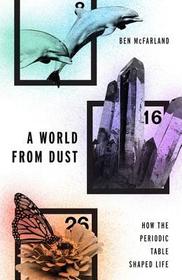
A World From Dust
How the Periodic Table Shaped Life
-
10% KEDVEZMÉNY?
- A kedvezmény csak az 'Értesítés a kedvenc témákról' hírlevelünk címzettjeinek rendeléseire érvényes.
- Kiadói listaár GBP 48.49
-
21 893 Ft (20 850 Ft + 5% áfa)
Az ár azért becsült, mert a rendelés pillanatában nem lehet pontosan tudni, hogy a beérkezéskor milyen lesz a forint árfolyama az adott termék eredeti devizájához képest. Ha a forint romlana, kissé többet, ha javulna, kissé kevesebbet kell majd fizetnie.
- Kedvezmény(ek) 10% (cc. 2 189 Ft off)
- Kedvezményes ár 19 703 Ft (18 765 Ft + 5% áfa)
Iratkozzon fel most és részesüljön kedvezőbb árainkból!
Feliratkozom
21 893 Ft

Beszerezhetőség
Megrendelésre a kiadó utánnyomja a könyvet. Rendelhető, de a szokásosnál kicsit lassabban érkezik meg.
Why don't you give exact delivery time?
A beszerzés időigényét az eddigi tapasztalatokra alapozva adjuk meg. Azért becsült, mert a terméket külföldről hozzuk be, így a kiadó kiszolgálásának pillanatnyi gyorsaságától is függ. A megadottnál gyorsabb és lassabb szállítás is elképzelhető, de mindent megteszünk, hogy Ön a lehető leghamarabb jusson hozzá a termékhez.
A termék adatai:
- Kiadó OUP USA
- Megjelenés dátuma 2016. július 14.
- ISBN 9780190275013
- Kötéstípus Keménykötés
- Terjedelem352 oldal
- Méret 165x239x25 mm
- Súly 635 g
- Nyelv angol
- Illusztrációk 42 0
Kategóriák
Rövid leírás:
In A World From Dust, Ben McFarland brings together the latest genetic, chemical, mathematic, and geological evidence to tell the story of how life has evolved on this planet over billions of years.
TöbbHosszú leírás:
A World From Dust describes how a set of chemical rules combined with the principles of evolution in order to create an environment in which life as we know it could unfold. Beginning with simple mathematics, these predictable rules led to the advent of the planet itself, as well as cells, organs and organelles, ecosystems, and increasingly complex life forms. McFarland provides an accessible discussion of a geological history as well, describing how the inorganic matter on Earth underwent chemical reactions with air and water, allowing for life to emerge from the world's first rocks. He traces the history of life all the way to modern neuroscience, and shows how the bioelectric signals that make up the human brain were formed. Most popular science books on the topic present either the physics of how the universe formed, or the biology of how complex life came about; this book's approach would be novel in that it condenses in an engaging way the chemistry that links the two fields. This book is an accessible and multidisciplinary look at how life on our planet came to be, and how it continues to develop and change even today.
The narrative should appeal to anyone interested in viewing chemistry and biology from a general, perhaps poetic, perspective. Although intended for a general audience, some background knowledge of chemistry, biology, and evolution of the world is probably needed to fully appreciate the story. The style is informal, and the presentation includes many intriguing real-world contexts and examples, and numerous thought-provoking metaphors and analogies.
Tartalomjegyzék:
Chapter 1: Arsenic Life?
Chapter 2: A Tapestry from Three Threads
Chapter 3: Unfolding the Periodic Table
Chapter 4: The Triple-Point Planet
Chapter 5: Seven Clues for Quickening the Rocks
Chapter 6: Wheels Within Wheels
Chapter 7: The Colorful Path to Oxygen
Chapter 8: One Step Back, Two Steps Forward
Chapter 9: Cracked Open and Knit Together by Oxygen
Chapter 10: The End of (Chemical) Evolution
Chapter 11: How Chemistry Shaped History, Through Words
Chapter 12: Cosmos and Chaos

