

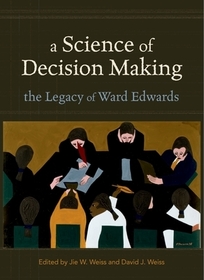
A Science of Decision Making
The Legacy of Ward Edwards
-
10% KEDVEZMÉNY?
- A kedvezmény csak az 'Értesítés a kedvenc témákról' hírlevelünk címzettjeinek rendeléseire érvényes.
- Kiadói listaár GBP 66.00
-
31 531 Ft (30 030 Ft + 5% áfa)
Az ár azért becsült, mert a rendelés pillanatában nem lehet pontosan tudni, hogy a beérkezéskor milyen lesz a forint árfolyama az adott termék eredeti devizájához képest. Ha a forint romlana, kissé többet, ha javulna, kissé kevesebbet kell majd fizetnie.
- Kedvezmény(ek) 10% (cc. 3 153 Ft off)
- Kedvezményes ár 28 378 Ft (27 027 Ft + 5% áfa)
Iratkozzon fel most és részesüljön kedvezőbb árainkból!
Feliratkozom
31 531 Ft

Beszerezhetőség
Megrendelésre a kiadó utánnyomja a könyvet. Rendelhető, de a szokásosnál kicsit lassabban érkezik meg.
Why don't you give exact delivery time?
A beszerzés időigényét az eddigi tapasztalatokra alapozva adjuk meg. Azért becsült, mert a terméket külföldről hozzuk be, így a kiadó kiszolgálásának pillanatnyi gyorsaságától is függ. A megadottnál gyorsabb és lassabb szállítás is elképzelhető, de mindent megteszünk, hogy Ön a lehető leghamarabb jusson hozzá a termékhez.
A termék adatai:
- Kiadó OUP USA
- Megjelenés dátuma 2009. március 26.
- ISBN 9780195322989
- Kötéstípus Keménykötés
- Terjedelem536 oldal
- Méret 178x257x40 mm
- Súly 1103 g
- Nyelv angol
- Illusztrációk numerous tables and figures 0
Kategóriák
Hosszú leírás:
Ward Edwards is well known as the father of behavioral decision making. In his 1954 Psychological Bulletin paper on decision making, he brought psychological ideas into what had been the province of economists. His influence in this realm is so pervasive that the Nobel committee was able to trace a direct path from Edwards's work to Daniel Kahneman's 2002 Prize for prospect theory. In a 1963 Psychological Review paper, Edwards brought Bayesian statistics to the attention of psychologists, who have continued to proliferate Bayesian ideas, underscoring the importance of the perspective. In a 1962 IEEE paper, Edwards foresaw how the world of intelligence gathering and analysis could by transformed by systems in which humans provided (subjective) probabilities and machines provided computational power. He also showed, in a 1986 book written with Detlof von Winterfeldt, how multiattribute utility analysis could help real-world decision makers generate satisfactory solutions to complex problems.
In this book, 29 of Ward Edwards's most important published papers are reprinted, a selection that spans six decades, allowing the reader to see how this strikingly creative thinker generated many of the ideas that are now core beliefs among current researchers. It is perhaps less well known that Edwards continued to make substantial contributions during the years after his retirement. Illness reduced his public appearances, but he continued his incisive thinking behind the scenes. At the time of his passing, he was involved in several projects, and seven new papers from these projects were completed for this book by his last set of collaborators.
Edwards's papers are a treat to read. His prose is the model of elegant simplicity, yet full of style and wit. With each paper, the editors have included a short introduction that presents Edwards's reflections on the content or impact of the older papers, or describes the creation of the new ones. Obituaries written by former students and colleagues flesh out the human side of this remarkable scholar.
Tartalomjegyzék:
Introduction by the Editors
Contributors to papers written especially for this Volume
Complete listing of publications written or co-written by Edwards
I Papers on Behavioral Decision Theory
Edwards, W. (1954). The theory of decision making. Psychological Bulletin, 51, 380-417
Edwards, W. (1961). Behavioral decision theory. Annual Review of Psychology, 12, 473-498
Edwards, W. (1961). Probability learning in 1000 trials. Journal of Experimental Psychology, 62, 385-94
Edwards, W. (1962). Dynamic decision theory and probabilistic information processing. Human Factors, 4, 59-73
Edwards, W. (1962). Subjective probabilities inferred from decisions. Psychological Review, 69, 109-135
Phillips, L.D., & Edwards, W. (1966). Conservatism in a simple probability inference task. Journal of Experimental Psychology, 72, 346-354
Miller, L.W., Kaplan, R.J., & Edwards, W. (1969). JUDGE: A laboratory evaluation. Organizational Behavior and Human Performance, 4, 97-111
Edwards, W. (1971). Bayesian and regression models of human information processing: A myopic perspective. Organizational Behavior and Human Performance, 6, 639-648
Fryback, D.G. & Edwards, W. (1973). Choices among bets by Las Vegas gamblers: Absolute and contextual effects. Journal of Experimental Psychology, 98, 271-278
Edwards, W. (1998). Hailfinder: Tools for and experiences with Bayesian normative modeling. American Psychologist, 53, 416-428
II Papers on Statistics and Methodology
Edwards, W. (1961). Costs and payoffs are instructions. Psychological Review, 68, 275-284
Edwards, W., Lindman, H., & Savage, L.J. (1963). Bayesian statistical inference for psychological research. Psychological Review, 70, 193-242
Edwards, W. (1965). Tactical note on the relation between scientific and statistical hypotheses. Psychological Bulletin, 63, 400-402
Slovic, P., Lichtensen, S. & Edwards, W. (1965). Boredom-induced changes in preferences among bets. American Journal of Psychology, 78, 208-217.
Edwards, W. (1983). Human cognitive capabilities, representativeness, and ground rules for research. In P.C. Humphreys, O. Svenson, & A. Vari (Eds.), Analyzing and aiding decision processes (pp. 507-513). Amsterdam: North-Holland
von Winterfeldt, D., & Edwards, W. (1982). Costs and payoffs in perceptual research. Psychological Bulletin, 91, 609-622.
Edwards, W., Schum D., & Winkler, R.L. (1990). Murder and (of?) the likelihood principle: A trialogue. Journal of Behavioral Decision Making, 3, 75-87
Weiss, D.J., & Edwards, W. (2005). A mean for all seasons. Behavior Research Methods, 37, 677-683
Weiss, J.W., Edwards, W., & Weiss, D.J. (prepared for this volume). The clinical significance decision
Weiss, D.J., Edwards, W., & Shanteau, J. (prepared for this volume). The measurement of behavior: Indices and standards
III Papers on Diagnosis
Gustafson, D. H., Edwards, W., Phillips, L. D., & Slack, W. V. (1969). Subjective probabilities in medical diagnosis. IEEE Transactions on Man-Machine Systems, MMS-10, 3, 61-65
Edwards, W. (1972). N = 1. Diagnosis in unique cases. In J. A. Jacquez (Ed.) Computer diagnosis and diagnostic methods (pp. 139-151). Springfield, Il: Charles C. Thomas
Edwards, W. (1972). N = 1. Diagnosis in unique cases. In J. A. Jacquez (Ed.) Computer diagnosis and diagnostic methods (pp. 139-151). Springfield, Il: Charles C. Thomas
Thornbury, J. R., Fryback, D. G., & Edwards, W. (1975). Likelihood ratios as a measure of the diagnostic usefulness of excretory urogram information. Radiology, 114, 561-565
Shanteau, J., Edwards, W., & Weiss, D. J. (prepared for this volume). Diagnosis and treatment
IV Papers on Multiattribute Utility
Gardiner, P.C., & Edwards, W. (1975). Public values: Multi-attribute utility measurement for social decision making. In M. F. Kaplan & S. Schwartz (Eds.), Human judgment and decision processes (pp. 1-37). New York: Academic Press
Edwards, W. (1977). How to use multiattribute utility measurement for social decision making. IEEE Transactions on Systems, Man, & Cybernetics, 7, 326-340
Edwards, W. (1979). Multiattribute utility measurement: Evaluating desegregation plans in a highly political context. In R. Perloff (Ed.), Evaluator interventions: Pros and cons (pp. 13-54). Beverly Hills, CA: Sage
Edwards, W. (1980). Reflections on and criticisms of ahighly political multiattribute utility analysis. In L. Cobb & R. M. Thrall (Eds.), Mathematical frontiers of behavioral and policy sciences (pp.157-186). Boulder, CO: Westview Press
Stillwell, W.G., Barron, F. H., & Edwards, W. (1983). Evaluating credit applications: A validation of multiattribute utility weight elicitation techniques. Organizational Behavior & Human Decision Processes, 32, 87-108
Edwards, W. & Barron, F. H. (1994). SMARTS and SMARTER: Improved simple methods for multiattribute utility measurement. Organizational Behavior and Human Decision Processes, 60, 306-325
Edwards, W., & Fasolo, B. (2001). Decision technology. Annual Review of Psychology, 52, 581-606
Weiss, J. W., Edwards, W., & Mouttapa, M. (prepared for this volume). The puzzle of adolescent substance initiation
Weiss, J. W., Weiss, D. J., & Edwards, W. (prepared for this volume). Big decisions, little decisions: The hierarchy of everyday life
. Bauer, J., Spackman, S., & Edwards, W. (prepared for this volume). The clinical decision tree of oral health in geriatrics
. Weiss, D. J., Edwards, W., & Weiss, J. W. (prepared for this volume). Why is a bird in the hand worth two in the bush?
V Obituaries
Dennis G. Fryback, Society for Medical Decision Making Newsletter, Summer 2005
Lawrence D. Phillips, European Association for Decision Making Bulletin, Spring/Summer 2005
David J. Weiss & James Shanteau, Society for Judgment/Decision Making Newsletter, March 2005

