

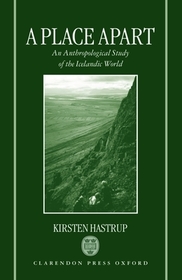
A Place Apart
An Anthropological Study of the Icelandic World
Sorozatcím: Oxford Studies in Social and Cultural Anthropology;
-
10% KEDVEZMÉNY?
- A kedvezmény csak az 'Értesítés a kedvenc témákról' hírlevelünk címzettjeinek rendeléseire érvényes.
- Kiadói listaár GBP 180.00
-
81 270 Ft (77 400 Ft + 5% áfa)
Az ár azért becsült, mert a rendelés pillanatában nem lehet pontosan tudni, hogy a beérkezéskor milyen lesz a forint árfolyama az adott termék eredeti devizájához képest. Ha a forint romlana, kissé többet, ha javulna, kissé kevesebbet kell majd fizetnie.
- Kedvezmény(ek) 10% (kb. 8 127 Ft)
- Kedvezményes ár 73 143 Ft (69 660 Ft + 5% áfa)
Iratkozzon fel most és részesüljön kedvezőbb árainkból!
Feliratkozom
81 270 Ft

Beszerezhetőség
Megrendelésre a kiadó utánnyomja a könyvet. Rendelhető, de a szokásosnál kicsit lassabban érkezik meg.
Why don't you give exact delivery time?
A beszerzés időigényét az eddigi tapasztalatokra alapozva adjuk meg. Azért becsült, mert a terméket külföldről hozzuk be, így a kiadó kiszolgálásának pillanatnyi gyorsaságától is függ. A megadottnál gyorsabb és lassabb szállítás is elképzelhető, de mindent megteszünk, hogy Ön a lehető leghamarabb jusson hozzá a termékhez.
A termék adatai:
- Kiadó OUP Oxford
- Megjelenés dátuma 1998. július 16.
- ISBN 9780198233800
- Kötéstípus Keménykötés
- Terjedelem240 oldal
- Méret 242x162x18 mm
- Súly 565 g
- Nyelv angol
- Illusztrációk numerous halftones, 2 maps 0
Kategóriák
Rövid leírás:
A Place Apart offers a rich and reflective representation of Iceland and Icelanders today. Kirsten Hastrup draws upon extensive first-hand research, but also upon her original theory of what anthropology is and should be, which this book exemplifies. In two previous books she studied the processes and patterns which shaped Icelandic society from medieval times to the nineteenth century; now she brings this historical study up to date by giving a view from within the contemporary Icelandic world. She examines images of Icelandicness and how they relate to local social experience; she seeks to convey how Icelandic villagers understand their world; she traces resonances from history in contemporary life; she gives a unique view of a unique place.
TöbbHosszú leírás:
A Place Apart offers a rich and reflective representation of Iceland and Icelanders today. Kirsten Hastrup draws upon extensive first-hand research, but also upon her original theory of what anthropology is and should be, which this book exemplifies. In two previous books she studied the processes and patterns which shaped Icelandic society from medieval times to the nineteenth century; now she brings this historical study up to date by drawing out the dominant themes in present-day Icelandic self-understanding. In many ways Icelanders' sustained image of themselves as a singular people in the world refracts the actual social reality. The image tends to favour particular interpretations of history as well as particular social groups, as Hastrup shows through analyses of tradition and ideology, landscape and memory, community and honour. She investigates the ways in which everyday life is informed by a living tradition and a stress on the historical depth and cultural uniqueness of this place apart. The result is a renewed sense of the texture of the Icelandic world, seen not as a static and prescriptive culture, but rather as a space within which Icelanders are suspended between modernity and consciousness of the antiquity of Icelandic values, between presentness and pastness.
she convincingly argues that much of her material suggest that Icelanders have tradtionally refused to separate myth and history, pointing out that such a position is summarised in the concept of saga. Second, the chapter on landscape provides an excellent analysis of the phenomenology of spatial relations and Icelanders' attachment to both land and sea. Finally, Hastrup's portrayal of the food ritual called porrablot as a kind of Babette's Feast is both entertaining and perceptive.
Tartalomjegyzék:
Prelude.
I: KEYS. 1: Times past and present. 2: Ethnographic field sites. 3: The contact zone.
II: ORCHESTRATION. 4: Tradition and ideology. 5: Landscape and memory. 6: Community and honour.
III: THEMES. 7: Time: Uchronia. 8: Space: Remoteness. 9: People: Othering.
Finale
References
Index

